Society & current events
The fabric of contemporary society is being rewoven before our eyes. From the screens that mediate our relationships to the algorithms that shape our economic opportunities, we’re navigating challenges our grandparents never imagined. Yet beneath the technological veneer, timeless human needs persist: the craving for genuine connection, the demand for fairness, and the desire to contribute meaningfully to our communities.
Understanding today’s social landscape requires more than casual observation. It demands a clear-eyed examination of how digital life transforms human bonds, why certain voices still struggle to be heard in public spaces, and what mechanisms—both visible and invisible—shape who gets ahead and who gets left behind. This exploration offers a framework for making sense of the forces reshaping our collective life, from the intimate scale of face-to-face conversation to the systemic scale of algorithmic decision-making.
Whether you’re grappling with the loneliness of urban life, advocating for accessible infrastructure, negotiating your worth in the workplace, or simply trying to listen more deeply, the threads connect. Each challenge reveals something essential about what it means to live alongside others in this particular historical moment.
How Digital Life Is Reshaping Human Connection
Think of human connection as a muscle. For millennia, we exercised it daily through physical proximity—at the market, the town square, the neighborhood gathering spot. Now, much of that exercise happens through screens, and the muscle is changing shape in ways we’re only beginning to understand.
The phenomenon known as urban isolation isn’t simply about living alone. It’s about being surrounded by thousands of people yet lacking the informal social infrastructure that once made chance encounters meaningful. The coffee shop where nobody looks up from their laptop. The apartment building where neighbors remain strangers. These aren’t personal failures but architectural and cultural shifts that require intentional redesign of our living spaces and daily routines.
Digital-only interactions create what researchers call an empathy deficit. Without the mirror neurons firing that comes from reading facial expressions and body language, we lose crucial feedback loops that regulate social behavior. Online disinhibition—the tendency to say things digitally we’d never utter face-to-face—stems partly from this sensory deprivation.
Yet the solution isn’t abandoning digital spaces but rather understanding their proper role. Online communities, or “digital tribes,” serve as valuable discovery mechanisms for finding your specific people. The transition from digital to offline interaction, however, requires deliberate skill-building: establishing trust with strangers, avoiding echo chambers that reinforce rather than challenge our assumptions, and timing engagement so virtual connection enhances rather than replaces physical presence.
Building Truly Inclusive Communities
Accessibility isn’t a specialized concern for a minority—it’s a design philosophy that improves everyone’s experience. The curb cut, originally mandated for wheelchair users, now benefits parents with strollers, delivery workers with hand trucks, and travelers with rolling luggage. This is universal design in action: solutions that accommodate the widest range of human diversity from the outset.
The most insidious barriers are the “invisible” ones—assumptions baked into spaces and systems so deeply that those unaffected never notice them. The public building with a single step at the entrance. The emergency evacuation plan that relies entirely on auditory alarms. The city navigation app that doesn’t account for broken elevators or construction that blocks accessible routes.
Creating inclusive infrastructure requires three parallel efforts:
- Auditing existing spaces to identify gaps between stated accessibility and lived experience
- Budgeting realistically for retrofitting, recognizing that accessibility modifications often cost less than assumed when planned thoughtfully
- Leveraging technology not as a substitute for physical access but as a complementary tool for navigation, communication, and emergency response
The goal isn’t perfection but continuous improvement—and crucially, involving disabled people themselves in design decisions rather than making assumptions about their needs.
Navigating Economic Fairness in Modern Society
Two seemingly separate issues—wage negotiation and algorithmic bias—share a common thread: both involve systems that distribute resources unequally while maintaining a veneer of objectivity.
The Mechanics of Salary Negotiation
The wage gap persists partly because negotiation itself is an unfair game. Linguistic traps abound: asking about “salary expectations” forces candidates to anchor the conversation, often to their disadvantage. Those from cultures that view self-promotion as unseemly face additional barriers. The solution lies in systematic preparation: benchmarking your market value accurately using multiple data sources, structuring the entire compensation package rather than fixating on base salary alone, and timing your ask strategically—typically after demonstrating value but before desperation sets in.
Handling pushback requires reframing rejection not as personal failure but as information. When an employer says “that’s above our range,” the conversation hasn’t ended—it’s merely entered a new phase of creative problem-solving.
Algorithmic Bias in Financial Systems
When a computer denies your loan application, it feels impersonal and therefore fair. In reality, algorithmic bias often amplifies historical discrimination by training on biased data. If past lending favored certain ZIP codes over others, the algorithm learns to perpetuate that pattern while hiding behind mathematical objectivity.
Protecting yourself requires proactive steps:
- Audit your personal credit data regularly for errors that algorithms will treat as gospel
- Compare multiple lenders, recognizing that different algorithms weigh factors differently
- Understand your right to appeal automated decisions and request human review
- Monitor regulatory changes as lawmakers slowly catch up to technological reality
The common lesson across both domains: apparent objectivity often masks subjective choices that benefit those who understand the system’s hidden rules.
Finding Meaning Through Civic Engagement
The desire to contribute beyond yourself is fundamental, yet traditional volunteering models—requiring large time blocks and long-term commitments—exclude many who would otherwise participate. Enter micro-volunteering: discrete tasks completable in minutes or hours, often remotely, that collectively create substantial impact.
The challenge isn’t finding opportunities but rather aligning personal values with causes in a way that prevents burnout. Compassion fatigue—the emotional exhaustion that comes from prolonged exposure to others’ suffering—is real and predictable. Sustainable engagement requires treating advocacy like marathon training rather than sprinting: pacing yourself, integrating activities into existing routines (such as advocacy work during lunch breaks), and optimizing scheduling to match your energy patterns.
Balancing career and community engagement isn’t about achieving perfect equilibrium. It’s about recognizing that professional skills often transfer directly to volunteer contexts, creating synergies rather than zero-sum competitions for your time. The accountant who helps a nonprofit understand their finances. The teacher who designs educational materials for a cause they believe in. These aren’t separate identities but integrated expressions of competence and care.
Mastering the Art of Authentic Communication
Most of us think we’re better listeners than we actually are. The gap between perceived and actual skill reveals itself in patterns like conversational narcissism—the tendency to redirect every topic back to our own experience rather than exploring the other person’s perspective.
Authentic communication rests on several learnable techniques. Reflecting back what you’ve heard, not by parroting words but by capturing emotional content, demonstrates understanding and gives the speaker opportunity to clarify. Using silence strategically—resisting the urge to fill every pause—creates space for deeper thoughts to emerge. This feels uncomfortable initially because silence activates social anxiety, but it’s precisely in those pregnant pauses that real insight often surfaces.
The “fix-it trap” ensnares even well-intentioned listeners. Someone shares a problem, and we immediately jump to solutions, inadvertently communicating that their feelings are obstacles to overcome rather than valid experiences to acknowledge. Sometimes the most helpful response is simply bearing witness.
Timing difficult conversations requires reading contextual cues: choosing moments when both parties have emotional bandwidth, avoiding ambushes, and recognizing that some conversations need multiple sessions rather than forced resolution in a single sitting. Like developing stronger skills in understanding how screens affect empathy, improving face-to-face communication demands conscious practice in an era that provides fewer natural opportunities to develop these capabilities.
Understanding Cultural Exchange in a Connected World
The line between cultural appreciation and appropriation isn’t always obvious, but it hinges on power dynamics and context. Appreciation involves genuine engagement with a culture’s depth—learning its history, supporting its practitioners, crediting its origins. Appropriation extracts aesthetic elements while ignoring or profiting from the people who created them.
Several principles help navigate this terrain responsibly:
- Buying from the source rather than corporations that commodify cultural elements without compensating originating communities
- Crediting the origin explicitly rather than treating cultural products as generic inspiration
- Exercising particular caution with religious symbols, recognizing that what’s decorative to an outsider may be sacred to practitioners
- Examining who benefits economically and socially from your engagement with another culture
Timing matters here too. When a marginalized group’s cultural elements become trendy, the timing reveals appropriation: the same hairstyles or garments that resulted in discrimination when worn by their originators suddenly become fashionable when adopted by dominant groups.
This isn’t about policing individual choices but rather developing cultural literacy—understanding that every aesthetic choice exists within historical and political contexts that shape its meaning and impact.
The challenges explored here—from designing more connected cities to negotiating fair pay to listening with genuine presence—might seem disparate. Yet they share a common foundation: the recognition that contemporary life requires actively rebuilding social capabilities that previous generations developed organically. The good news is that these are skills, not innate traits. With understanding, practice, and commitment to examining the systems shaping our collective experience, we can navigate modern society with greater awareness, effectiveness, and humanity.

The Empathy Deficit: How Digital Life Is Rewiring Our Ability to Read Faces
Digital communication doesn’t just filter out social cues; it actively disrupts the brain’s fundamental empathy-building circuits, leading to a measurable decline in our ability to connect. Video calls create a “feedback loop failure,” where the absence of micro-expressions prevents the…
Read more
Cultural Appreciation vs. Appropriation: Where Is the Line in Modern Fashion?
Navigating cultural expression in fashion isn’t about a simple checklist of ‘dos and don’ts’; it’s about mastering a ‘ritual of exchange’ built on respect, reciprocity, and understanding. Context and power dynamics determine whether an act is appreciative (a tourist respectfully…
Read more
Why Most People Listen to Reply Instead of Understanding Communication?
The constant cycle of misunderstanding in our relationships often stems from a cognitive shortcut: our brains are wired to reply, not to understand. Effective communication is not a passive habit but a deliberate skill built on structural techniques like paraphrasing…
Read more
Why Niche Online Communities Feel More Supportive Than Real-Life Friends
Contrary to popular belief, the profound support found in online communities isn’t a lesser version of real friendship; it’s the result of superior “support architecture” built into the platforms themselves. Anonymity and merit-based systems (like upvotes) filter for expertise over…
Read more
Beyond ‘Finding Time’: A Strategic Guide to Balancing Your Career and Civic Impact
Balancing a demanding career and community work isn’t about sacrificing sleep; it’s about adopting a strategic ‘civic portfolio’ approach to your skills and energy. Focus on high-leverage, skills-based volunteering that can be completed in short, asynchronous bursts. Proactively design boundaries…
Read more
How Algorithmic Discrimination Affects Mortgage Approvals for Minorities
Automated lending systems perpetuate historical discrimination, but a forensic approach to your data provides the power to fight back. AI models penalize applicants from minority neighborhoods through “digital redlining,” using zip codes as a proxy for race. Specific errors on…
Read more
How to Negotiate Your Salary and Bridge the Tech Gender Gap
The key to closing the gender pay gap isn’t just asking for more; it’s building an undeniable, data-driven case that removes emotion and bias from the conversation. Frame your compensation requests using objective market data, not subjective feelings like “I…
Read more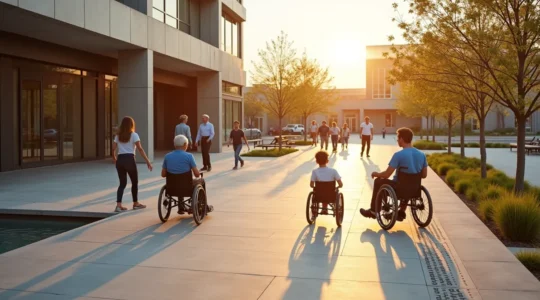
How to Design Public Spaces for Active Social Inclusion of Wheelchair Users?
Designing for legal compliance is not the same as designing for human inclusion; the key difference is the user’s finite physical and cognitive energy. Minimum standards often create environments that are technically accessible but functionally exhausting, leading to exclusion. True…
Read more
Why Loneliness Is the New Epidemic in Contemporary Urban Society
Contrary to popular belief, urban loneliness isn’t a sign of personal failure but a predictable outcome of modern city design and digital habits. The digital world offers low-friction “connections” that increase anxiety rather than providing genuine dopamine. The physical disappearance…
Read more