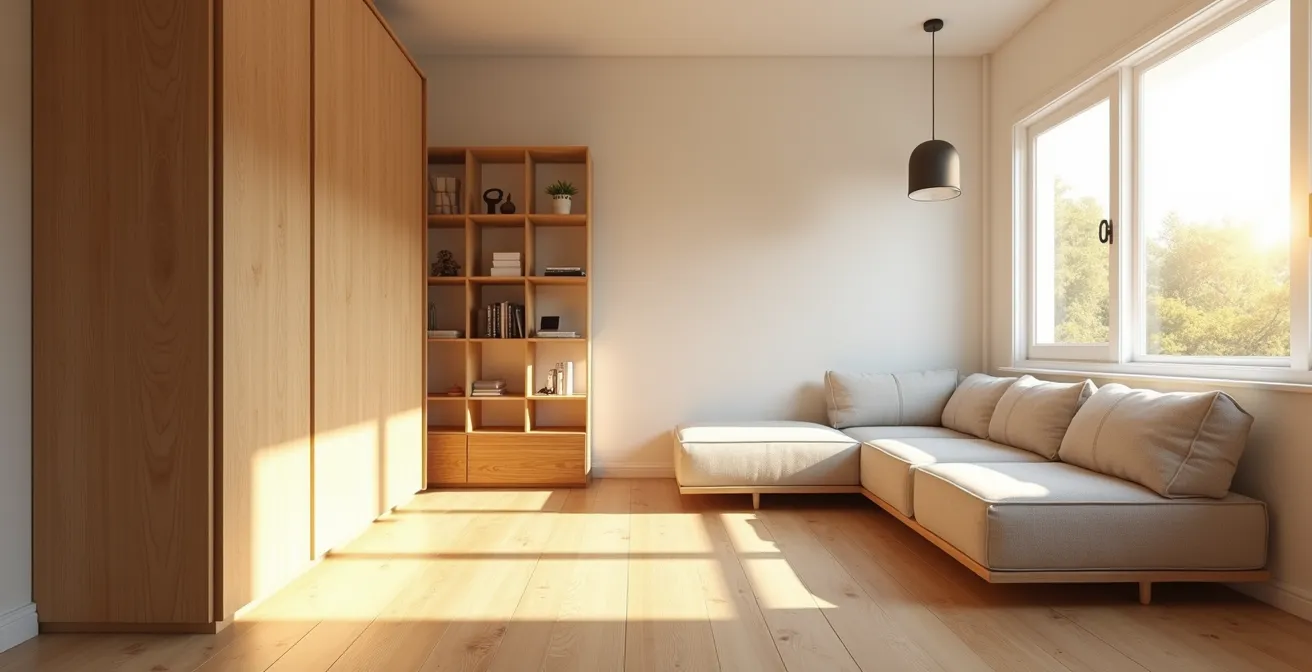
The key to a successful 300 sq ft studio isn’t just space-saving furniture; it’s using modularity to create a psychologically supportive environment.
- A quality Murphy bed offers a far greater return on investment in space and sleep quality than a standard sofa bed.
- Strategic modular arrangements can make a room feel significantly larger while defining distinct zones for work, rest, and life.
Recommendation: Approach your studio layout as an act of environmental psychology—prioritize pieces that give you control and flexibility to combat the constraints of small-space urban living.
Living in a 300-square-foot studio presents a universal challenge: how do you fit your entire life into a single box without it feeling cramped and chaotic? The common advice is predictable: get a sofa bed, hang mirrors, and use light colors. While these tips have merit, they only scratch the surface. They treat the problem as purely spatial, a game of Tetris with oversized blocks. But living small in a dense city is also a psychological challenge. The lack of defined space can blur the lines between work and rest, leading to burnout, while the compact nature of solo living can amplify feelings of isolation.
What if the solution wasn’t just about saving space, but about reclaiming it for your well-being? This is where the true power of modular furniture comes in. It’s not just about multi-functionality; it’s about transformation. A modular approach allows you to assert control over your environment, to shape and reshape it according to your needs. It’s a design philosophy that empowers you to build a home that is responsive, intelligent, and deeply personal. As one design expert notes, the thoughtful furnishing of a tiny home is a powerful act of defiance against urban anonymity.
This guide moves beyond simple space-saving hacks. We will explore how specific modular choices—from the bed you sleep on to the shelves that divide your room—can create a space that not only functions efficiently but also nurtures your mental health. We will deconstruct the “why” behind these strategies, giving you the tools to design a studio that feels expansive, organized, and, most importantly, like a sanctuary.
This article will guide you through the strategic decisions that make a small space truly livable. Below, the summary outlines how to invest wisely in core pieces, use modules to craft distinct living zones, spot quality defects, and arrange your furniture to visually expand your home.
Summary: Furnishing a 300 Sq Ft Studio With Modular Furniture for Max Space?
- Why a Murphy bed is worth the investment compared to a sofa bed?
- How to use a modular shelf to separate “bedroom” and “office” without blocking light?
- The hinge defect to look for when buying cheap modular furniture
- How to arrange modules to make the room look 20% bigger?
- When do furniture brands discount modular systems during the year?
- Coliving vs. Studio: Which housing model actually reduces depression rates?
- The seating layout error that reinforces hierarchy and silences juniors
- Why Loneliness Is the New Epidemic in Contemporary Urban Society?
Why a Murphy Bed Is Worth the Investment Compared to a Sofa Bed?
The single largest piece of furniture in a studio is the bed, and the choice between a sofa bed and a Murphy bed is a foundational one. While a sofa bed seems like a practical two-in-one solution, it represents a significant compromise in both sleeping and seating comfort. The thin, foldable mattresses are rarely suitable for nightly use, leading to poor sleep quality. Conversely, a Murphy bed is an investment in reclaiming your floor space without sacrificing your rest. It allows you to use a standard, high-quality mattress (typically 10-12 inches thick), ensuring your sleep is never compromised.
The financial and spatial return on investment is clear. A queen-sized Murphy bed frees up approximately 42 square feet of usable floor space during the day. This is space that can become your yoga area, your workspace, or simply open room to breathe. While the initial cost can be higher, with prices ranging from $300 to $5,800 depending on the system and materials, their value is amortized over a long lifespan. A well-made unit with solid wood construction can last over 20 years, and a robust lifting mechanism has a significantly higher weight capacity (800-1000 lbs) compared to the typical 600-lb limit of a sofa bed. As Lori Beds, a specialist in the field, states in their investment analysis, “A durable, high-quality, easy-to-use Murphy bed is one of the best investments you can make for your home.”
Ultimately, a Murphy bed transforms a static bedroom into a dynamic, multi-purpose living area. It’s the ultimate expression of spatial agency, allowing you to dictate the function of your room on your own terms, hour by hour. This choice prioritizes both high-quality rest and maximized daytime functionality, a combination a sofa bed simply cannot match.
How to Use a Modular Shelf to Separate “Bedroom” and “Office” Without Blocking Light?
One of the biggest challenges in a studio is creating psychological separation between life and work. How do you “leave the office” when your desk is three feet from your pillow? A modular shelving system is the most effective tool for this, acting as a permeable wall that defines zones without sacrificing precious natural light. The key is to choose an open-back or ladder-style system rather than a solid bookcase. This maintains sightlines and allows light to filter through, preventing the space from feeling divided and smaller.
To maximize this effect, think like a visual designer. Vary the density of the items on the shelves. Leave some compartments completely empty to create “windows” through the divider. Use a mix of horizontal book stacks, vertical decorative objects, and translucent storage boxes. The goal is to create a visual barrier that signals a shift in function without building an oppressive wall. By arranging items artfully, the shelf becomes a sculptural element in its own right, adding character and depth.
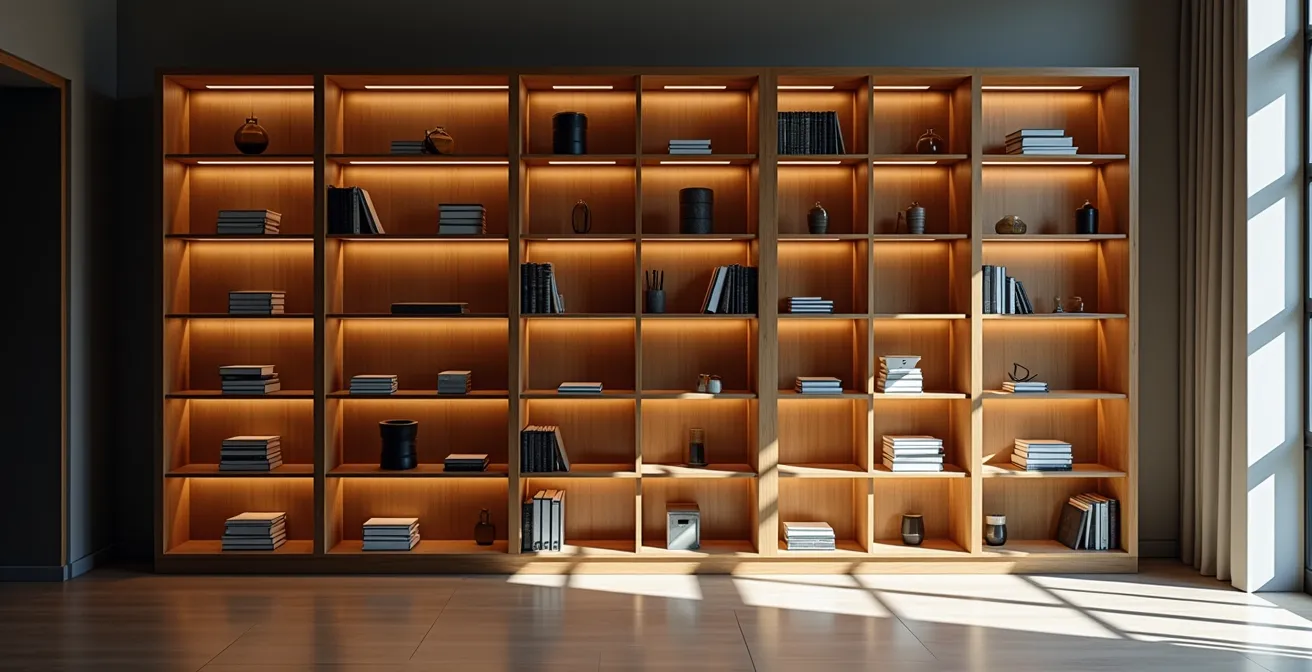
This approach creates a clear sense of psychological zoning. The side facing your desk can hold work-related items, signaling “work mode.” The side facing your bed can hold personal items, books, and calming objects, signaling “rest mode.” This simple act of curating your environment helps your brain transition between different mindsets, which is crucial for mental well-being when living and working in the same room.
Case Study: Studiomama’s 13sqm Micro-Apartment
As a prime example of this principle, the British design firm Studiomama famously transformed a tiny 13 square metre house in London using custom plywood modules. Each section of the home—including a fold-out bed, standing desk, and dining area—was ingeniously defined by modular furniture, creating distinct functional zones within a single, compact space without relying on solid walls.
The Hinge Defect to Look for When Buying Cheap Modular Furniture
Modular furniture’s flexibility is its greatest strength, but with cheaper systems, the points of connection are their greatest weakness. When evaluating budget-friendly options, the primary component to scrutinize is the hinge or connector mechanism. A common and critical defect is hinge sag or misalignment, especially on pieces that fold or transform, like drop-leaf tables or fold-out desks integrated into a shelving unit.
When you’re in the showroom, or if you’re assembling a flat-pack piece, pay close attention to the material around the hinge screws. In low-cost furniture, these are often drilled directly into particleboard or medium-density fiberboard (MDF). This material is essentially compressed sawdust and glue, and it has very poor screw-holding integrity. Over time, with repeated movement and weight-bearing, the wood fibers will strip, causing the screws to loosen. The hinge will then sag, the door or panel will no longer close flush, and the entire piece will lose its structural stability. Look for a slight wobble or a gap that wasn’t there before—it’s the first sign of failure.
A superior, though often more expensive, system will use metal-to-metal connections or anchor hinges in solid wood or high-grade plywood inserts. When inspecting a floor model, open and close the hinged component several times. Does it move smoothly and silently, or does it creak and catch? Apply gentle pressure when it’s open. Is there any give or flex at the hinge point? Even a millimeter of play can translate into a major failure down the line. A wobbly hinge isn’t just an aesthetic issue; it’s a safety hazard and a clear indicator that the furniture’s lifespan will be short.
How to Arrange Modules to Make the Room Look 20% Bigger?
Beyond the furniture itself, the arrangement of modular pieces is a powerful tool of spatial illusion. With a few strategic placements, you can trick the eye into perceiving a room as larger and more open than its physical dimensions suggest. The core principle is creating forced perspective and preserving long sightlines. This involves arranging furniture by height to guide the eye and create a sense of depth.
Place your tallest modules, such as floor-to-ceiling bookshelves or wardrobe units, against the wall furthest from the main entrance. Then, graduate the height of your furniture downwards as it gets closer to the entryway. For instance, a tall shelf on the far wall, a medium-height sofa in the middle, and low-profile ottomans or coffee tables in the foreground. This arrangement mimics the way we perceive distance in landscapes, making the far wall feel further away and the ceiling appear higher. It’s an old trick from theater set design, and it works wonders in a small studio.
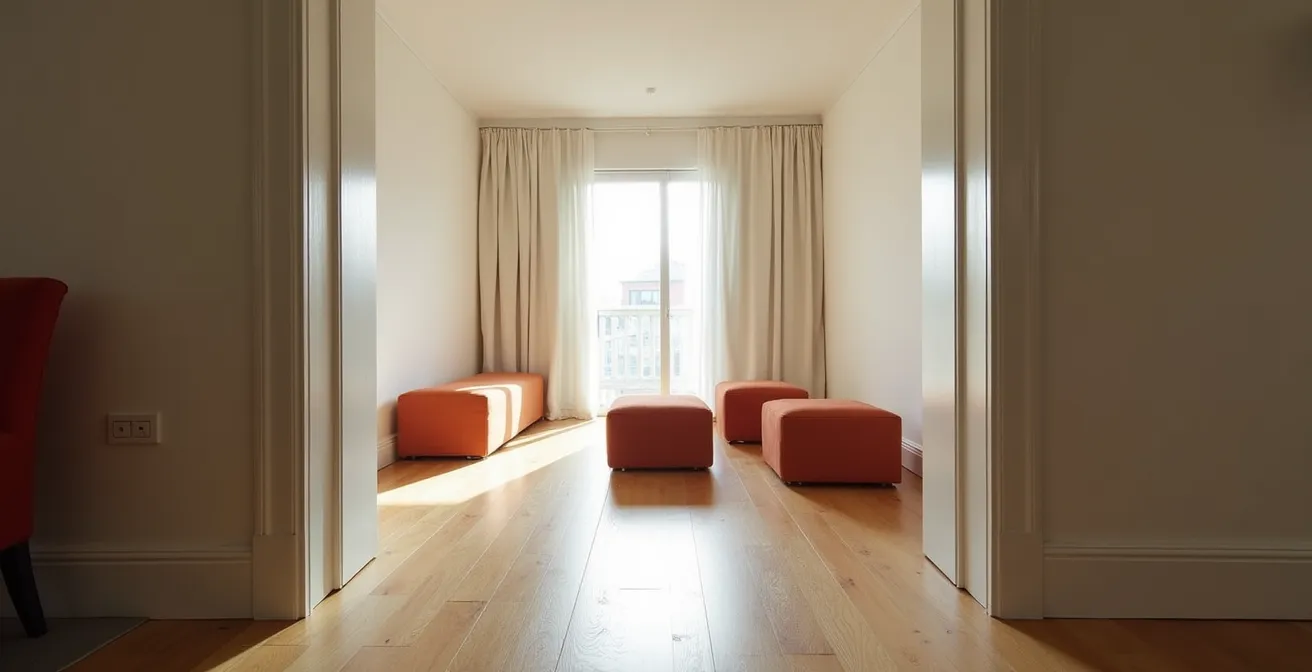
Another key is to create “negative space” both horizontally and vertically. Instead of pushing every piece of furniture against a wall, try “floating” a low-profile sofa or a few modular cubes in the center of a zone to maintain clear sightlines across the room. Similarly, when using wall-mounted modules, leave intentional gaps of 8-12 inches between them. This breaks up a solid mass of storage and allows the wall color to show through, creating a lighter, more airy feeling. Combined with layered lighting, these techniques can dramatically alter the perception of space.
Action Plan: Visually Expand Your Studio
- Force Perspective: Position all tall modules (over 5 feet) against the wall furthest from the entry point to create an illusion of depth.
- Define Pathways: Maintain clear pathways of 30-36 inches between furniture groupings to ensure fluid movement and open sightlines.
- Preserve Sightlines: Float low-profile modular pieces (under 30 inches high) in the room’s center to avoid blocking the view across the space.
- Create Vertical Space: Use wall-mounted modules with 8-12 inch gaps between units to introduce vertical negative space and reduce visual bulk.
- Soften Boundaries: Angle corner modules diagonally to break up the boxy feel of the room and encourage a more dynamic flow.
When Do Furniture Brands Discount Modular Systems During the Year?
Investing in a quality modular system can be a significant expense, but strategic timing can lead to substantial savings. Furniture retail operates on a predictable calendar, and knowing its rhythm allows you to plan your purchase around key discount periods. The most significant markdowns often occur when brands are managing inventory transitions.
Major furniture brands typically refresh their collections or introduce new models twice a year. This means the periods of January/February (after the holidays) and August/September (before the fall season) are prime times to find discounts on the previous year’s models. Retailers are eager to clear floor space for new arrivals, making them more willing to negotiate or offer clearance pricing on outgoing modular collections. These are often the best times to get a high-quality system for a mid-range price.
Beyond these seasonal changeovers, your best bets for sales are the major holiday weekends in the U.S., which have become retail events. According to a guide on furniture purchasing cycles, you should target these specific times:
- Holiday Weekends: Memorial Day, Labor Day, and especially Black Friday (the day after Thanksgiving) are when brands consistently offer sitewide discounts, often ranging from 15-40% off.
- Tiered Promotions: Keep an eye out for “buy more, save more” deals, such as “Save 20% when you buy 3+ modules.” These are common during the spring moving season (March-May) when demand for new furniture is high.
- Newsletter Subscriptions: Signing up for a brand’s email list is one of the easiest ways to get a leg up. Subscribers often receive early access to sales or exclusive discount codes not available to the general public.
By aligning your purchase with these key dates, you can make your budget stretch further and afford a higher-quality system that will stand the test of time.
Coliving vs. Studio: Which Housing Model Actually Reduces Depression Rates?
The debate between coliving and solo studio living often centers on cost and community. Coliving offers built-in social interaction, which can be a powerful antidote to urban loneliness. However, a studio apartment provides something equally valuable for mental health: autonomy and personal control. The ability to fully control one’s own environment—to set its rules, its cleanliness, its noise level, and its aesthetic—is a significant factor in reducing stress and fostering a sense of stability.
While coliving forces social exposure, it can also introduce friction from incompatible lifestyles, lack of privacy, and a feeling of having no true personal sanctuary. A studio, when designed intentionally, can become a “recharge station” tailored perfectly to the occupant’s needs. This is where modular furniture plays a crucial psychological role. A modular sofa, for example, is not just a piece of furniture; it’s a tool for environmental adaptation. As one analysis on the psychological benefits of modularity points out, the ability to reconfigure your space to suit your mood or needs—from a cozy solo lounge to a welcoming setup for guests—provides a powerful sense of agency.
This flexibility allows a studio resident to toggle between solitude and social connection on their own terms. The space can be a private retreat one day and a hub for friends the next. This adaptability directly counters the powerlessness that can contribute to feelings of depression in a rigid or shared living environment. Therefore, while coliving offers a default social network, a well-designed studio empowers the resident to build their own social life with a secure, personal home base to return to. The “better” model is less about the housing type and more about which one provides the individual with the greater sense of control and spatial agency.
The Seating Layout Error That Reinforces Hierarchy and Silences Juniors
In a corporate setting, seating arrangements can subtly reinforce power dynamics. A long, rectangular table with the boss at the head creates a formal hierarchy. In contrast, a circular arrangement promotes equality. This concept from organizational psychology, which we can call intentional friction, applies directly to a studio apartment when you host guests. The layout error many people make is arranging seating in a presentational format.
This often looks like a sofa directly facing a television, with one or two chairs angled toward the same focal point. When guests arrive, they are forced into an “audience” configuration. The host often takes the central spot on the sofa, unconsciously claiming the position of power. This layout discourages free-flowing, group conversation. People tend to speak to the person next to them or direct comments toward the “stage” (the TV or the host), silencing those on the periphery. It’s a layout designed for consumption, not connection.
To create a more inclusive and engaging social environment in your studio, you must intentionally design for conversation. Using modular seating cubes, ottomans, and rearrangeable sofa sections is perfect for this. The goal is to create a rough circle or a “U” shape where guests can easily make eye contact with everyone else. Pull seating away from the walls and create a central focal point—like a low coffee table—that is not a screen. This “campfire” arrangement signals that the purpose of the gathering is interaction. It breaks down subconscious hierarchies and encourages a dynamic where everyone feels equally empowered to contribute. Even in 300 square feet, this small shift in layout can transform the social energy of your home.
Key Takeaways
- Prioritize a Murphy bed over a sofa bed for a massive gain in both daytime floor space and nighttime sleep quality.
- Use open-back modular shelving as a permeable divider to create distinct psychological zones without blocking natural light.
- Arrange furniture by graduating heights—tallest in the back, lowest in the front—to create forced perspective and make the room feel larger.
Why Loneliness Is the New Epidemic in Contemporary Urban Society?
Contemporary urban life, for all its opportunities, has become a breeding ground for a modern epidemic: loneliness. Despite being surrounded by millions of people, city dwellers often experience profound social isolation. High-density living doesn’t automatically translate to high-quality connection. The fast pace, transient populations, and the design of our living spaces all contribute to this paradox. The studio apartment, the quintessential urban dwelling, can be both a symptom and a potential cure for this issue.
Living alone in a small box can amplify feelings of anonymity. Your home can feel less like a sanctuary and more like a storage container for a life lived elsewhere. This is where the concept of spatial agency becomes a powerful psychological tool. When you are unable to control the vast, chaotic city outside, gaining complete control over your immediate personal environment can be an incredibly grounding and empowering act. It is a way to push back against the feeling of being a small cog in a giant machine.
The act of thoughtfully furnishing a small space as a direct response to the anonymity and powerlessness of dense urban living. It’s an act of reclaiming agency over one’s immediate environment.
– Interior Design Perspective, Combating Urban Loneliness Through Intentional Space Design
Modular furniture is the vehicle for this agency. Its inherent flexibility means your home is not a fixed, static entity. It is a transformative space that can evolve with you. It can be configured for deep focus when you’re working on a project, opened up for social connection when you host friends, or cleared for physical activity when you need to move your body. By actively and repeatedly shaping your environment to meet your needs, you are engaging in a continuous act of self-care and identity-building. You are telling yourself that your needs matter and that you have the power to create a world that supports them, even if it’s only 300 square feet.
Begin transforming your studio from a mere container into a dynamic, supportive home today. The first step is to rethink your core furniture not just as objects that take up space, but as tools that give you back control, comfort, and a profound sense of place in the city.