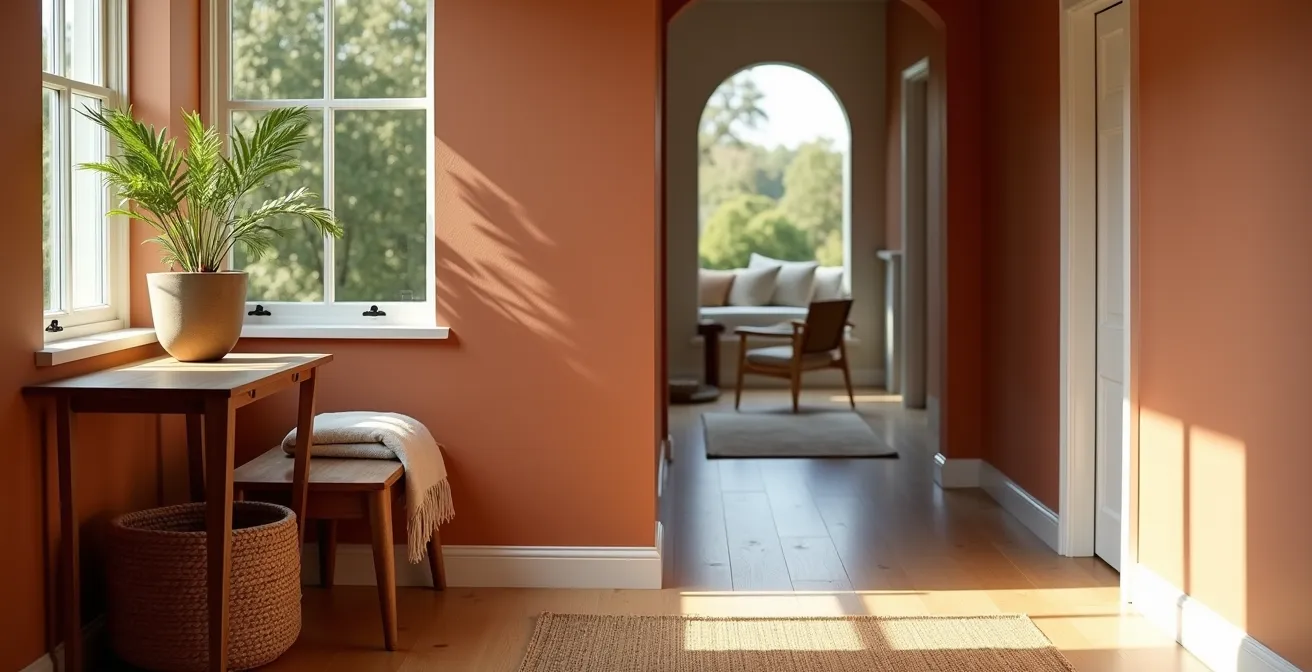
Contrary to the popular belief that a flawless, showroom-style house is the most welcoming, the true art of hospitality lies in psychological design. The secret isn’t achieving perfection, but intentionally creating “permission to relax.” This guide reveals how to move beyond sterile aesthetics and use subtle cues in your layout, textures, and styling to make guests feel genuinely comfortable and at ease the moment they walk through your door.
As a hospitality designer, I’ve seen countless homeowners invest in beautiful furniture and pristine decor, only to find their space feels more like a museum than a home. Guests are hesitant, they perch on the edge of sofas, and they seem afraid to touch anything. The common advice—declutter, light a candle, add a plant—only scratches the surface. It addresses the ‘what’ but completely ignores the ‘why’. These homes lack a crucial, invisible ingredient: psychological safety.
The problem isn’t that your home isn’t beautiful; it might be *too* beautiful, too perfect. It communicates a message of “look, don’t touch.” The key to transforming this is to shift your mindset from decoration to emotional connection. It’s about understanding the subconscious signals your space is sending. A truly welcoming interior isn’t about impressing guests, but about inviting them to exhale and feel like they belong.
This article will guide you through the psychological principles that turn a sterile house into a warm, inviting home. We’ll deconstruct the elements that create genuine comfort, from the science of first impressions in your entryway to the subtle power of “intentional imperfection.” You’ll learn not just what to do, but why it works, empowering you to create a space that feels as good as it looks.
To help you navigate these concepts, this article is structured to build your understanding step by step. Below is a summary of the key areas we will explore to master the art of at-home hospitality.
Summary: How to Design a Welcoming Home: The Psychological Secrets to Making Guests Feel Instantly at Ease
- Why the first 5 seconds of entering your home define the guest’s comfort level?
- Sofa vs. Armchairs: Which layout encourages guests to stay longer?
- How to use rugs and throws to soften a modern, cold architectural style?
- The perfectionist mistake that makes guests afraid to sit down
- When to light candles or start music before guests arrive?
- Coliving vs. Studio: Which housing model actually reduces depression rates?
- Why painting a bedroom red raises your heart rate and hinders sleep?
- How to Style Decorative Objects Without Creating Visual Clutter?
Why the first 5 seconds of entering your home define the guest’s comfort level?
The moment a guest crosses your threshold, their brain is performing a rapid, subconscious safety assessment. This isn’t a conscious judgment of your decor, but a primal evaluation of the environment. Within seconds, they are processing spatial cues to determine if the space is safe, welcoming, and comfortable. As cognitive scientists explain, non-verbal cues are processed quickly by the brain and can make or break these crucial first impressions.
Think of your entryway as the first sentence of your home’s story. It needs to communicate warmth and care instantly. A dark, cluttered, or confusing entrance triggers a subtle stress response, putting a guest on guard. Conversely, a clear, well-lit, and thoughtfully arranged entry signals that they are expected and valued. This is your first opportunity to offer psychological comfort.
Practical elements play a huge role in this initial assessment. Is there an obvious place for their coat and bag? Is the pathway into the main living area unobstructed? These small details remove cognitive load and uncertainty. Providing a console table or a hall stand creates a designated “landing strip” for belongings, an unspoken invitation to shed the outside world and settle in. Well-placed lighting, like a warm pendant or wall sconces, not only illuminates the space but also creates a welcoming glow, drawing people in. Even a clean welcome mat and a cared-for front door send a powerful message: this home is a sanctuary.
Sofa vs. Armchairs: Which layout encourages guests to stay longer?
The debate between a large sofa and a collection of armchairs isn’t just about aesthetics; it’s about social psychology. The way you arrange your seating directly influences conversation, intimacy, and a guest’s sense of autonomy. The goal is to create a “socio-petal” arrangement—a term architects use for layouts that encourage social interaction by orienting people towards each other.
This layout should respect personal space. The foundational work of anthropologist Edward T. Hall on proxemics provides a framework for this. His research shows that a social distance of 4-10 feet is optimal for group interactions. Placing seating too far apart creates a “socio-fugal” space that discourages connection, while placing it too close can feel intrusive. The ideal layout encourages conversation without forcing intimacy.
To truly understand how furniture shapes behavior, consider this insight from hospitality design.
Case Study: The Psychology of Seating Arrangements
Research on hospitality spaces reveals that creating intimate seating clusters or nooks encourages guests to gather and engage in conversation. The combination of sofas and individual armchairs allows guests to self-regulate their comfort level by choosing between closeness (sofa) or autonomy (armchair), which is considered the highest form of hospitality. Human-centered design acknowledges diverse preferences and body types, with ergonomic principles and adjustable features accommodating different comfort needs.
The best solution is often a hybrid approach. A comfortable sofa provides a space for closeness and shared experience, while individual armchairs offer guests autonomy and control over their personal space. This combination allows a diverse group to self-select their desired level of interaction, making everyone feel more comfortable. An L-shaped or U-shaped arrangement, with a coffee table as a central anchor, is particularly effective at creating an inclusive conversational pit.
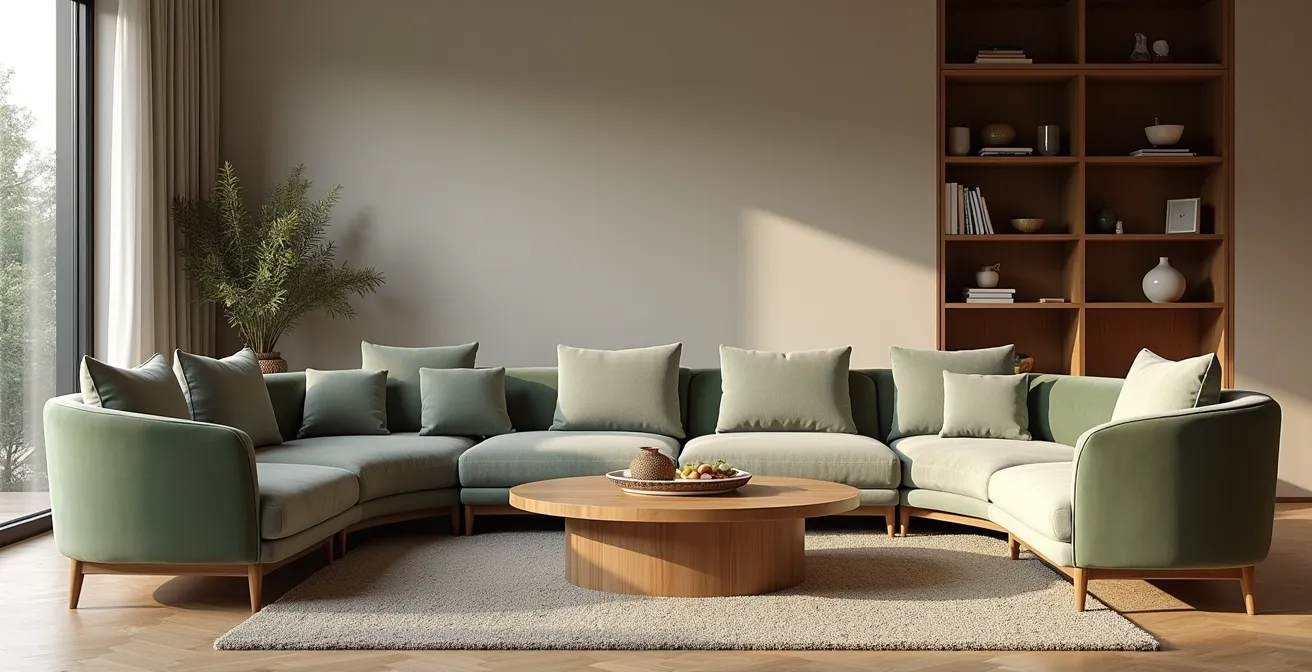
As you can see in this layout, the furniture is oriented to foster connection. No one is left on the periphery. This arrangement sends a clear, non-verbal message: “we are here to connect with each other.” It turns the living room from a passive viewing space into an active social hub.
How to use rugs and throws to soften a modern, cold architectural style?
Modern architecture, with its clean lines, hard surfaces, and minimalist aesthetic, can often feel visually stunning but emotionally cold. Concrete floors, large panes of glass, and sharp angles can create an environment that feels more like a gallery than a sanctuary. The most effective way to counteract this is through sensory layering, specifically with soft textiles like rugs and throws.
Our brains are wired to associate soft textures with safety, comfort, and warmth. This is a deeply ingrained instinct. Introducing these elements into a stark space provides a necessary tactile contrast. A plush, high-pile rug doesn’t just feel good underfoot; it visually anchors a seating area, defining it as a zone of comfort. It also absorbs sound, reducing echo and creating a more intimate, hushed atmosphere. The act of adding soft textures is a direct way to tell your guests’ subconscious that this is a place for rest and relaxation.
As the design team at Judd Builders points out in their guide on creating a welcoming home:
Adding soft textures and textiles creates a sense of coziness. From fluffy carpets to smooth wooden furniture, surrounding yourself and guests with these soothing textures they can touch will make them feel comfortable.
– Judd Builders, 10 Ways to Make Your House a Welcoming Home
Throws and cushions are your tools for adding micro-moments of comfort. A cashmere or chunky-knit throw blanket draped over the arm of a sleek leather sofa is an explicit invitation to get cozy. It breaks the severity of the furniture’s lines and says, “it’s okay to lounge here.” Use materials that beg to be touched: velvet, wool, faux fur, or soft linen. This is not just about visual appeal; it’s about providing haptic feedback that communicates comfort and care directly to the nervous system.
The perfectionist mistake that makes guests afraid to sit down
The single greatest mistake a host can make is creating a space that is too perfect. A sofa with flawlessly chopped cushions, a coffee table with nothing on it, and a throw blanket folded with military precision sends a clear, albeit unintentional, message: “This space is for admiring, not for living in.” This is the “showroom effect,” and it creates a barrier of intimidation, making guests afraid they will mess something up. True hospitality is about giving your guests permission to relax.
This is achieved through what I call “intentional imperfection.” It’s the art of making your home look lived-in and approachable, not staged. Design experts note that overstuffed, cushy seating creates a “siren’s call,” inviting people to sink in and get comfortable. It’s about choosing materials and arrangements that prioritize use over pristine aesthetics. Down-filled cushions that look soft and pliable are far more inviting than rigid foam that holds a perfect shape. The goal is to create an environment that says, “come on in and make yourself at home.”
This principle requires a conscious shift away from a rigid, “perfect” home. It means a casually draped throw is better than a perfectly folded one. It means a small stack of books on the coffee table is more welcoming than a bare surface. These small, deliberate touches of life signal that the space is actively used and enjoyed, which instantly puts guests at ease. They no longer feel like they are the first person to ever sit on your sofa.
Action Plan: Granting Permission to Relax
- Layer cozy blankets casually across the back of a couch instead of folding them perfectly.
- Use an odd number of toss pillows (e.g., three or five) for a more dynamic and less rigid appearance.
- Keep a few interesting books or magazines casually stacked on coffee tables or side tables.
- Place coasters in accessible stacks rather than presetting them in a formal arrangement.
- Choose durable, high-quality fabrics that are beautiful but don’t feel too precious to be used.
- Leave a single throw casually draped over the arm of a chair, as if someone just got up.
- Display personal items that invite conversation, not just sterile decor that only invites admiration.
When to light candles or start music before guests arrive?
Creating a welcoming atmosphere is a multi-sensory experience that extends beyond visual aesthetics. Scent and sound are powerful, invisible tools that shape mood and emotion from the moment someone enters your home. However, their effectiveness hinges on timing and subtlety. The goal is an ambient feeling that seems effortless, not an overwhelming sensory assault.
As interior designer Suzie Anderson notes, the power of scent is deeply psychological:
Scent has a powerful impact on mood, memory, and atmosphere, and introducing a signature fragrance can instantly make your interiors more inviting.
– Suzie Anderson, How to Create a Welcoming Home: 8 Interior Design Tips
To achieve the right balance, timing is everything. A candle lit moments before the doorbell rings will be too strong and obvious. Instead, experts advise that 20-30 minutes before guests arrive is optimal for lighting candles. This allows the fragrance to mellow and disperse naturally throughout the space, creating a subtle background note rather than a fragrant punch. The wax will have had time to pool, creating a beautiful, warm glow that adds to the visual ambiance.

The same principle of subtlety applies to music. The music should be started 10-15 minutes before arrival and set at a volume low enough to be a background texture, not a focal point. It should fill the silence but never compete with conversation. Choose a playlist that reflects a relaxed, welcoming mood—instrumental, soft jazz, or chill lo-fi beats work well. The goal is to create a sensory layer that enhances the feeling of comfort without consciously drawing attention to itself.
Coliving vs. Studio: Which housing model actually reduces depression rates?
The principles of hospitality design aren’t just for hosting guests; they are fundamental to our own well-being and can inform how we structure our living environments to combat loneliness. The rising popularity of coliving spaces versus traditional studio apartments provides a fascinating large-scale case study on the psychology of space and social connection. While a studio offers ultimate privacy, it can also lead to isolation. Coliving, by its nature, is designed to foster community.
The underlying science is clear: proximity breeds connection. In a landmark large field experiment found that proximity significantly increases friendship formation, even when seating was randomized in classrooms. Coliving models apply this principle to daily life by creating shared spaces—kitchens, lounges, workspaces—that act as natural collision points for spontaneous social interaction. These are the modern equivalent of the village well, designed to combat the social isolation that can contribute to depression.
However, successful social design is not just about forcing people together. It’s about providing choice. The most effective spaces, whether in a home or a hotel, masterfully balance public and private zones. This is known in architectural psychology as the concept of “prospect and refuge.” We are most comfortable in environments that offer both open, social areas (“prospect”) and safe, private nooks for withdrawal (“refuge”). A well-designed coliving space provides vibrant communal lounges but also ensures each resident has their own private, quiet bedroom to retreat to. It gives residents control over their level of social engagement, which is the key to sustainable well-being.
Why painting a bedroom red raises your heart rate and hinders sleep?
Color is not merely a decorative choice; it is a form of energy that directly communicates with our nervous system. The emerging field of neuroaesthetics studies how our brains and bodies respond to aesthetic experiences, and its findings confirm what hospitality designers have long known intuitively: color has a profound, measurable impact on our psychological and physiological state.
Warm colors like bright red, yellow, and orange are associated with energy, passion, and excitement. When our eyes perceive these high-wavelength colors, they can trigger a physiological response, including an increase in heart rate and blood pressure. While this can be fantastic for a gym or a creative workspace, it’s the exact opposite of what you want in a bedroom, where the goal is to activate the parasympathetic nervous system—our body’s “rest and digest” mode.
Research in the field validates this connection. According to a review of studies in neuroarchitecture, the emerging field of neuroaesthetics demonstrates how aesthetic choices affect our emotional outlook and behavior. For spaces intended for relaxation and sleep, the most effective palettes are composed of cool, desaturated, and earthy tones. Blues, greens, soft grays, and warm beiges are low-wavelength colors that have a calming, soothing effect on the brain. They mimic the colors found in nature—the sky, water, forests—which we are evolutionarily programmed to find restorative. These colors help lower the heart rate and prepare the body for sleep, making them ideal for creating a restful sanctuary.
Key Takeaways
- True hospitality is not about perfection; it’s about creating “permission to relax” for your guests.
- Seating arrangements should be “socio-petal,” encouraging interaction while respecting personal space by offering a mix of sofas and armchairs.
- Combat the coldness of modern design by layering soft, tactile textures like rugs and throws to provide sensory comfort.
How to Style Decorative Objects Without Creating Visual Clutter?
The final layer of creating a welcoming home is styling your decorative objects. This is where many well-intentioned hosts falter, either by creating a sterile, impersonal space or by overwhelming it with so many items that it becomes visual noise. The secret is to curate, not just collect. Your objects should tell a story and invite conversation, not simply fill a surface. This is the final step in reinforcing the “lived-in” feeling and moving away from the dreaded showroom effect.
The first rule is to create breathing room. Negative space is not empty space; it is an active design element that allows the eye to rest and appreciate the objects you’ve chosen to display. Instead of lining items up along a mantelpiece, group them into thoughtful clusters. A powerful guideline is the “rule of three” (or any odd number), which creates a more dynamic and visually appealing composition than an even-numbered group. Vary the height, shape, and texture within each cluster to create interest.
To prevent these groupings from looking like clutter, use trays. A tray acts as a visual frame, containing a collection of smaller items—a candle, a small plant, a stack of coasters—and making them read as a single, cohesive unit. This is particularly effective on coffee tables and consoles. Finally, and most importantly, choose objects that are meaningful to you. A generic decor item from a big-box store adds little personality. A stack of art books, a beautiful rock from a memorable hike, or a framed family photo are conversation starters. They are authentic extensions of you, and that authenticity is the ultimate source of warmth and welcome in a home.
By moving beyond surface-level decorating and embracing the psychology of space, you can transform your home into a place where people feel not just welcomed, but truly at ease. The next logical step is to look at your own space with these new eyes and begin making small, intentional changes.