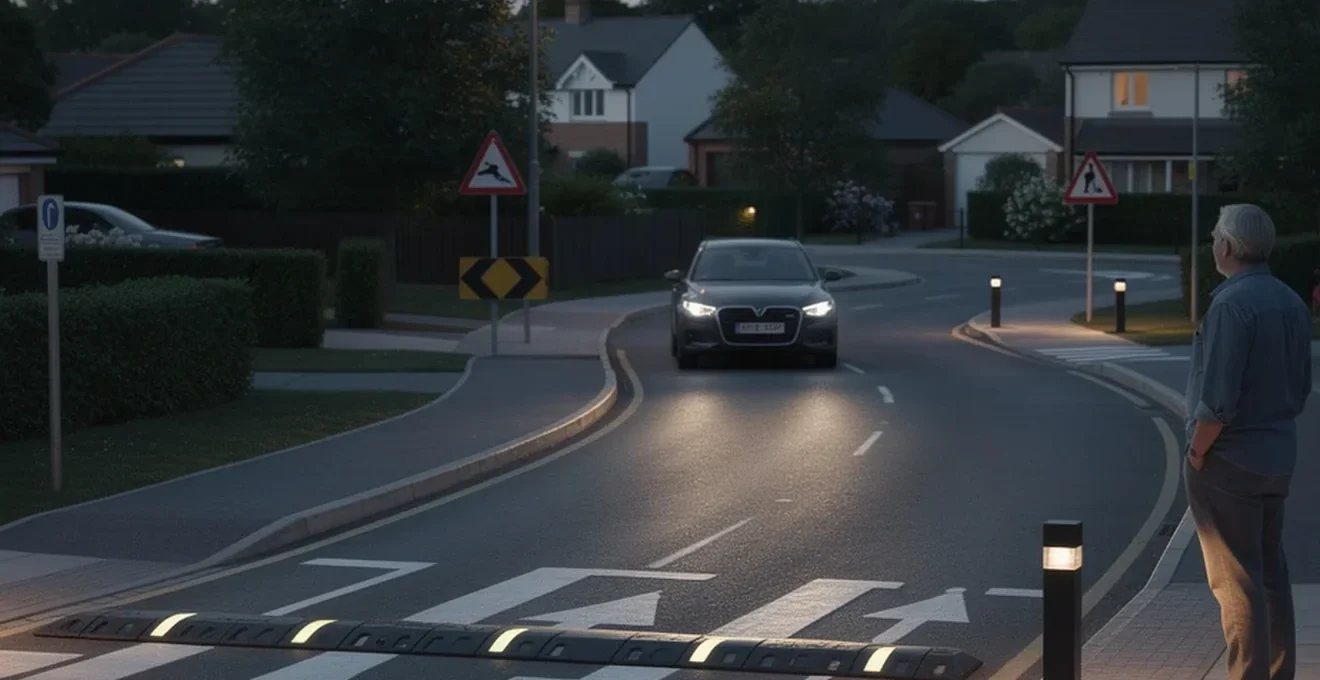
Private access roads sit outside the normal system of highway inspection and repair, yet they carry the same mix of cars, delivery vans, cyclists and pedestrians as any public street. Without a highway authority responsible for signage, drainage or surface repairs, the job of keeping these roads safe falls to the landowner, developer or residents who use them. This creates real risks: poor visibility, unmarked hazards, uneven surfaces and confusion over right of way can all lead to collisions and injuries. This article sets out the practical steps that private road owners and residents’ associations can take to reduce those risks, from signage and traffic calming to lighting, surfacing and the legal responsibilities that come with managing a road that the public highway rules do not automatically cover.
Understanding the unique risks of private access roads
Private access roads often serve a small number of properties, a farm, a business park or a residential development, but the risks they present are not necessarily smaller than those on public roads. In many cases, the absence of formal oversight means hazards go unnoticed for longer, and road users may wrongly assume that a private road follows the same visible standards as a public one.
Lack of statutory adoption and highway authority oversight
A public highway is maintained by a highway authority, which has statutory duties to keep the surface, signage and drainage in a reasonable state of repair. A private access road that has not been formally adopted has no such body responsible for it by default. This means there is no automatic inspection regime, no guaranteed budget for repairs and no external body checking that signage meets recognised standards. Responsibility instead rests with whoever owns or has legal control of the road, whether that is a single landowner, a developer, or a residents’ association acting collectively.
This gap matters because many of the general road safety principles that apply to public roads, such as adapting driving to the type and condition of the road, being alert for unmarked junctions where nobody has priority, and being prepared to stop for hazards, apply just as much on private roads. Drivers cannot assume that a private road has been engineered, signed or maintained to the same standard as a public one, and owners cannot assume that users will automatically drive with appropriate caution.
Common hazards: poor drainage, potholes and uneven surfaces
Roadways should be constructed with a surface suitable to their purpose, kept free of obstructions and properly drained, with firm and even surfaces throughout. On private roads, these basic standards are frequently overlooked until a problem becomes visible or someone is injured.
Potholes should not be allowed to develop, and where they do appear they should be repaired promptly rather than left to worsen. Poor drainage is a related and often underestimated hazard: standing water can mask the depth of a pothole, freeze in cold weather to create black ice, or gradually undermine the surface structure, leading to more extensive and costly damage over time. Steep slopes should be avoided wherever possible, and where they are unavoidable, they should be clearly signposted so that drivers can adjust their speed and approach accordingly.
Shared use conflicts between vehicles, cyclists and pedestrians
Many private access roads were never designed with a clear separation between vehicles and people on foot or on bicycles. Where pedestrians and vehicles share the same traffic route, the route should be wide enough to allow vehicles to pass pedestrians safely, and any areas reserved exclusively for pedestrians or vehicles should be clearly marked.
Where pedestrian and vehicle routes cross, appropriate crossing points should be provided, clearly marked and protected. If crowds of people are likely to use a road at particular times, for example residents leaving for work at the same time each morning, it may be worth considering whether vehicle access should be restricted during those periods. Separate pedestrian and vehicle doors or access points, fitted with vision panels, help reduce the risk of a driver or pedestrian being taken by surprise at a shared entrance.
Liability under the occupiers’ liability act 1957
Anyone who owns, occupies or controls a private access road has a duty of care towards people who use it, including visitors, delivery drivers, and members of the public with lawful reason to be there. This duty means taking reasonable steps to ensure that the road is reasonably safe for the purposes for which people are permitted to use it. In practice, this translates into the same maintenance and safety obligations that apply to any other workplace or private premises: keeping the surface in good repair, removing obstructions promptly, providing adequate signage for known hazards, and ensuring lighting is sufficient for the conditions. Failing to address a known hazard, such as a longstanding pothole or an unlit junction, can expose the responsible party to a claim if someone is injured as a result.
Essential signage and road marking standards
Clear, well-maintained signage is one of the most cost-effective ways to improve safety on any road. Conveying important information quickly gives drivers and pedestrians time to adjust their speed or position appropriately.
Applying traffic signs regulations and general directions (TSRGD) principles
Public roads are governed by the Traffic Signs Regulations and General Directions, which set out the design, colour and wording of legally recognised road signs. While private roads are not legally bound by these regulations in the same way, adopting the same visual standards makes signs instantly recognisable to every road user, regardless of how familiar they are with the specific site. Using established, standardised sign designs rather than improvised or ambiguous wording reduces the risk of misunderstanding, particularly for visiting drivers who are unfamiliar with the layout.
It can also be useful to provide a plan of the site at the entrance, and at other key points, showing vehicle routes, one-way systems and pedestrian areas. This is particularly valuable at sites that receive regular visiting traffic, such as business parks or shared driveways serving multiple properties.
Speed limit signage and advisory warning signs
Sensible speed limits should be set and clearly signposted throughout a private access road. Advisory warning signs should be used to highlight specific hazards, such as sharp bends, junctions, blind corners, steep gradients or roadworks, giving drivers advance warning so they can adjust their speed in good time. Height restrictions, and any dangerous obstructions such as low overhead cables, should be prominently signed both at the obstruction itself and on the approach to it.
Pedestrian crossing points and give way markings
Where pedestrian and vehicle routes cross, the crossing point should be clearly marked, protected where necessary, and its use encouraged or enforced through design. Give way markings help establish priority at junctions and shared access points, particularly where visibility is limited. On roads without a clear priority, drivers should be alert to the possibility that nobody has right of way, in the same way they would be on an unmarked junction in a rural lane, and signage should reflect this uncertainty rather than leave it to guesswork.
Reflective bollards and chevron boards for Low-Visibility conditions
Signs and markings are only useful if they remain visible in poor weather or after dark. Reflective materials and illuminated signage are essential wherever conditions such as rain, fog or reduced winter daylight are likely. Reflective bollards help define the edges of a carriageway or mark a junction, while chevron boards are effective at highlighting bends, particularly sharper ones that are not obvious from a driver’s normal approach speed. All signs and lighting should be kept clean and properly maintained, since even a well-designed sign loses its value if it becomes obscured by dirt, vegetation or fading over time.
Physical traffic calming measures for private roads
Signage alone often cannot control vehicle speed on its own; physical measures encourage drivers to slow down naturally, regardless of whether they have read or absorbed the signs.
Speed bumps and speed cushions: sizing and placement
Speed bumps and speed cushions are among the most familiar traffic-calming measures. Drivers approaching them should reduce their speed and maintain that reduced speed along the whole stretch of road affected by the calming measures, rather than accelerating between individual bumps. Placement should take into account cyclists and motorcyclists, who need enough room to pass through such features safely without being forced into an uncomfortable manoeuvre.
Chicanes and pinch points to reduce vehicle speed
Chicanes and narrowings work by physically restricting the width of the road, forcing drivers to slow down to navigate the change in alignment. As with speed bumps, drivers should not attempt to overtake other moving road users while passing through these features, and should give way to oncoming traffic where signs direct them to do so. On a private access road, pinch points can be particularly effective near entrances, junctions or areas where pedestrians are known to cross frequently.
Rumble strips and textured surfacing techniques
Textured surfacing, including rumble strips, provides an audible and tactile warning to drivers that they are approaching a hazard or entering a zone requiring reduced speed. This can be especially useful on the approach to a private road from a faster public road, alerting drivers to the change in environment before they reach any junction or shared pedestrian area.
Improving lighting and surface conditions
Adequate lighting and a well-maintained surface are two of the most fundamental safety measures available, and both are entirely within the control of a private road owner.
LED bollard lighting versus traditional lamp posts
All roads, manoeuvring areas and yards should be sufficiently lit, with particular attention given to junctions, pedestrian areas and places where vehicles regularly move. LED bollard lighting offers a lower-level, more focused alternative to traditional lamp posts, and can be particularly suitable for marking the edges of a carriageway or highlighting pedestrian routes without the cost and scale of full street lighting columns. Traditional lamp posts remain useful for illuminating wider areas, such as parking zones or junctions, where broader coverage is needed.
Solar-powered lighting solutions for rural private roads
For private roads in rural locations without an existing electricity supply, solar-powered lighting offers a practical way to improve visibility without the cost of connecting to the grid. This can be especially valuable for isolated farm access roads or long private driveways where extending mains power would be disproportionately expensive relative to the benefit.
Resurfacing options: tarmac, gravel and Resin-Bound solutions
Roadways should ideally be constructed of tarmac, concrete or another suitable material, with firm and even surfaces that are properly drained. Tarmac remains the most common choice for private roads carrying regular vehicle traffic, offering durability and a smooth, predictable surface. Gravel can be a lower-cost option for lighter-use tracks, though it requires more frequent maintenance to prevent rutting and pothole formation. Resin-bound surfacing offers a permeable, low-maintenance alternative that can help address drainage concerns while still providing a stable surface for both vehicles and pedestrians. Whichever material is chosen, the surface should be maintained to provide good grip for vehicles, including gritting in icy conditions, and any potholes that develop should be repaired promptly before they worsen.
Legal responsibilities for private road owners and residents’ associations
Managing a private access road is not simply a matter of goodwill; it carries defined legal and practical responsibilities that owners and residents’ associations need to understand and act upon.
Establishing a maintenance agreement under section 106
Where a private road serves a new development, a Section 106 agreement can be used to set out clear obligations for the ongoing maintenance of that road, including who is responsible for repairs, drainage and signage, and how costs will be shared among the properties served. Establishing this kind of agreement early, ideally as part of the original planning process, helps avoid disputes later about who is responsible for repairing a pothole, replacing a faded sign, or funding a resurfacing project.
Insurance considerations for shared private roads
Because private road owners and residents’ associations owe a duty of care to anyone using the road, appropriate insurance cover is an important part of managing the associated risk. This typically includes public liability cover to protect against claims arising from injuries or accidents connected to the condition of the road. Residents’ associations managing a shared private road collectively should ensure that cover is arranged in a way that reflects the shared nature of the responsibility, rather than assuming that an individual property owner’s household policy will be sufficient.
Enforcing speed limits without police jurisdiction
Speed limits on private roads are not enforced by the police in the way they are on public highways, since the relevant road traffic legislation is generally tied to public roads. This means that any speed limit set on a private access road relies on physical traffic-calming measures, clear signage and community expectation for its effectiveness, rather than the threat of a fine or penalty points. This makes the physical measures described earlier, such as speed bumps, chicanes and textured surfacing, particularly important on private roads, since they are often the only reliable way to keep vehicle speeds down.
Community-led safety initiatives and best practice case studies
Because private roads fall outside statutory highway maintenance, improving safety often depends on residents and users organising themselves collectively rather than waiting for external intervention.
Setting up a residents’ road safety committee
A dedicated residents’ committee focused on road safety gives a private road community a structured way to identify hazards, agree priorities and coordinate responses. This might include organising regular visual inspections to spot faded markings, damaged signage or developing potholes before they become serious, and agreeing a clear process for reporting and addressing problems promptly. Early identification of deterioration, whether in the surface, signage or lighting, generally means a quicker and cheaper solution than waiting until the problem becomes severe.
Crowdfunding infrastructure improvements through private road levies
Where a maintenance agreement does not already set out how costs are shared, residents’ associations can agree a levy system to fund infrastructure improvements collectively, such as resurfacing works, new lighting installations or additional signage. Spreading costs across all households or businesses that benefit from the road ensures that safety improvements are not left to a single property owner to fund alone, and can make larger projects, such as full resurfacing or a comprehensive lighting upgrade, financially achievable where they might otherwise be postponed indefinitely.