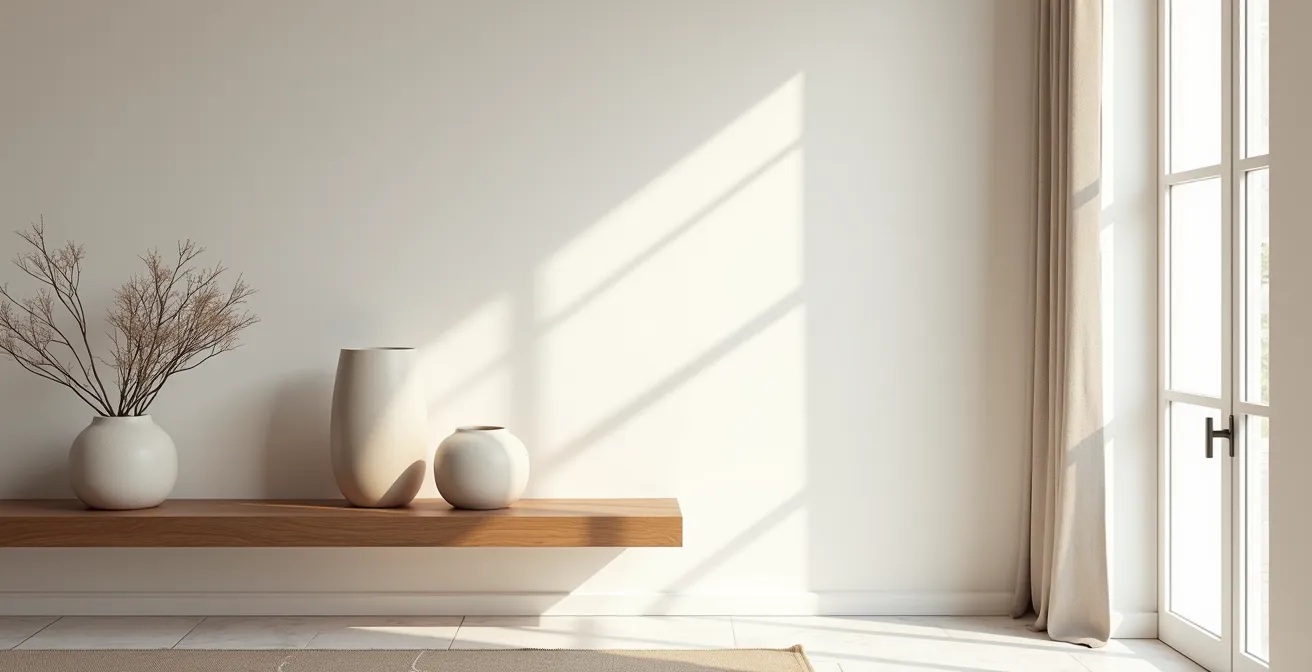
The secret to an elegant display isn’t adding more, but intentionally subtracting. It’s a shift from merely arranging objects to actively curating your space.
- Effective styling relies on a “Curator’s Archive,” where 50% of your collection is thoughtfully stored to allow displayed pieces to shine.
- Creating a “visual dialogue” between objects—balancing eras, textures, and forms—transforms a simple grouping into a compelling narrative.
Recommendation: Begin by viewing your collection not as a whole, but as individual stories. Select only the pieces that speak most clearly for the current season and store the rest.
For the decor enthusiast, the line between a vibrant collection and visual chaos is perilously thin. You’ve gathered objects you love—a vase from a memorable trip, a sculpture that speaks to you, a stack of art books. Yet, when placed together, the magic fades, replaced by a sense of clutter. The common advice often circles around simple rules: group items in threes, vary their height, or use trays to contain the spread. While helpful, these tips address the symptoms, not the root cause of the problem.
These rules treat styling as a static formula. But what if the true art of display is not a one-time arrangement, but a dynamic, ongoing practice? The solution lies in adopting the mindset of a curator. A curator doesn’t just place art on a wall; they edit, select, and create narratives. They understand that the space around an object is just as important as the object itself. This approach transforms your home from a storage unit for beautiful things into a personal gallery, where every piece is given the space to breathe and tell its story.
This guide will walk you through the curatorial method of styling. We will explore the psychological power of composition, the techniques to create harmony between contrasting pieces, and the discipline of rotating your collection. You will learn how to light your treasures like a museum, find untapped display potential, and protect your most delicate items. It’s time to stop arranging and start curating.
To help you master this art, this article breaks down the essential principles of curatorial styling. The following sections will guide you from the foundational concepts of composition to the advanced strategies of collection management and preservation.
Summary: Mastering the Art of Curated Display
- Why grouping items in odd numbers is more visually appealing to the brain?
- Antique Vase vs. Modern Sculpture: How to balance contrasting eras?
- How to store 50% of your decor to keep the display fresh and airy?
- The open-shelving error that doubles your cleaning time
- How to position accent lighting to highlight a specific sculpture?
- Why the space above your cabinets is the most wasted storage area?
- The flash photography mistake that fades ancient pigments over time
- Why Investing in Local Works of Art Is Smarter Than Buying Mass-Market Prints?
Why grouping items in odd numbers is more visually appealing to the brain?
The “rule of three” is perhaps the most repeated advice in decorating, but its power lies not in a magic number, but in fundamental human psychology. Our brains are hardwired to seek patterns, and a pair of objects is immediately processed as a symmetrical, static unit. An even number of items creates pairs, which the eye can easily categorize and dismiss. An odd number, however, forces the eye to move around, creating a more dynamic and engaging visual experience. This forced movement creates a sense of energy and prevents the arrangement from feeling rigid.
This is because an odd-numbered group, particularly a trio, naturally forms a triangle. This is the most stable and satisfying geometric shape for our brain to interpret in a composition. One object becomes the peak, and the other two form a solid base, creating a clear visual hierarchy. According to research on visual psychology reveals that items grouped this way are perceived as a single, cohesive vignette rather than a collection of disparate things. This simple shift from even to odd is the first step in moving from random placement to intentional curation.
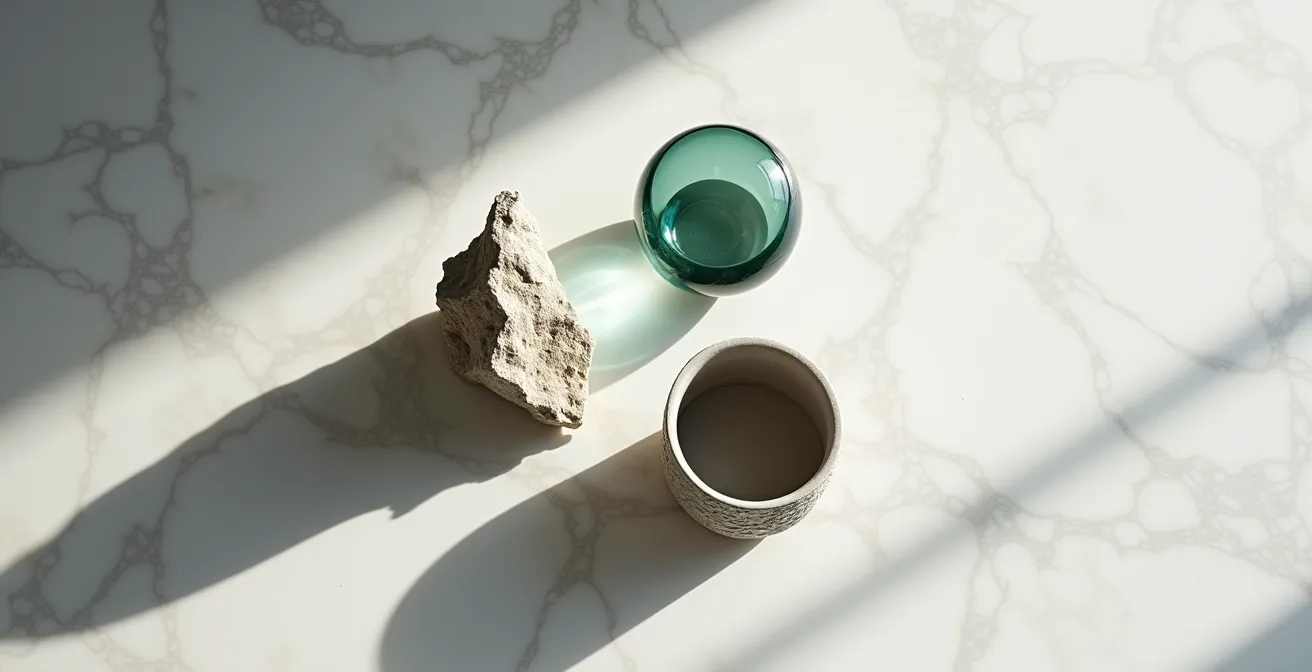
As you can see in the arrangement above, the variance in height and texture within the trio further enhances the composition. The tallest object acts as a natural focal point, while the others support it, creating a balanced yet interesting flow. Mastering this principle is about creating a small, contained story where each object has a role. It’s the visual equivalent of a well-structured sentence—clear, concise, and impactful.
Action Plan: The Visual Triangle Technique
- Start with your largest object as the anchor piece. This will be the peak of your visual triangle and establish the overall scale.
- Add a medium-sized item at a different height to create visual movement and prevent a flat, linear look.
- Complete the triangle with a smaller third piece to balance the composition, often placed slightly forward.
- Ensure objects vary in texture, material, or color to create a rich, tactile dialogue and add depth.
- Leave deliberate breathing room—negative space—between items to avoid visual density and allow each piece to be seen.
Antique Vase vs. Modern Sculpture: How to balance contrasting eras?
One of a collector’s greatest challenges is creating harmony between pieces from different time periods. Placing a rustic antique next to a sleek, modern sculpture can easily result in visual discord. The secret to bridging this gap is not to force a match, but to create an intentional “visual dialogue” between the objects. Instead of seeing them as opposites, a curator looks for a common thread—a shared color, material, or form—that can unify them into a single, cohesive story.
This technique, sometimes called “Anchor and Echo,” involves using one element to connect disparate pieces. For example, the warm patina of a bronze antique vase can be echoed in the subtle metallic finish of a modern picture frame nearby. A curved, organic-shaped sculpture can create a conversation with the soft, rounded lines of a traditional ceramic pot. It’s about finding a shared language. When objects share a commonality, their differences in age and style become a source of interest and tension, rather than a point of conflict. This elevates the arrangement from a simple display to a thoughtful composition that tells a richer story about your personal taste.
This table illustrates how to find that unifying thread, transforming potential conflict into a beautiful dialogue between eras.
| Approach | Traditional Pairing | Modern Bridge | Visual Result |
|---|---|---|---|
| Color Echo | Patina bronze vase | Matte black sculpture | Unified through dark tones |
| Material Thread | Ceramic antique | Contemporary ceramic art | Common material language |
| Form Dialogue | Curved vase silhouette | Abstract curved sculpture | Harmonious line flow |
| Scale Balance | Large statement vase | Smaller modern pieces | Proportional hierarchy |
How to store 50% of your decor to keep the display fresh and airy?
The most transformative curatorial act is not what you choose to display, but what you choose to store. A cluttered space is often the result of trying to give every beloved object a permanent home at the same time. The solution is to think like a museum director and create a “Curator’s Archive.” This is a system of intentional, organized storage for your collection. The goal is to rotate your pieces seasonally or quarterly, ensuring your living space remains fresh, dynamic, and free of visual overload.
The innovative 50-50 decorating hack demonstrates that storing at least half of your decorative items at any given time can dramatically reduce clutter and renew your appreciation for the pieces you do display. When an object is on display for too long, it becomes part of the background, and its specialness fades. By rotating items, you are constantly re-introducing them into your environment, allowing you to see them with fresh eyes. This practice turns your home into a living gallery with evolving exhibitions that reflect the season, your mood, or new inspirations.
As decorator Rachel from The Antiqued Journey notes, this process is about creating space for life itself:
It’s a breath of fresh air when the clutter is cleared and there is space to live and breathe! It’s my sincere hope that you found a fresh perspective through these minimalist decorating tips from a collector! I truly believe that anyone can source, curate, and style a home with beloved collections in a mindful way.
– Rachel, The Antiqued Journey
Creating your own archive is a practical process:
- Visual Inventory: Photograph all decorative items before storing them to create a digital catalog. This makes planning your next “exhibition” easy.
- Smart Storage: Use clear, labeled boxes to categorize items by season, color story, or theme (e.g., “Winter Whites,” “Coastal Summer”).
- Rotation Schedule: Set calendar reminders for quarterly rotations. Treat it as a creative and refreshing ritual, not a chore.
- Staging Area: Keep one “staging box” for items in transition, making the swap-out process seamless and organized.
The open-shelving error that doubles your cleaning time
Open shelving is a beautiful way to showcase a curated collection, but it has a practical enemy: dust. The most common mistake enthusiasts make is prioritizing aesthetics over maintenance, leading to displays that are a nightmare to clean. The error is visual density. Packing shelves with too many intricate, small, or overlapping items creates a “dust trap.” Every cleaning day becomes a tedious project of removing dozens of objects one by one, wiping them down, and attempting to recreate the arrangement.
A curator, however, styles with maintenance in mind. The key is to arrange objects for a “one-swipe clean.” This involves strategic placement and, most importantly, the generous use of negative space. By leaving enough room between objects, you can dust the shelf surface with a single pass of a cloth or duster without having to move everything. This doesn’t mean your shelves have to be sparse; it means the composition must be intelligent. Think of it as choreographing a dance where each object has its own space to perform.
To implement this strategy effectively, consider the following principles:
- Minimum Clearance: Leave at least 4 inches of clear space around each object or small grouping. This provides enough room for a duster to pass through easily.
- Surface-Smart Placement: Place smooth-surfaced items like glass or polished metal on higher, harder-to-reach shelves, as they are quicker to wipe. Keep complex, textured pieces at eye level for more detailed cleaning.
- Strategic Grouping: Grouping smaller items on a decorative tray not only creates a cohesive vignette but also allows you to move them all at once for cleaning.
- Monthly Rotation: Even a slight reshuffling of items on a monthly basis prevents dust from permanently settling in hard-to-reach corners.
How to position accent lighting to highlight a specific sculpture?
In a curator’s toolkit, light is as powerful as any object. Proper accent lighting can elevate a simple sculpture from a mere decoration to a dramatic focal point. The mistake is to rely on general, ambient room lighting, which tends to flatten objects and wash out their details. To truly make a piece sing, you must light it with intention, using techniques borrowed from galleries and museums. This involves controlling the direction, intensity, and color temperature of the light.
One of the most effective techniques is called “grazing.” This involves placing a light source (like a small, adjustable spotlight or picture light) at a steep angle, very close to the object. The light rakes across the surface, casting dramatic shadows that accentuate every texture, curve, and detail. This is especially powerful for sculptures with intricate surfaces, natural materials like wood or stone, or textiles. Another technique is uplighting, where a light is placed below the object, casting shadows upward to create a sense of drama and importance. For objects in a bookcase, using flexible LED strip lighting along the front interior edge can create a beautiful “wall wash” effect that illuminates the entire collection.

The color temperature of the light is also critical. It should complement the material and era of the object to evoke the right mood. A warm, golden light will enhance the historical feel of an antique, while a crisp, neutral white light will give a modern sculpture a sharp, gallery-like presence. Choosing the right light is the final, transformative touch in your curatorial process.
This guide will help you select the ideal light temperature to match the emotional impact you want to create for each type of object.
| Object Type | Kelvin Range | Light Effect | Emotional Impact |
|---|---|---|---|
| Antique pieces | 2700K-3000K | Warm, golden | Intimate, historical |
| Modern sculpture | 3500K-4000K | Neutral white | Crisp, gallery-like |
| Natural materials | 3000K-3500K | Soft white | Organic, calming |
| Metal/glass art | 4000K-5000K | Cool daylight | Contemporary, dramatic |
Why the space above your cabinets is the most wasted storage area?
The awkward, empty space between the top of your kitchen or wardrobe cabinets and the ceiling is often a design dead zone. For many, it becomes an unintentional graveyard for dusty, forgotten items. However, from a curator’s perspective, this vertical real estate is a prime opportunity for a high-impact display. The reason it’s so often wasted is a failure of scale. People tend to place small, disconnected objects up there, which look diminutive and lost from below, creating a cluttered, unintentional look.
The key to reclaiming this space is to think in terms of bold silhouettes and large-scale objects. This is not the place for your delicate teacup collection. Instead, it’s a stage for a few dramatic pieces that can be appreciated from a distance. Think of oversized ceramic vessels, large woven baskets, or architectural salvage pieces. The goal is to create a visual statement that draws the eye upward and makes the room feel taller and more considered. As organization experts at Extra Space Storage note that maximizing vertical space with intention is key to maintaining an open, airy feeling.
To style this area effectively, follow the rule of scale and silhouette:
- Go Big or Go Home: Choose a maximum of 3-5 large-scale objects for the entire span. A single, dramatic piece is often more effective than a group of smaller ones.
- Focus on Form: Select items with interesting and clearly defined silhouettes that are recognizable from the ground. Complex details will be lost.
- Create Continuity: For a minimalist look, paint the wall behind the objects the same color as the ceiling or the cabinets. This creates a seamless backdrop and makes the objects pop.
- Leave Breathing Room: Ensure at least 30% of the total space is left empty. This prevents a top-heavy, crowded appearance and allows each piece to stand out.
The flash photography mistake that fades ancient pigments over time
For a collector, preserving the integrity of their treasures is as important as displaying them. One of the most insidious and often overlooked sources of damage is light. While most people are aware of the dangers of direct sunlight, they often ignore the cumulative damage caused by artificial lighting, especially intense bursts like a camera flash. The high-energy ultraviolet (UV) and infrared (IR) radiation from a flash can be incredibly destructive to delicate, light-sensitive materials over time. Each flash is a micro-dose of damage that, repeated, can cause irreversible fading in ancient pigments, photographs, and textiles.
The mistake is thinking that such damage only happens in museums. The truth is, the very act of documenting your collection or taking casual photos for social media can contribute to its slow degradation. Natural dyes in antique rugs, watercolors, and old manuscripts are particularly vulnerable. The damage is cumulative and permanent; once a color has faded, it is gone forever. A curator’s primary duty is preservation, which means adopting a mindset of light management. This involves assessing which pieces in your collection are most at risk and creating a display strategy that protects them without hiding them away entirely.
Protecting your collection involves both proactive measures and careful display choices. You should avoid using flash photography on sensitive pieces altogether. When photographing, rely on diffused natural light or continuous, low-UV artificial light sources. For display, consider using museum-grade UV-filtering glass for framed art and rotating sensitive items out of brightly lit areas regularly. This protective mindset ensures that your collection can be enjoyed for generations to come, not just for a fleeting photograph.
Key Takeaways
- Adopt a curator’s mindset: Style your home by actively editing, selecting, and rotating objects, rather than just arranging them.
- Embrace the “Curator’s Archive” by storing at least 50% of your decor to keep displays fresh, airy, and impactful.
- Create visual dialogue between objects by finding common threads in color, material, or form to harmonize contrasting styles and eras.
Why Investing in Local Works of Art Is Smarter Than Buying Mass-Market Prints?
In the final stage of curating your home, the focus shifts from arranging what you have to acquiring new pieces with intention. In a world saturated with mass-produced decor and generic canvas prints, choosing to invest in local art is a powerful act of personal expression and storytelling. While a big-box store print can fill a wall, it lacks a narrative. A piece created by a local artist, however, comes with a story—about the artist, their process, and your own journey of discovery in finding it.
This is the ultimate expression of the curator’s ethos: every object should have a purpose and a meaningful connection to your life. Supporting local artists does more than just decorate your home; it invests in your community’s creative ecosystem. It provides a direct link between you and the maker, turning a simple transaction into a relationship. Furthermore, an original work of art—be it a painting, sculpture, or ceramic piece—infuses your space with a unique energy and authenticity that a machine-made object can never replicate. It has texture, imperfections, and a soul. This choice is the difference between a house that is decorated and a home that is curated.
The editorial team at Artifact Uprising captures this philosophy perfectly, framing minimalism and thoughtful acquisition as a path to greater creativity:
Minimalism isn’t simply about doing less, it’s an exercise in doing less with more intention. Incorporating fewer pieces allows us to approach the props and decorations we acquire more thoughtfully, making way for creativity that might otherwise have gone unfound… With each piece, ask yourself: What purpose will this serve? How can I utilize this in a meaningful way?
– Artifact Uprising Editorial Team, Minimalist Interior Design Guide
Building your own local art collection is an accessible and rewarding journey. Start small by researching local galleries, attending art walks or open studio events, and connecting with artists whose work resonates with you. It’s a smarter investment not just financially—as you are often acquiring unique pieces with potential for appreciation—but emotionally, as you build a home that is a true reflection of your story and values.
To begin this journey, view your space not as a container to be filled, but as a gallery to be edited. Start today by selecting one shelf or surface and applying these curatorial principles to transform it.
Frequently Asked Questions About Protecting Your Collection
Which materials are most sensitive to light damage?
Textiles, watercolors, photographs, and paper are highly sensitive and should be displayed away from direct sunlight or under UV-filtered glass
How can I protect my collection without sacrificing display quality?
Use museum-grade UV-filtering glass for frames, install UV-filtering window films, and rotate displays seasonally to minimize exposure
What’s the ideal lighting setup for mixed material collections?
Position LED lights with adjustable intensity, keep sensitive items in shadowed areas, and use timer systems to limit daily light exposure