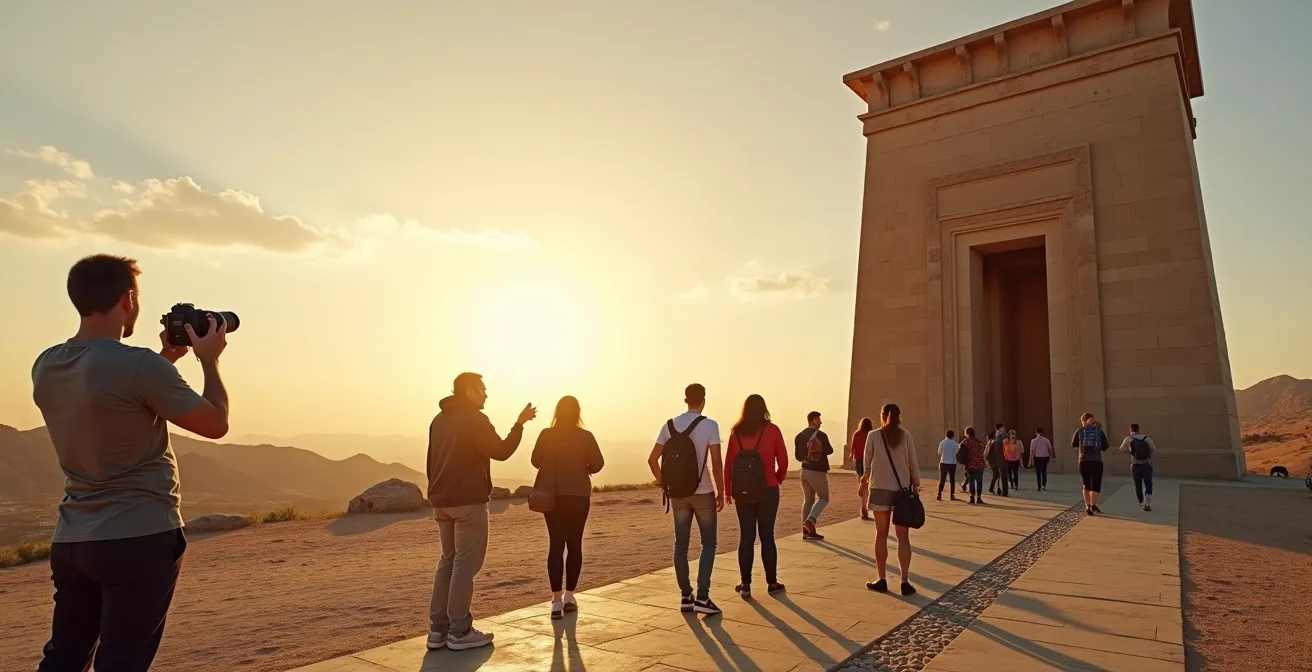
The common tourist dilemma is believing that heritage protection is simply about following rules like “do not touch.” This article reframes that perspective. The key is not passive avoidance but active stewardship, which comes from understanding the hidden science of degradation—from the chemistry of a single touch to the physics of a footstep. By grasping these principles, a traveler transitions from a potential risk into a conscious, effective guardian of our shared history.
Visiting a place where history breathes from the very stones is a profound experience. You stand before a millennia-old statue, a medieval castle wall, or an ancient mosaic, and the impulse is to connect—often, through touch. We are told “do not touch,” “stay on the path,” and “take only memories.” These rules are the baseline of responsible tourism, yet they often feel like sterile prohibitions, positioning the traveler as a potential threat to be managed rather than an ally in preservation.
This approach misses a crucial opportunity. The most common advice focuses on what to avoid, but rarely explains the intricate ‘why’ behind the rules. What if the key to protecting these irreplaceable sites was not just about following a list of restrictions, but about actively understanding the forces at play? What if you, the traveler, could become an informed and effective steward, armed with knowledge that transforms your visit from a passive tour into a deliberate act of conservation?
This guide moves beyond the platitudes. We will explore the scientific mechanisms of decay, the logistical realities of site management, and the crucial difference between consuming culture and safeguarding it. By understanding the real impact of your presence—from the oils on your skin to the pressure of your shoes—you will learn how to participate actively and intelligently in the great mission of passing our collective heritage on to future generations.
To navigate this crucial topic, this article breaks down the core principles of active traveler stewardship. We will delve into the science of preservation, the practical steps for intervention, and the profound challenge of protecting not just buildings, but the living cultures they represent.
Summary: A UNESCO Guide: How Travelers Can Actively Protect Monuments During Visits
- Why touching ancient statues transfers oils that degrade the stone?
- App vs. Guard: What is the fastest way to report damage at a heritage site?
- How to join a “working holiday” to restore castle walls legally?
- The illegal act of taking “just one rock” that destroys archaeological context
- When to visit fragile sites to reduce humidity and CO2 impact?
- Why your sneakers are more dangerous to mosaics than weather erosion?
- The line between keeping a dance alive and turning it into a tourist show
- Why Preserving Intangible Cultural Heritage Is Harder Than Saving Buildings?
Why touching ancient statues transfers oils that degrade the stone?
The simple sign “Do Not Touch” is the most common and perhaps most ignored rule at heritage sites. To understand its vital importance, we must look at the micro-level chemistry. Human skin constantly produces sebaceous oils, sweat, and acids. When a hand touches a porous surface like marble, limestone, or sandstone, these substances are immediately transferred. It’s not just a surface-level smudge; it’s an invasion.
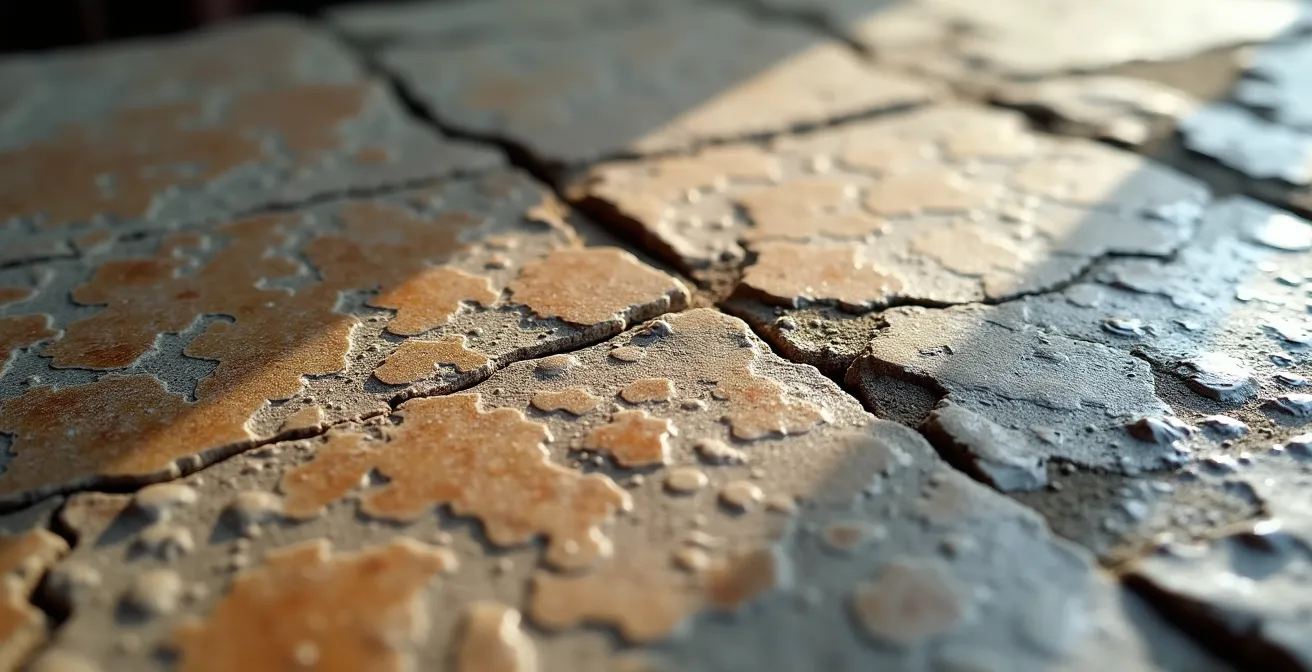
Over time, these organic compounds penetrate deep into the stone’s capillaries. They attract dust and pollutants from the air, creating a dark, stubborn stain that is nearly impossible to remove without damaging the original material. As conservation experts warn, this repeated handling of stone sculptures leads to permanent staining, fundamentally altering the artwork’s appearance. The damage is cumulative; the touch of a single person is negligible, but the touch of millions over decades is a potent corrosive force, slowly erasing the very details that make these artifacts precious.
This process is a form of micro-erosion driven by biochemistry. Unlike erosion from wind or rain, which wears a surface down relatively uniformly, the damage from human touch is concentrated in the most accessible and often most significant parts of a sculpture—a face, a hand, a delicate fold of drapery. This targeted degradation is what makes the simple act of touching so uniquely destructive, transforming a gesture of connection into an unintentional act of vandalism.
App vs. Guard: What is the fastest way to report damage at a heritage site?
Witnessing damage at a heritage site—whether from vandalism, accident, or neglect—can leave a responsible traveler feeling helpless. The traditional response is to find a security guard. While this is a crucial immediate step, it is not always the most effective way to ensure the damage is officially documented and addressed by conservation experts. In the digital age, the fastest and most comprehensive reporting method often involves a combination of on-site notification and digital documentation.
The modern traveler can act as a first responder for heritage. Specialized mobile applications have been developed to streamline this process. Tools like the AMAL in Heritage toolkit allow anyone to create a detailed, geolocated report in minutes. This digital record, complete with photos and precise coordinates, provides conservation bodies like the World Monuments Fund or UNESCO with the actionable data they need for assessment and intervention. It transforms a vague verbal report into a structured, scientific incident file.
Therefore, the optimal strategy is a two-pronged approach. First, alert an on-site guard or staff member for immediate site security. They are the frontline defense and can prevent further harm. Second, while the incident is fresh, create a digital report using a heritage app or by contacting the relevant national or international heritage authority directly. This ensures the incident enters the official conservation workflow. The guard handles the immediate present; your digital report secures the site’s future care.
How to join a “working holiday” to restore castle walls legally?
For the traveler who wants to move from passive protection to active restoration, “voluntourism” presents a compelling opportunity. The idea of spending a holiday reinforcing ancient castle walls or carefully cleaning artifacts is deeply rewarding. However, this field is fraught with pitfalls, from well-intentioned but poorly managed projects to outright scams that can cause more harm than good. The key is to engage only with legitimate, professionally supervised programs.
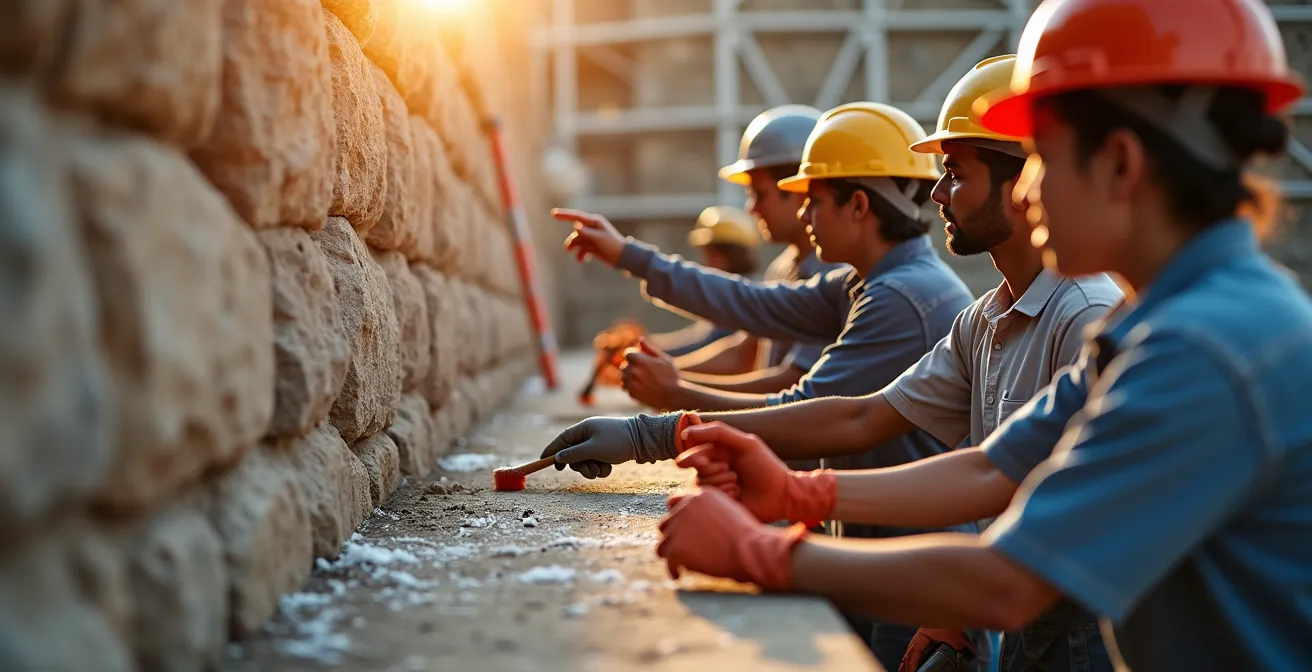
The gold standard for these opportunities is initiatives run by globally recognized heritage organizations. A prime example is the World Heritage Volunteers Initiative, operated by UNESCO. These programs are not casual sightseeing with a bit of light work. They are structured projects where volunteers work under the direct supervision of professional archaeologists, conservators, and engineers. Participants receive proper training on handling historical materials and using appropriate techniques, ensuring their contribution is genuinely constructive.
Before joining any project, rigorous vetting is essential. A legitimate program will always be affiliated with a recognized body (like UNESCO, ICOMOS, or a national trust), have professional staff on-site, provide clear training and safety protocols, and be transparent about its goals and funding. Anything less risks turning your desire to help into an instrument of destruction. A true working holiday is about skilled, supervised labor that respects the science of conservation, not just enthusiastic amateur effort.
The illegal act of taking “just one rock” that destroys archaeological context
The urge to take a small souvenir—a pebble from the Roman Forum, a shard of pottery from an ancient trail—seems harmless. It feels like a personal, tangible connection to the past. In reality, this act is a form of theft that has two devastating consequences: cumulative physical loss and the irreversible destruction of scientific knowledge. It is not a harmless memento; it is a crime against history.
First, consider the cumulative impact. While one small rock seems insignificant, millions of visitors frequent major heritage sites annually. If even a fraction of them take a “harmless” souvenir, the monument is subjected to a staggering loss of mass. This isn’t a theoretical problem; it’s a measurable threat that accelerates the decay of sites from Pompeii to the Great Wall of China. Each pocketed stone is one of millions of small wounds that, together, constitute a massive hemorrhage of the site’s physical integrity.
Second, and arguably more catastrophic, is the destruction of archaeological context. An artifact’s location, its position relative to other objects, and the soil layer it was found in are what give it meaning. A simple pottery shard tells a story about trade routes, daily life, and historical timelines—but only when its context is known. Plucking that shard from its location and putting it on a mantelpiece is like tearing a word out of an ancient manuscript. The word may be interesting, but its contribution to the larger sentence is lost forever. You haven’t just taken a rock; you’ve erased a piece of data that can never be recovered.
The legal consequences reflect this severity. Authorities are increasingly cracking down on this behavior, with punishments ranging from steep fines to imprisonment. As one memorable case illustrates, after a tourist chipped an ear off a famous Moai statue, Easter Island’s mayor called for a severe penalty, and the visitor ultimately faced a $17,000 fine. This is the clear message from the global heritage community: our shared history is not a souvenir shop.
When to visit fragile sites to reduce humidity and CO2 impact?
Beyond direct physical contact, a traveler’s very presence alters the environment of a heritage site. In enclosed or fragile spaces like ancient tombs, caves with prehistoric paintings, or historic house interiors, the simple act of breathing has a significant impact. Each visitor exhales carbon dioxide, water vapor, and heat, and introduces microscopic particles from their clothes and skin. When multiplied by thousands of daily visitors, this creates a microclimate that can be incredibly destructive to delicate materials like frescoes, manuscripts, and organic artifacts.
High humidity from collective breath can promote mold growth and accelerate salt crystallization on wall paintings, causing the paint to flake off. Increased CO2 levels can react with surfaces, while body heat alters the stable temperatures required for preservation. This is why sites like Machu Picchu have had to manage visitor flow; although UNESCO recommends a capacity of no more than 2,500 visitors per day, summer visitation is often double that number, forcing authorities to restrict access to preserve the site. Your timing, therefore, becomes a powerful conservation tool. Visiting during off-peak hours (early morning) or the shoulder season (spring and fall) contributes to a more stable environment. Fewer people mean less cumulative humidity, CO2, and heat, reducing the stress on the monument.
The table below provides a general framework for choosing the best times to visit different types of sites to minimize your environmental footprint.
| Site Type | Best Time | Avoid | Environmental Reason |
|---|---|---|---|
| Enclosed Tombs/Caves | Early morning weekdays | Peak summer afternoons | Lower cumulative humidity from breath |
| Coastal Monuments | Dry season mornings | Humid evenings | Reduced salt crystallization risk |
| Mountain Sites | Late spring/early fall | Winter freeze-thaw cycles | Stable temperature prevents cracking |
| Desert Ruins | After rare rainfall | Sandstorm seasons | Natural cleaning without erosion |
Why your sneakers are more dangerous to mosaics than weather erosion?
It seems counterintuitive. How can the soft sole of a running shoe be more damaging than centuries of rain, wind, and ice? The answer lies in the physics of pressure. Natural forces like rain are broadly distributed over a wide surface area, exerting a low, relatively uniform pressure. A human footstep, however, concentrates the entire body’s weight onto a few square inches. The hard rubber edges of a modern sneaker focus this force into an incredibly high-pressure event.
Conservation science demonstrates that this concentrated, repetitive stress is uniquely destructive to delicate surfaces like ancient Roman mosaics or painted floors. Each step acts like a tiny hammer blow, creating micro-fractures in the tesserae (the small tiles of the mosaic) and the mortar that holds them. Over time, these fractures grow, causing tiles to loosen, crack, and eventually become dislodged. Furthermore, the abrasive particles of grit and sand embedded in shoe soles act like sandpaper, scratching and dulling polished surfaces with every pivot and shuffle. Weather erodes; footsteps pulverize.
This is why heritage sites increasingly implement strict footwear policies. Designated walkways, viewing platforms, and mandatory soft-soled shoe covers are not arbitrary rules. They are critical engineering solutions designed to diffuse the destructive pressure of foot traffic. By respecting these guidelines—or better yet, by choosing soft, flat-soled shoes for your visit—you are directly mitigating a primary source of mechanical degradation. You are choosing to tread lightly on history, recognizing that your every step carries weight.
Action Plan: Your Personal Heritage Footprint Audit
- Gear & Apparel Audit: Before your next visit, examine your gear. Are your shoes soft-soled to minimize pressure on ancient floors? Are your bags free of sharp buckles that could snag or scratch a wall?
- Proximity & Path Review: After a visit, reflect on your movement. Did you consistently maintain a respectful distance from artifacts? Did you stay strictly on marked paths, even when it meant a less-than-perfect photo?
- Consumption & Waste Analysis: Inventory every single-use item you brought to the site (water bottles, snack wrappers). Account for each one and confirm it was packed out with you, leaving absolutely no trace.
- Digital Conduct Check: Review the photos and videos from your trip. Did you use a flash in a prohibited area, which can fade pigments? Did you step off a path or lean on a ruin for a selfie, prioritizing the shot over the site’s integrity?
- Action Plan for Next Visit: Based on this audit, identify one specific, concrete behavior to improve. Examples: “I will bring a reusable water bottle” or “I will choose loafers instead of hiking boots for indoor sites.”
The line between keeping a dance alive and turning it into a tourist show
Protecting heritage is not limited to static objects; it extends to the vibrant, living traditions of communities, known as Intangible Cultural Heritage. This includes oral traditions, performing arts, social practices, rituals, and craftsmanship. For the traveler, engaging with this living heritage—watching a traditional dance, attending a local festival—can be the most meaningful part of a journey. However, it also presents a delicate ethical challenge.
The danger is “fossilization” or “commodification,” where a living cultural practice is altered to cater to tourist expectations. A sacred, hours-long ritual might be shortened into a 15-minute dinner show. A dance that tells a complex community story might be simplified, its meaning lost in favor of colorful spectacle. When this happens, the tradition is no longer a living expression of a community’s identity; it becomes a product for consumption. The very tourism that was meant to appreciate it ends up distorting and ultimately eroding it.
The key to authentic engagement is to seek out experiences where the community is in control and is the primary beneficiary, not a third-party tour operator. An authentic performance is often tied to a local calendar or event, not staged on demand every night. The most responsible way a traveler can participate is by being a respectful observer, contributing to an economy that empowers the artists to maintain their traditions on their own terms. As Sisa Ntshona, former CEO of South African Tourism, wisely stated, “When people are excluded, they destroy. When they are included, they protect.” Supporting community-led cultural tourism ensures that your presence helps a tradition thrive rather than turning it into a hollow performance.
Key Takeaways
- Active Stewardship: True heritage protection is not passive rule-following but active, informed participation based on understanding the science of decay.
- Cumulative Impact: Seemingly harmless individual actions (touching, taking a pebble, a single footstep) combine to cause massive, irreversible damage to heritage sites.
- Intangible vs. Tangible: Preserving living culture (dances, rituals) is a delicate ethical challenge that requires supporting community-led initiatives, not just consuming tourist-oriented shows.
Why Preserving Intangible Cultural Heritage Is Harder Than Saving Buildings?
Saving a crumbling building is a monumental task, requiring expertise, funding, and labor. Yet, preserving a language, a ritual, or a traditional craft can be an even more complex and fragile endeavor. Tangible heritage—buildings, statues, artifacts—is made of matter. While it decays, it does so over long periods, often centuries or millennia. Intangible heritage is made of memory, practice, and human transmission. Its vessel is not stone, but people.
As UNESCO research confirms, a tradition can vanish in a single generation. If the elders of a community pass away without teaching the younger generation a specific weaving technique, a unique dialect, or the songs of a ceremony, that piece of human heritage is lost forever. It cannot be excavated by archaeologists or restored by engineers. This makes its preservation uniquely challenging; it depends not on chemistry and materials science, but on social continuity, cultural pride, and economic viability.
This is why the global approach to heritage has evolved. The landmark 1972 UNESCO World Heritage Convention uniquely links the preservation of cultural sites with nature conservation, and subsequent efforts have intensely focused on safeguarding intangible heritage. This holistic strategy recognizes that a site is more than its physical structure; it is embedded in a community and an ecosystem. Effective preservation, therefore, must involve and empower local communities. It must address modern pressures like rapid urbanization and mass tourism by ensuring that communities have the incentive and the means to keep their traditions alive. A building can be saved from ruin, but a culture can only save itself. The traveler’s role is to support the economies and respect the social structures that make this cultural survival possible.
By shifting your mindset from a passive tourist to an active steward, your travels become a force for good. The next logical step is to consciously apply these principles to your next journey, turning understanding into meaningful action and ensuring our world’s wonders endure for all.
Frequently Asked Questions on How Travelers Can Actively Participate in Protecting Monuments During Visits?
How can I tell if a cultural performance is authentic or staged for tourists?
Look for performances tied to local calendars and community events, not just scheduled for tourist convenience. A key indicator of authenticity is when the performers themselves are the primary financial beneficiaries, rather than a large, external tour company. When tourists visit a place specifically to experience the culture respectfully, it strengthens community allyship and encourages genuine expression.
Should tourists participate in traditional ceremonies?
Participation should only ever occur when you are explicitly and personally invited by a member of the community. Authentic participation should feel like being welcomed into a shared moment of cultural significance, not like consuming a product that has been delivered for your entertainment. If there is an entry fee or it is widely advertised to the general public, it is a performance, not a ceremony you should join.