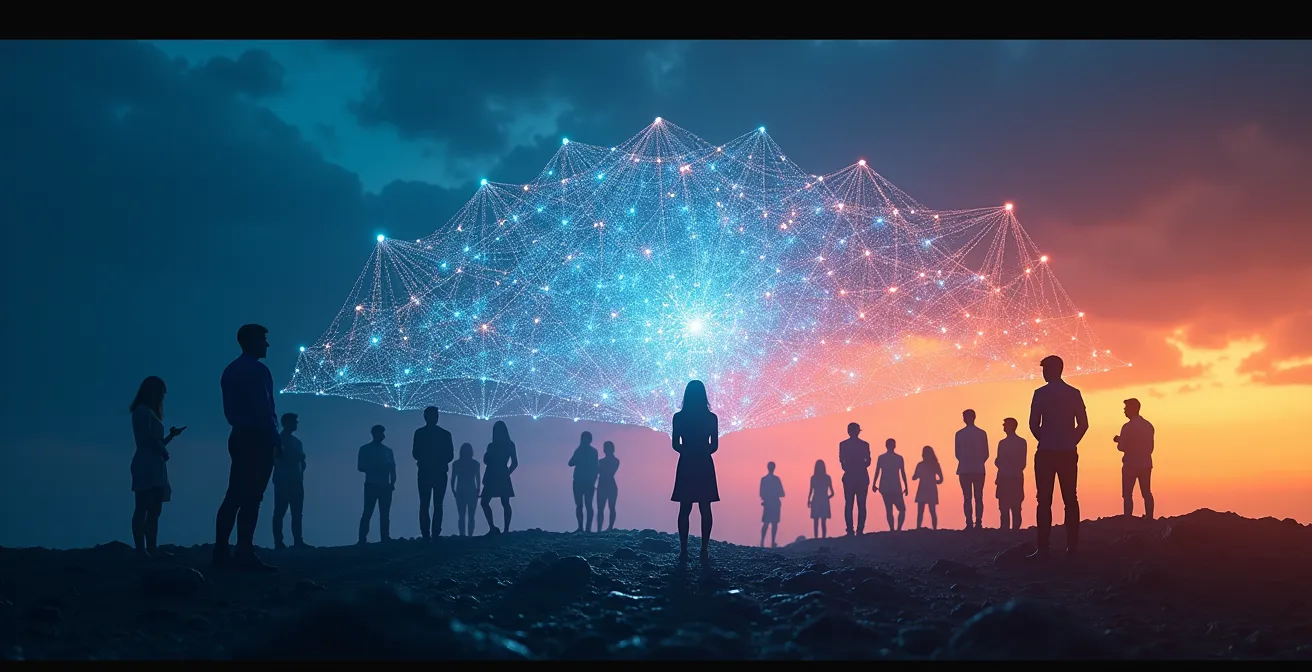
Contrary to popular belief, the profound support found in online communities isn’t a lesser version of real friendship; it’s the result of superior “support architecture” built into the platforms themselves.
- Anonymity and merit-based systems (like upvotes) filter for expertise over social obligation, providing higher-quality advice.
- Searchable archives and asynchronous communication allow for deeper, more thoughtful engagement than fleeting real-time conversations.
Recommendation: Instead of viewing online connections as a substitute for real life, learn to leverage their unique structural strengths for specialized support while consciously managing their risks.
Have you ever tried to explain a passion, a problem, or a peculiar obsession to a close friend, only to be met with a well-meaning but vacant stare? You’re surrounded by people who love you, yet on this one specific topic that defines a part of you, you feel utterly alone. This is a common paradox of modern social life. The standard advice—join a local club, call your family—often falls short when your interests are incredibly niche or your struggles are deeply specific. We’re told that physical presence is the gold standard for connection, but for many, it fails to provide the specialized understanding they crave.
This gap is where digital tribes and niche online communities have quietly risen, not just as a pastime, but as a primary source of validation and support. The initial assumption is that these connections are superficial, a pale imitation of “real” friendship. But what if this assumption is fundamentally wrong? What if the very design of these online spaces—their anonymity, their rules, their systems for ranking information—creates a more effective and efficient support system than the messy, emotionally complex dynamics of our existing relationships?
This article explores this provocative idea. We will dissect the “support architecture” of different platforms, moving beyond the simple fact that they connect like-minded people. We’ll examine the structural elements that make online support feel so powerful. We will analyze how to identify genuine mentors in anonymous spaces, navigate the transition from online to offline friendship, and recognize the psychological traps like groupthink. Ultimately, we’ll reveal how these digital connections are not just replacing the dwindling “third places” like the local pub, but are evolving into powerful engines for meaningful civic engagement.
To help you navigate these complex digital landscapes, this guide breaks down the key dynamics of online communities, from choosing the right platform to leveraging your digital tribe for real-world impact. Explore the sections below to understand the architecture of modern belonging.
Summary: Why Niche Online Communities Feel More Supportive Than Real-Life Friends
- Reddit vs. Facebook Groups: Where to find high-quality discussion for your niche?
- How to spot a supportive mentor in an anonymous forum?
- How to safely meet an “internet friend” in real life for the first time?
- The groupthink trap that happens when you only talk to people who agree with you
- When to log off the community to prevent it from replacing your real life?
- The disappearance of the local pub and its cost to community cohesion
- How to make an impact with just 2 hours of skills-based volunteering per month?
- How to Balance a Full-Time Job with Meaningful Engagement in Civic Society?
Reddit vs. Facebook Groups: Where to find high-quality discussion for your niche?
The search for a digital tribe often begins with a choice between two giants: Reddit and Facebook Groups. While both host communities, their underlying “support architecture” creates vastly different experiences. The key difference isn’t the people, but the platform’s design. Facebook is built around your real-life identity, prioritizing personal stories and emotional reactions. Its algorithm favors content that generates engagement, not necessarily quality. Reddit, with its foundation of anonymity and pseudonyms, operates on a meritocracy of ideas. The upvote and karma systems are designed to elevate expertise and valuable contributions, not just popular sentiment. For niche topics requiring deep knowledge, this structure is inherently superior.
With over 430 million monthly active users across 130,000 communities, Reddit’s scale offers unparalleled specificity. Whether your interest is in antique fountain pens, a rare genetic condition, or a specific coding language, a “subreddit” for it likely exists. This structure allows conversations to become highly specialized, complete with their own jargon and in-jokes—a sign of a thriving, focused culture. In contrast, Facebook’s one-size-fits-all environment and ephemeral feed make deep, searchable knowledge archives nearly impossible. It’s no wonder that a staggering 88% of creators using Facebook Groups report wanting to switch platforms, citing algorithmic frustrations and a lack of specialized features. They sense the architectural flaw: the platform is designed for social connection, not for building a library of expertise.
The following table breaks down the fundamental architectural differences that determine which platform is right for your needs. For those seeking high-signal, low-noise discussion, the choice becomes clear.
| Feature | Facebook Groups | |
|---|---|---|
| Identity | Anonymous/Pseudonymous | Real names required |
| Content Ranking | Upvote/Karma system rewards expertise | Algorithm-based, reactions reward emotional resonance |
| Content Durability | Searchable, permanent threads | Ephemeral feed, poor archiving |
| Community Culture | Specialized jargon, inside jokes | Personal storytelling, universal language |
| User Control | User-built with minimal top-down control | Platform-controlled with strict policies |
How to spot a supportive mentor in an anonymous forum?
In the anonymous theater of a Reddit forum, titles and real-world credentials vanish. This is a feature, not a bug. It forces us to evaluate individuals based on the quality of their contributions alone. A true mentor isn’t the person with the loudest voice or the most frequent posts, but the one who demonstrates consistent value and a specific set of behaviors. The first and most crucial trait is epistemic humility—they are quick to admit what they don’t know and avoid making absolute, declarative statements. They understand that expertise is a process, not a destination.
A genuine guide acts as a “Guide on the Side,” not a “Sage on the Stage.” Observe their communication patterns. Do they ask clarifying questions before offering advice? A good mentor seeks to understand the nuances of your situation before prescribing a solution. Their goal is to facilitate your own discovery, not to broadcast their knowledge. Analyze their signal-to-noise ratio: are their posts consistently thoughtful and high-quality, or do they contribute a high volume of low-value comments? Finally, check their history in disagreements. A supportive mentor practices de-escalation and constructive debate, showing respect for differing opinions rather than trying to “win” an argument. They model the healthy communication they wish to see in the community.

This image of a guiding hand represents the ideal mentor’s role: they point the way through complexity without taking control, empowering you to navigate your own path. This subtle guidance, built on demonstrated wisdom and respect, is the hallmark of a valuable mentor in any anonymous space. By learning to recognize these patterns, you can find profound mentorship from people you may never know by their real name.
How to safely meet an “internet friend” in real life for the first time?
The transition from a digital tribe to a real-life friendship is a significant step, one that carries both immense potential and inherent risk. The bond you’ve formed is real, but it was built within a specific, text-based context. The challenge is to manage the gap between your digital perception and physical reality. As the poet T.S. Eliot once asked, in a completely different context that resonates deeply today:
What life have you if you have not life together?
– T.S. Eliot, Choruses from ‘The Rock’ (1934)
To bridge this gap safely, a strategy of graduated exposure is essential. This psychological approach involves slowly increasing the level of personal exposure to test the chemistry and ensure mutual comfort. Don’t jump from DMs to a three-hour dinner. Start by moving from text-only chat to voice notes, which adds the crucial element of vocal tone. If that feels comfortable, schedule a short, 15-minute voice or video call. A video call is a key step, as it introduces visual cues and body language, helping to close the “expectation vs. reality gap” before you meet.
Before any physical meeting, establish a “Social Safety Contract.” This isn’t a formal document, but an explicit conversation about expectations. Agree on a public, neutral location, a clear time boundary (e.g., “just coffee for an hour”), and comfortable exit strategies. Saying “I have another appointment at 3 PM” upfront gives both parties an easy, no-fault way to end the meeting if it feels awkward. Be prepared for their physical presence—their voice, height, and mannerisms—to be different from the image you constructed in your mind. This is normal. The goal of the first meeting isn’t to perfectly replicate your online dynamic; it’s to see if a new, in-person dynamic has the potential to grow.
The groupthink trap that happens when you only talk to people who agree with you
The greatest strength of niche communities—connecting you with like-minded people—is also their greatest danger. When a supportive “safe space” calcifies into a rigid “echo chamber,” it begins to distort reality. This is the groupthink trap. It happens when dissenting opinions are no longer debated but are silenced, and the shared beliefs of the group are reinforced until they feel like objective truth. The very architecture of platforms like Reddit, with its isolated subreddits, can unintentionally foster these epistemic bubbles. While they offer deep support, research on Reddit community dynamics shows that the subreddit system can create isolated communities that often turn into echo chambers, where the group’s perspective is the only one heard.
Escaping this trap requires a conscious effort to maintain a healthy “intellectual diet.” This means actively and intentionally scheduling weekly exposure to well-reasoned opposing viewpoints from credible sources. It’s not about arguing on the internet; it’s about understanding the strongest arguments of the other side. A practical step is to join at least one community with a diverse range of perspectives on your topic of interest, even if it feels less comfortable. Within your primary community, you can even playfully designate a “Devil’s Advocate” role to encourage constructive dissent on important topics, ensuring that ideas are pressure-tested.

The key is to perform regular “bubble checks.” Are dissenting voices welcomed or shouted down? Notice your own dopamine response: does constant agreement feel addictive, while any form of disagreement causes disproportionate stress? These are warning signs. You must learn to distinguish a supportive safe space, where you can be vulnerable without judgment, from a toxic echo chamber, where your perception of reality is warped by a lack of alternative views. The goal is support, not delusion.
When to log off the community to prevent it from replacing your real life?
Niche communities offer powerful, specialized support, but there’s a tipping point where they can shift from a healthy supplement to a detrimental replacement for real-life connection. The internet is vast, and recent data on online community engagement reveals that 76% of internet users participate in them, with many visiting more frequently than in the past. This deep engagement is a double-edged sword. Recognizing when to log off requires self-awareness and a conscious audit of your digital habits. The line is crossed when you consistently choose the comfort of the online community over available, albeit more complex, real-life social opportunities.
A key indicator is a declining “Emotional ROI” (Return on Investment). Are you investing a huge amount of emotional energy into the community—perhaps as the go-to expert or mediator—without receiving proportional support back? This leads to support burnout. Another red flag is social skill atrophy, where you become so accustomed to the curated, asynchronous nature of online chat that you lose patience for the nuances, interruptions, and awkward silences of real-life conversation. The ultimate question is one of replacement. Is the community filling a void, or is it creating one by pulling you away from the people physically around you?
To maintain a healthy balance, you need to conduct regular, honest self-audits. This checklist provides a framework for evaluating whether your engagement is enhancing your life or replacing it.
Your digital wellness audit: 5 steps to balance online and real life
- Map your touchpoints: List the 2-3 online communities where you spend the most time and energy. This is your digital social map.
- Conduct a replacement test: For one week, track each time you choose the online community over an available real-life connection (e.g., scrolling the forum instead of calling a friend back).
- Assess your emotional ROI: At the end of the week, honestly compare the emotional energy you invested online versus the tangible support you received. Is the exchange rate favorable?
- Check for skill atrophy: Notice your feelings during real-life conversations. Are you more impatient or less tolerant of differing opinions than you used to be? This is a key warning sign.
- Create an integration plan: Based on your audit, set concrete boundaries. Use app timers to enforce daily limits and designate specific “offline-only” hours (e.g., during meals, the first hour of the day) to reclaim your physical world.
The disappearance of the local pub and its cost to community cohesion
For generations, community cohesion was forged in “third places”—physical locations separate from the two primary environments of home (the first place) and work (the second). The local pub, the coffee shop, the town square, the barbershop; these were the informal hubs where people from different walks of life could interact, build weak ties, and foster a sense of shared identity. As these physical third places decline due to economic pressures and changing social habits, a void has been created. This isn’t just a loss of social venues; it’s a loss of the very infrastructure of casual, local community.
Into this void have stepped digital tribes. Niche online communities are, in many ways, the digital third places of the 21st century. They offer a space for regular, informal social interaction outside of the pressures of work and family life. A study on this very topic notes that online communities aren’t inherently “better” or “worse” than their physical counterparts. Rather, the internet has simply provided accessibility for those who struggled to find their tribe locally. The core human need for a third place hasn’t changed, only the form it takes. The internet didn’t invent community; it just removed the barrier of geography.
As research from Quiip highlights, “Communities continue to be as broad or as narrow as we want them to be. It is the ways we participate in them that have changed.” These digital spaces successfully replicate the key functions of a traditional third place: they have regulars, a low barrier to entry, a playful mood, and conversation as the main activity. For someone with a niche interest, the global digital pub is far more welcoming than a local sports bar where they have nothing in common with the other patrons. While we may mourn the loss of the physical pub, we must also recognize that its spirit is being reborn and, in some ways, improved upon in these new digital gathering halls.
How to make an impact with just 2 hours of skills-based volunteering per month?
One of the most profound shifts in online communities is their evolution from passive support networks to active platforms for impact. The same architecture that provides validation can also be harnessed for skills-based “micro-volunteering.” This is a new model of contribution that breaks down large tasks into small, manageable actions that can be completed by community members from anywhere in the world. You don’t need to dedicate every weekend; you can make a tangible difference with just two hours a month by leveraging your professional skills.
This model thrives in online communities because they are pools of specialized talent. A forum for writers can organize to proofread grant applications for a small non-profit. A community of coders can host a “swarm problem-solving” session, dedicating a weekend to debugging a charity’s website. You can offer digital mentorship by dedicating 30 minutes each week to guiding a junior member in your field. This sense of collective purpose is incredibly powerful. Indeed, research on online community impact shows that 98% of online group members feel a sense of belonging, and a huge part of that belonging comes from shared action and mutual contribution.
The opportunities are vast. You can join global initiatives like Missing Maps (mapping vulnerable areas for humanitarian aid) or Zooniverse (classifying scientific data) from your couch. Within your own community, you can take the lead in documenting institutional knowledge, spending a couple of hours a month creating guides and FAQs for newcomers—a vital act of service. This isn’t just about feeling good; it’s a highly efficient way to apply high-value skills where they are needed most, unbound by geography or a rigid 9-to-5 schedule.
Key takeaways
- The perceived superiority of online support stems from its “support architecture” (anonymity, merit-based systems), not just shared interests.
- Safely transitioning from online to offline friendship requires a “graduated exposure” strategy, moving from text to voice to video before meeting.
- Healthy online engagement requires actively fighting groupthink by maintaining a diverse “intellectual diet” and performing regular “bubble checks.”
How to Balance a Full-Time Job with Meaningful Engagement in Civic Society?
The ultimate evolution of a digital tribe is its transformation from a space of personal support to a launchpad for real-world civic action. For busy professionals, balancing a demanding job with a desire for meaningful engagement often feels impossible. The traditional models of civic life—town hall meetings, evening volunteer shifts—are often incompatible with modern work schedules. Online communities offer a solution through the power of asynchronous participation. You can contribute to a meaningful discussion, help organize a charity drive, or share your professional expertise with a local NGO during your lunch break or late in the evening, long after physical offices have closed.
Research from Harvard’s T.H. Chan School of Public Health found that social media use can compensate for diminishing face-to-face interactions, providing a platform that overcomes barriers of distance and time. This is the key: these communities are not a distraction from civic life; they are a new, more flexible venue for it. An online gardening forum can organize a local seed swap. A group of car enthusiasts can use their organizational skills to launch a successful charity toy drive. The community becomes an incubator where ideas are shared, plans are made, and momentum is built digitally before being unleashed in the physical world.
The path is to transform your specialized expertise into civic action. If you’re an accountant, you can help a local arts group with their books. If you’re a graphic designer, you can create a flyer for a neighborhood cleanup. You start by leveraging your online skills to take on small leadership roles within the community, building confidence and connections. This creates a bridge, allowing a gradual transition from digital engagement to local, physical involvement. It’s a sustainable model for civic life that fits the reality of a full-time job, turning a digital hobby into a powerful force for community good.
By intentionally applying the skills honed in your digital tribe—communication, organization, and specialized knowledge—you can build a bridge to meaningful real-world impact. Start today by identifying one skill you have that your local community could benefit from, and find the digital space to put it into action.