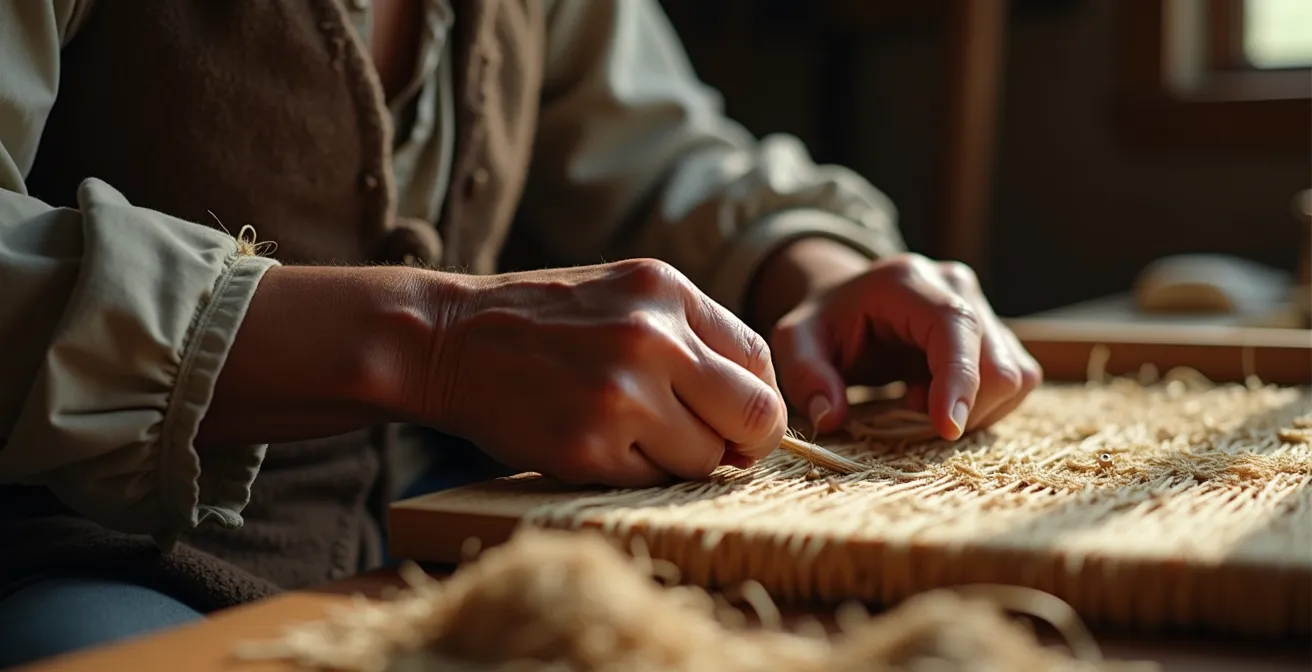
Contrary to popular belief, the greatest threat to our living traditions isn’t neglect, but our very methods of preservation—digital archives and tourism often perform a cultural autopsy, not life support.
- Static digital records, like videos or dictionaries, strip traditions of their context, turning living practices into dead data.
- Commercializing culture for tourism creates an “authenticity paradox” where performances become hollow shells, disconnected from community meaning.
Recommendation: Shift from being a digital archivist to a cultural gardener. The goal isn’t to perfectly store a dead specimen, but to cultivate the living, evolving conditions that allow tradition to breathe and adapt.
We see a crumbling monument and understand the urgency. We can measure the decay, erect scaffolding, and restore the stone. We treat preservation as a physical act of saving an object from the ravages of time. And so, when faced with the erosion of a language, a ritual dance, or a storytelling tradition, we instinctively apply the same logic. We rush to record, to digitize, to create an archive—a digital monument to what once was. We believe that by capturing it, we have saved it.
This is a profound and dangerous misunderstanding. Intangible cultural heritage is not an object; it is an action, a process, a relationship. It exists only in its performance, in its transmission from one person to another, within a specific, living context. The common solutions—cataloging traditions in databases, curating them for social media, or packaging them for tourist consumption—often fail to grasp this essential nature. They treat a living process like a static artifact.
But what if the very tools we use to “save” our heritage are the instruments of its demise? What if our obsession with creating perfect, permanent records is precisely what strips these traditions of their soul? The true challenge is not in building a better archive, but in learning to tend a living garden. It requires us to move beyond the mindset of an architect and adopt the perspective of a cultural anthropologist, focusing not on the artifact, but on the complex, evolving, and deeply human conditions that allow culture to thrive.
This article explores the friction between preservation and practice. We will deconstruct why digital archives can become digital graveyards, how the line between performance and parody is crossed, and what it truly means for a tradition to be alive. By understanding these paradoxes, we can learn to support, not suffocate, the world’s most precious and fragile cultural ecosystems.
Summary: Why Preserving the Soul of Culture Is a Living Act
- Audio vs. Video: Which format best captures the nuance of storytelling?
- How to make traditional basket weaving appeal to the TikTok generation?
- The line between keeping a dance alive and turning it into a tourist show
- The database error that creates incomplete dictionaries for future speakers
- When does a tradition officially become “extinct” if not recorded?
- Why silence in a Japanese meeting signifies thought, not disagreement?
- How to create a shared project glossary that prevents costly misunderstandings?
- How to Master Intercultural Dialogue When Moving to Japan for Work?
Audio vs. Video: Which format best captures the nuance of storytelling?
In the frantic race to preserve oral traditions, video seems like the perfect solution. It captures the storyteller’s gestures, expressions, and the physical setting. It feels complete. This belief has led to widespread preservation efforts; as cultural scholar Sheenagh Pietrobruno notes, a key method employed by heritage organizations is the storage of videos of immaterial heritage on YouTube. The logic is simple: a perfect visual record is the best defense against forgetting. But this approach mistakes the map for the territory, and in doing so, can perform a kind of cultural autopsy.
The problem is one of context collapse. A video flattens a multi-sensory, participatory event into a two-dimensional spectacle for a global, context-less audience. What it fails to capture is the feeling in the room, the shared understanding between storyteller and listener, and the subtle social cues that give the story its true weight. Audio, while seemingly less complete, can paradoxically be more powerful. It forces the listener to engage their imagination, to co-create the world of the story, making them an active participant rather than a passive observer. It preserves the intimacy of the spoken word.
Case Study: The Mevlevi Sema Ceremony on YouTube
The case of the Mevlevi Sema ceremony, or the whirling dervish ceremony of Turkey, is a stark example. When this deeply spiritual Sufi practice is filmed and uploaded to video platforms, its global transmission fundamentally reshapes its meaning. Algorithmic recommendations and viewer comments place it alongside entertainment content, stripping it of its sacred context. What was a form of active meditation becomes a mesmerizing performance, its spiritual purpose lost to the aesthetics of the spectacle. The video “preserves” the visuals but erases the soul.
Ultimately, neither format is a perfect vessel. The choice between them forces a critical question: are we trying to create a static, definitive record for future archivists, or are we trying to spark the imaginative engagement that keeps a storytelling tradition alive in the minds of a new generation? The answer determines whether our archives are libraries or mausoleums.
How to make traditional basket weaving appeal to the TikTok generation?
The question itself reveals a common anxiety: that ancient crafts are too slow, too quiet, and too irrelevant for a world of fleeting digital content. The instinctive response is to “market” the tradition—to package it in flashy, bite-sized videos that can compete for attention. While well-intentioned, this often focuses on the finished product, the beautiful basket, while ignoring the living process and the community knowledge embedded within it. The craft becomes another aesthetic trend, detached from its roots.
A more powerful approach is to reframe the goal. It’s not about “selling” basket weaving to a new generation, but about revealing its hidden layers of innovation, sustainability, and human connection. This means shifting the narrative from the past to the future. Instead of just showing the “how,” we must explain the “why.” Why this particular plant fiber? Why this specific weaving pattern? The answers often reveal a deep ecological wisdom and a complex cultural story that is far more engaging than a simple DIY tutorial. When presented this way, the craft transforms from a relic into a relevant, modern practice.
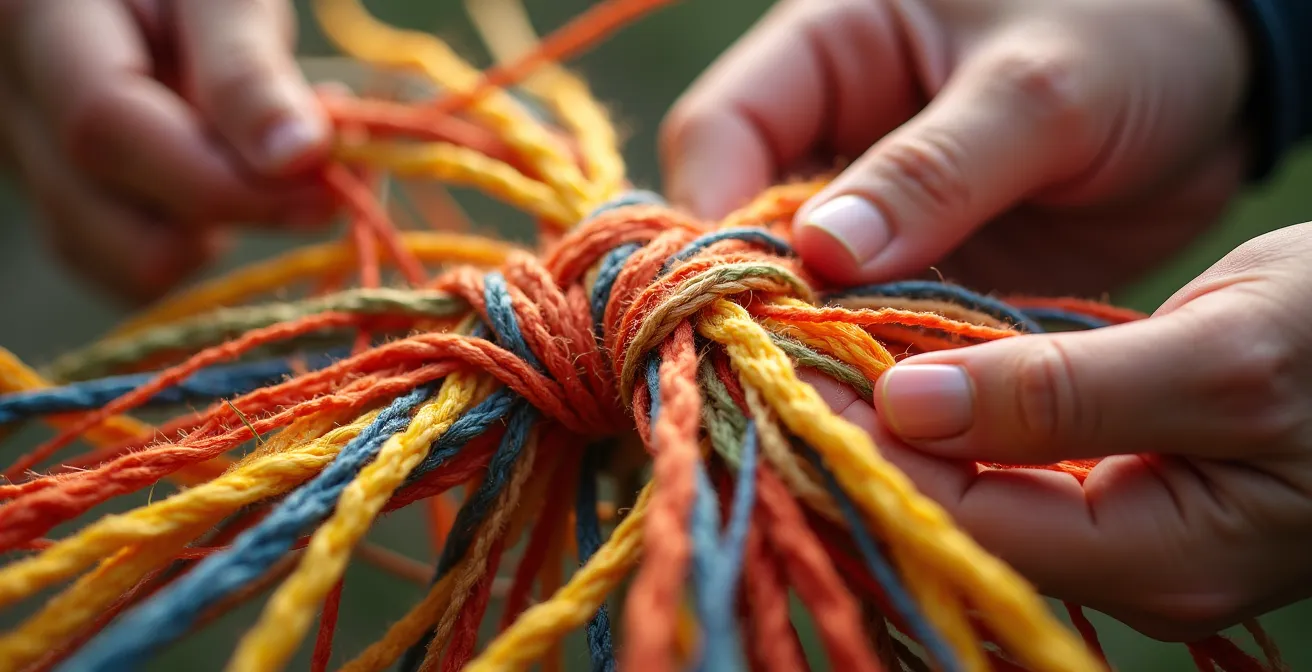
This image of traditional weaving techniques being applied to modern, recycled materials is a perfect metaphor. It shows that tradition is not a fragile, unchanging artifact. It is a living, adaptable body of knowledge. The true appeal for the TikTok generation may not be in replicating the past, but in being invited to co-create its future. The data supports this; research on short-video platforms shows that when intangible cultural heritage (ICH) is presented engagingly, over 50% of viewers actively share and forward ICH content. They don’t just consume; they participate in its transmission.
The key is authenticity. Instead of a polished influencer, feature a young apprentice learning from an elder. Show the mistakes, the shared laughter, the quiet moments of concentration. Frame it not as a lesson in history, but as an act of contemporary creativity and cultural resilience. This is how a tradition becomes more than just a hashtag; it becomes a living conversation.
The line between keeping a dance alive and turning it into a tourist show
This is perhaps the most painful paradox in cultural preservation. To secure funding, gain recognition, and share their art with the world, communities are often encouraged to perform for outsiders. Tourism can provide vital income and a platform for visibility. Yet, this very act of presentation can initiate a slow, insidious decay. The dance, once a sacred ritual or a vital form of community expression, is slowly tailored to meet the expectations of an audience that does not share its cultural context.
The performance is shortened. The most “spectacular” movements are exaggerated. Complex narratives are simplified into easily digestible explanations. The spiritual or social function is replaced by a commercial one. The community, once the primary stakeholder, becomes a cast of performers, and the elders, once the keepers of a sacred trust, become choreographers for a paying public. This is the authenticity paradox: the more a practice is polished for external validation, the less authentic it may feel to those who are meant to carry it forward. It is no longer theirs; it belongs to the tourist gaze.
Distinguishing between healthy adaptation and corrosive commercialization is incredibly difficult. It requires a deep and honest look at power dynamics, financial flows, and community agency. A dance that evolves organically to reflect new realities is alive. A dance that is frozen into a profitable, repeatable 15-minute show is a replica. The former is a testament to cultural resilience; the latter is a product. The tragedy is that from the outside, they can look almost identical.
Your Action Plan: Assessing Authenticity in Cultural Performance
- Control of Narrative: Identify who controls the choreography and the story told about the performance. Is it community elders or an outside tour operator?
- Financial Flow: Analyze who the primary financial beneficiaries are. Does the revenue flow back into the community to support the practice, or does it primarily enrich external agents?
- Protected Spaces: Verify the existence of protected, non-public spaces where the practice can be performed for its original sacred or social purpose, away from the public eye.
- Community Agency: Evaluate the level of community recognition and involvement in all decision-making regarding the performance. Do they have the power to say no?
- Evolution Monitoring: Monitor how the practice evolves. Is it responding to internal community needs and environmental changes, or is it adapting to audience feedback and market demands?
Without this rigorous self-examination, a community risks waking up one day to find that they have successfully “preserved” the body of their tradition, but have lost its heart in the process. The dance is still performed, but it no longer dances for them.
The database error that creates incomplete dictionaries for future speakers
In our digital age, the creation of databases and dictionaries for endangered languages seems like an unequivocal good. We gather words, record pronunciations, and build vast digital archives, believing we are constructing a lifeline for future generations. We assume that the technology is a neutral container for the language. However, this assumption is flawed. The very structure of a database imposes its own logic, a logic that can systematically erase the most nuanced and untranslatable aspects of a culture.
The problem is one of semantic friction. A database requires discrete, classifiable data points. But language is not a collection of neat data points. It is a web of context, history, and feeling. Concepts that are fluid, poetic, or deeply rooted in a specific worldview are often lost in translation or, worse, omitted entirely because they don’t fit into a predefined field in the database schema. The result is a dictionary that is technically accurate but culturally sterile. It contains the words, but not the world they describe.
This is not a hypothetical risk. The “metadata crisis” is a known issue in digital archiving. A case study on digital folklore collections found that without rich, searchable context, recordings become meaningless data for future generations. The database structure itself can impose linguistic biases that render the content useless. Furthermore, the logistical challenges are immense. A survey of Chinese ICH Protection Centers found that while rich in digital resources, their storage was often disordered and inconsistent. The digital library becomes a digital junkyard, full of treasures that can never be found.
A truly useful archive must be designed not as a static repository, but as a living document. It should capture not just the word, but the “why” behind it: the stories, the rejected alternative terms, and the historical context of its use. Without this rich metadata, we are not building a resource for future speakers; we are creating a collection of beautifully organized, meaningless data—the ghost of a language without its spirit.
When does a tradition officially become “extinct” if not recorded?
The question is rooted in a fundamental misunderstanding of what makes a tradition “alive.” We tend to think in terms of artifacts. A species is extinct when the last individual dies. A building is lost when it collapses into rubble. So, we reason, a tradition must be extinct when the last person who practiced it is gone, or when the last recording of it is lost. This archival mindset places the moment of extinction at the point of informational loss.
But intangible heritage operates on a different principle. Its lifeblood is not information, but recognition and relevance. As UNESCO’s foundational principle states, intangible cultural heritage can only be heritage when it is recognized as such by the communities, groups or individuals that create, maintain and transmit it. The point of extinction, therefore, is not when the last recording is corrupted. A tradition dies the moment its own community no longer sees it as a meaningful part of their identity. It can be perfectly documented in a thousand videos and books, but if it is not practiced, felt, and passed on, it is a fossil.
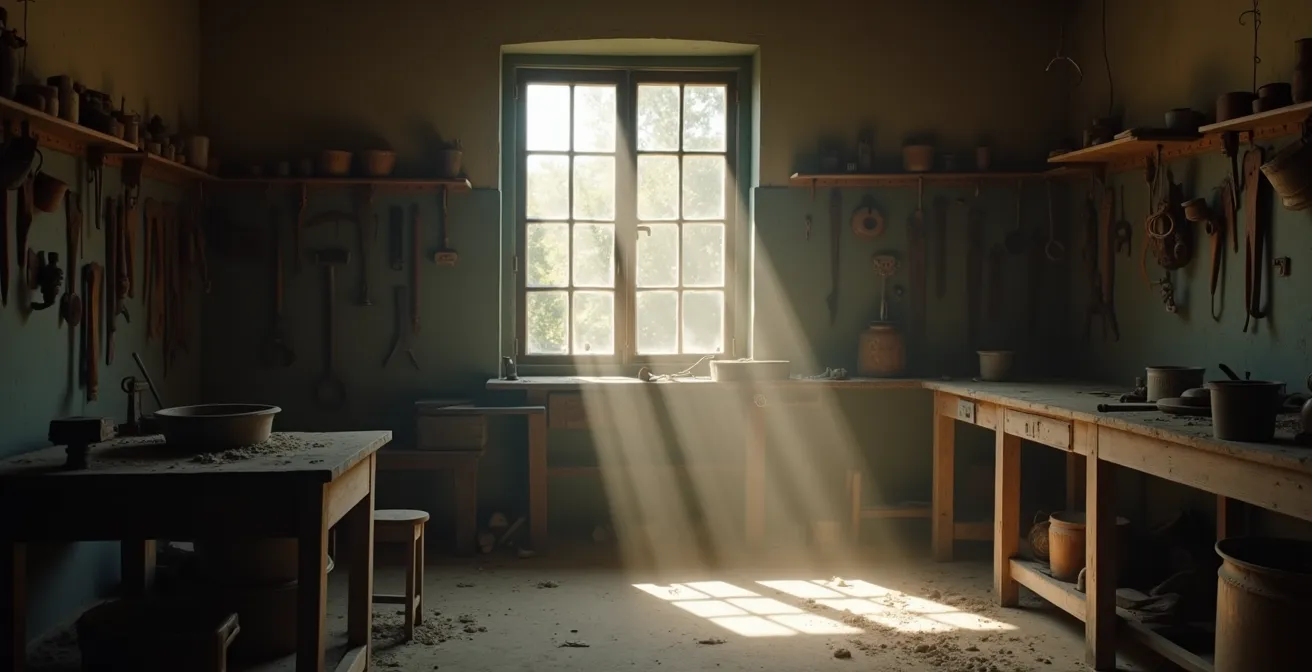
Conversely, a tradition can exist with no formal record at all. It can live in the hands of a few practitioners, in the memory of an elder, or in the stories told to a child. This is not to diminish the urgency of preservation—the UNESCO Intangible Cultural Heritage Lists currently include 676 ICH elements across 140 countries officially recognized as needing urgent protection. The threat is real. However, our focus must be on the community, not the archive. The image of an abandoned workshop is a powerful symbol. The tools are there, the knowledge is dormant, not necessarily extinct. The potential for revival exists as long as the spark of community recognition can be reignited.
A tradition is not “extinct” if not recorded. It is dormant. It is officially extinct when it is no longer relevant to a single living person. This shifts our entire preservation strategy. The goal is not to create a comprehensive encyclopedia of the past, but to ensure that traditions have a future by fostering the communities that are their sole, true guardians.
Why silence in a Japanese meeting signifies thought, not disagreement?
In many Western business cultures, silence is a vacuum. It represents a break in communication, an awkward pause that someone must rush to fill. It is often interpreted as disagreement, disengagement, or a lack of preparation. When an international team collaborates, this interpretation is automatically applied to all participants. Yet, in a Japanese context, this assumption can lead to disastrous misunderstandings. Here, silence is not a vacuum; it is a space. It is a vital, active component of communication known as *chinmoku* (silence) and is part of a larger cultural imperative of reading the air, *kuuki wo yomu*.
This silence is not empty. It is filled with consideration, deep thought, and respect for the group harmony (*wa*). A quick response can be seen as impulsive or dismissive of the complexity of the issue. The silence that follows a proposal is a sign that the listeners are giving it the serious contemplation it deserves. It is a collective process of consensus-building happening non-verbally before a formal response is articulated. To interrupt this silence is to show disrespect and impatience, effectively derailing the decision-making process.
The challenge is that this piece of intangible cultural heritage is invisible to the tools we now rely on. As research on intercultural communication points out, digital collaboration tools and AI meeting summarizers cannot interpret contextual silence, automatically translating it into “inactivity” or “non-participation,” and effectively destroying this cultural nuance. The technology, blind to context, commits a grave cultural error.
This table starkly illustrates the chasm in understanding. What one culture sees as a functional part of dialogue, another sees as a failure of it.
| Communication Aspect | Western Business Culture | Japanese Business Culture |
|---|---|---|
| Silence Duration | 2-3 seconds max | 8-10 seconds normal |
| Silence Meaning | Disengagement/Disagreement | Deep reflection/Consensus building |
| Response Style | Immediate verbal feedback | Considered non-verbal cues |
| Decision Process | Quick individual input | Slow group harmony |
This is a microcosm of the entire challenge of preserving intangible heritage. It is not about saving a “thing” (like the word for silence), but about preserving a shared understanding of its function and meaning. Without that, we are left with only noise.
How to create a shared project glossary that prevents costly misunderstandings?
In any complex project, especially one spanning different teams, departments, or cultures, misunderstandings are not just likely; they are inevitable. Seemingly simple words like “done,” “complete,” or “urgent” can have wildly different meanings to a developer, a marketer, and a client. These small fissures in understanding can grow into costly delays, rework, and project failure. The conventional solution is to create a project glossary—a static document defining key terms. But like so many other forms of archival, this approach often fails because it treats language as a fixed artifact.
A glossary created at the start of a project is obsolete almost immediately. Language is a living thing; it evolves with the project’s challenges and discoveries. A far more effective strategy is to treat the glossary not as a stone tablet, but as a living document. This means building a system, not just a list. It requires principles borrowed from software development, like version control, where terms can be proposed, debated, updated, and even “deprecated” as the project matures. The goal is to create a dynamic record of the team’s shared language.
The key is to document the “why” behind each term. A truly effective glossary doesn’t just list the final definition; it includes the rejected alternatives and the context behind the decision. It answers questions like: “Why did we choose ‘user journey’ instead of ‘user flow’ for this project?” This contextual history is invaluable for onboarding new team members and preventing the same debates from happening over and over. This is the essence of creating institutional memory—a core component of a team’s own intangible heritage.
This isn’t just a theoretical ideal. It has been proven in high-stakes environments. The successful implementation of digital preservation strategies in organizations like national archives shows that this approach works. One study revealed that organizations treating terminology as ‘living documents’ with rich metadata and context significantly reduce project misunderstandings and preserve institutional memory, achieving high scores for internal consistency. The glossary becomes more than a dictionary; it’s a dynamic map of the project’s intellectual and cultural history.
Key Takeaways
- True preservation is not about creating static digital archives, but about nurturing the living conditions for cultural practice.
- The tools we use to “save” heritage, from tourism to databases, can inadvertently strip traditions of their authentic meaning and context.
- A tradition is not extinct when it’s unrecorded; it’s extinct when it’s no longer relevant to its community. Our focus must be on people, not just data.
How to Master Intercultural Dialogue When Moving to Japan for Work?
Mastering intercultural dialogue, especially in a context as nuanced as Japan, is the ultimate practice in preserving intangible heritage. It requires moving beyond learning a language and memorizing etiquette rules. It demands that you become a student of the unseen—the unwritten rules, the shared assumptions, and the contextual meanings that form the true operating system of a culture. As the Canadian Commission for UNESCO notes, to be kept alive, intangible cultural heritage must be relevant to its community and transmitted from one generation to another. When you engage deeply, you become part of that transmission.
The core skill is not talking, but active observation. It is a form of deep listening that extends beyond words to include what is *not* said. You must become a cultural anthropologist of your own daily life. Watch the patterns of gift-giving, not just what is given, but when, how, and with what level of reciprocity. Study the different forms of apology; some are for accepting blame, while others are for smoothing social friction. Observe how group decisions are truly made—often in informal consensus-building before the official meeting even begins. These are the tangible manifestations of a deep cultural grammar.
This process is not about achieving perfection, but about demonstrating respect and a willingness to learn. You will make mistakes. The key is to transform these errors into learning opportunities. One powerful strategy is the “Mistake Sandbox”—intentionally creating a safe space with a trusted local colleague where you can make small cultural faux pas and receive direct, honest feedback. This controlled experimentation dramatically accelerates the learning curve, turning abstract cultural concepts into concrete, felt experiences.
Ultimately, mastering this dialogue is the most profound form of preservation. You are not placing a culture behind glass in a museum. You are participating in it, engaging with it, and in doing so, contributing to its life. You are proving its relevance not as a historical artifact, but as a living, breathing way of understanding and navigating the world.
The journey to understanding and preserving our world’s intangible heritage begins not in a dusty archive or a university library, but in a moment of genuine human connection. It starts with asking a question, listening to a story, or sharing a moment of thoughtful silence. To begin this journey, seek out the keepers of tradition in your own community and learn from them directly.
Frequently Asked Questions about Intangible Cultural Heritage
What role does observation play in understanding Japanese workplace culture?
Observation is crucial for decoding unwritten rules. Watch gift-giving patterns, apology styles, and group decision-making processes, as these are tangible manifestations of intangible cultural heritage that reveal deeper social operating systems.
How can I practice ‘reading the air’ (Kuuki wo Yomu) as a learnable skill?
Start by forming hypotheses about non-verbal cues and context, then test them in low-stakes situations. Track patterns in what isn’t said, body language shifts during meetings, and the timing of responses to build your contextual awareness systematically.
What is the ‘Mistake Sandbox’ strategy for cultural learning?
Instead of avoiding errors, intentionally create a safe space with a trusted Japanese colleague where you can make small cultural mistakes and receive direct, explicit feedback, dramatically accelerating your learning curve through controlled experimentation.