
The key to reducing industrial waste isn’t just new machinery; it’s gaining data-driven foresight into your existing operations, a capability unlocked by Digital Twins.
- Digital Twins transform invisible inefficiencies into quantifiable optimization opportunities, from energy use to material scrap.
- Retrofitting older equipment with non-invasive IoT sensors is faster and more cost-effective than you think, eliminating production downtime.
Recommendation: Instead of viewing waste as a sunken cost, treat it as an information stream. Start by piloting a digital twin on a single critical asset to prove the ROI before scaling.
For factory owners and sustainability officers, the pressure to reduce industrial waste is a constant battle fought on two fronts: environmental targets and financial viability. The conventional wisdom involves costly machinery upgrades or complex process re-engineering. Many hear about “Digital Twins” and dismiss it as another piece of expensive, futuristic tech hype that’s disconnected from the reality of the factory floor. The perception is that you need to build a new, smart factory from scratch to see any benefits.
But what if the most significant gains weren’t in replacing physical assets, but in understanding them with unprecedented clarity? The true power of a digital twin lies not in being a magical solution, but in providing data-driven foresight. It’s about creating a dynamic, virtual replica of your processes that receives real-time data, allowing you to see inefficiencies, predict failures, and test optimizations without risking a single piece of physical product or a minute of downtime. It transforms waste from an unavoidable byproduct into a clear signal of where your next optimization opportunity lies.
This approach moves beyond reactive problem-solving. Instead of just analyzing what went wrong, you can simulate scenarios to prevent issues from ever occurring. By identifying the operational blind spots in your facility—from energy consumption spikes to the premature replacement of perfectly good parts—you can make strategic, data-backed decisions. The goal is to evolve from simply managing waste to systematically engineering it out of your processes.
This article will guide you through the practical, ROI-focused methodology for implementing digital twins. We’ll explore how to start without massive capital expenditure, how to choose the right infrastructure, and how to interpret the data to achieve that often-cited, but rarely explained, 40% reduction in waste. We will demystify the technology and provide a clear roadmap from pilot project to a full-scale competitive advantage.
To navigate this strategic shift, we’ve broken down the key considerations and actionable steps. This guide provides a structured look at how to leverage digital twin technology, from initial concept to secure, scalable implementation, ensuring you can turn data into both sustainability and profitability.
Summary: Leveraging Digital Twins for a 40% Reduction in Industrial Waste
- What is a Digital Twin and why is it cheaper than physical prototyping?
- How to retrofit old machinery with IoT sensors without stopping production?
- Cloud vs. Edge Computing: Which is truly more energy efficient for your plant?
- The predictive maintenance error that leads to replacing parts too early
- When to scale your digital pilot project: 3 signs you are ready
- How to design a checklist that captures objective data on the factory floor?
- Why 40% of your company’s software spend is on credit cards you don’t track?
- Private vs. Public Cloud Solutions: Which Is Safer for Sensitive Client Data?
What is a Digital Twin and why is it cheaper than physical prototyping?
At its core, a digital twin is a dynamic, virtual representation of a physical object, process, or system. Unlike a static 3D model, it’s a living replica, continuously updated with real-time data from IoT sensors on its physical counterpart. This allows you to not only see the current state of an asset but also to simulate its future performance under various conditions. This capability is a game-changer, especially when compared to the traditional, costly process of physical prototyping and testing.
For example, instead of building multiple expensive physical prototypes of a new component to test for stress and failure points, you can run thousands of virtual simulations on its digital twin in a fraction of the time and at minimal cost. Siemens, for instance, utilizes digital twins of its electric motors, employing mathematical models to calculate performance far faster than physical testing allows. This process also generates virtual sensor data, which can be compared against real-world measurements to refine the model’s accuracy continuously. This accelerates the R&D cycle and drastically cuts down on material waste from discarded prototypes.
But the savings extend far beyond the design phase. Once a product is in production, its digital twin becomes a powerful tool for operational optimization. By analyzing the flow of data, you can identify micro-inefficiencies and process bottlenecks that would otherwise be invisible. This leads to substantial reductions in operational waste. A prime example comes from General Electric, whose implementation of Process Digital Twins demonstrated that this approach can lead to a 75% reduction in product waste and a 38% decrease in quality complaints. It’s a clear demonstration of how data-driven foresight translates into tangible financial and environmental returns.
How to retrofit old machinery with IoT sensors without stopping production?
A common and valid concern for factory owners is the assumption that embracing digital twins requires a complete overhaul of existing, often decades-old, machinery. The prospect of significant downtime and capital expenditure on “smart” equipment is a major barrier. However, the solution lies in a non-invasive strategy: retrofitting legacy machines with modern, external IoT sensors. This approach allows you to gather the necessary data without interrupting production schedules.
These “parasitic” sensors are designed to be attached to the exterior of a machine, monitoring key performance indicators like vibration, temperature, acoustic signatures, and power consumption. Installation is fast, requires no internal modification to the equipment, and can often be done during routine, short maintenance checks or even while the machine is running. This approach provides a low-cost, low-risk entry point into data collection, giving you the “senses” needed to feed your digital twin.
The choice between this external approach and a full internal integration involves clear trade-offs in cost, downtime, and data granularity. The key is to select the method that aligns with your immediate goals and budget.
| Approach | Data Coverage | Downtime Required | Installation Cost | Implementation Speed |
|---|---|---|---|---|
| Parasitic Sensors (External) | 80% of critical data | 0% | Low | Immediate |
| Internal Sensors (Full Integration) | 100% of data | Scheduled maintenance windows | High | Gradual over months |
| Digital Shadow (One-way) | 60% baseline metrics | 0% | Very Low | Days to weeks |
A paper mill provides a classic use case. To prevent costly shutdowns from failed roller bearings on their massive paper machines, they retrofitted the equipment with external sensors measuring vibration, temperature, and speed. This data feeds a digital twin that analyzes patterns and predicts potential failures. The system alerts maintenance teams to service a specific bearing *before* it fails, turning unscheduled downtime into a planned, efficient maintenance task. This demonstrates how a simple retrofit can yield significant Return on Information (ROI-I).
Cloud vs. Edge Computing: Which is truly more energy efficient for your plant?
Once your sensors are collecting data, the next critical decision is where to process it. The choice between cloud computing and edge computing isn’t just a technical one; it’s a strategic decision that directly impacts your operational efficiency, response time, and even your energy footprint. While the cloud offers virtually unlimited processing power for long-term analysis, sending massive amounts of data back and forth consumes significant energy and introduces latency.
Edge computing, on the other hand, processes data locally, either on the device itself or on a nearby gateway server. This is crucial for applications requiring immediate action. For instance, if a sensor detects a pressure anomaly that could lead to a material spill, you need a decision in milliseconds, not seconds. Edge computing’s ability to reduce latency to milliseconds is what allows a digital twin to intervene and prevent waste in real-time. This localized processing also reduces the energy costs associated with transmitting terabytes of data to a distant data center.
The optimal solution for most manufacturing environments is a hybrid approach, using the edge for immediate control and real-time alerts, while sending aggregated or summarized data to the cloud for deep analysis, AI model training, and long-term trend identification. This balances responsiveness with powerful analytical capabilities.
| Factor | Cloud Computing | Edge Computing | Hybrid Approach |
|---|---|---|---|
| Latency | High (seconds) | Low (milliseconds) | Optimized per task |
| Processing Power | Unlimited scalability | Limited by local hardware | Best of both |
| Energy Cost | Data transmission overhead | Local processing only | Reduced transmission |
| Best Use Case | Long-term analysis, AI training | Real-time control, immediate response | Combined optimization |
| Data Security | Centralized protection | Local control | Layered security |
Understanding the energy and carbon implications of your data strategy is part of a holistic approach to sustainability. Calculating the carbon footprint of data transmission can reveal surprising inefficiencies that can be solved with a smarter architecture.
Action Plan: Calculating Your Data’s Carbon Footprint
- Calculate the terabytes of sensor data generated daily by your facility.
- Measure the distance in kilometers to your nearest cloud data center.
- Apply the energy cost per gigabyte transmitted (average of 0.2 kWh/GB).
- Compare this with the energy consumption of local edge processing hardware.
- Factor in the cooling requirements for both the on-site hardware and your share of the data center.
- Calculate the total carbon emissions based on the regional energy mix for both locations.
The predictive maintenance error that leads to replacing parts too early
Predictive maintenance is the most frequently cited benefit of digital twins, and for good reason. Research confirms that these programs can achieve a 30-50% reduction in machine downtime and 10-40% lower maintenance costs. However, a common error in less sophisticated programs is a focus solely on preventing failure. This often leads to replacing parts based on a conservative, predetermined schedule or the moment the first potential anomaly is detected, resulting in a different kind of waste: the disposal of components with significant remaining useful life.
This is where the true “foresight” of a digital twin provides a competitive edge. It moves beyond simple failure prediction to component degradation analysis. Instead of a binary “good” or “about to fail” status, the twin models the wear and tear on a component over time, creating a unique degradation signature. It learns how a specific bearing, blade, or filter behaves in your unique operational environment, under your specific loads.
This detailed understanding allows you to shift from preventative or even predictive maintenance to truly prescriptive, just-in-time maintenance. The system can recommend not just *that* a part needs replacing, but precisely *when* to replace it to maximize its lifespan without risking failure. You are no longer wasting the final 20-30% of a component’s life out of an abundance of caution.
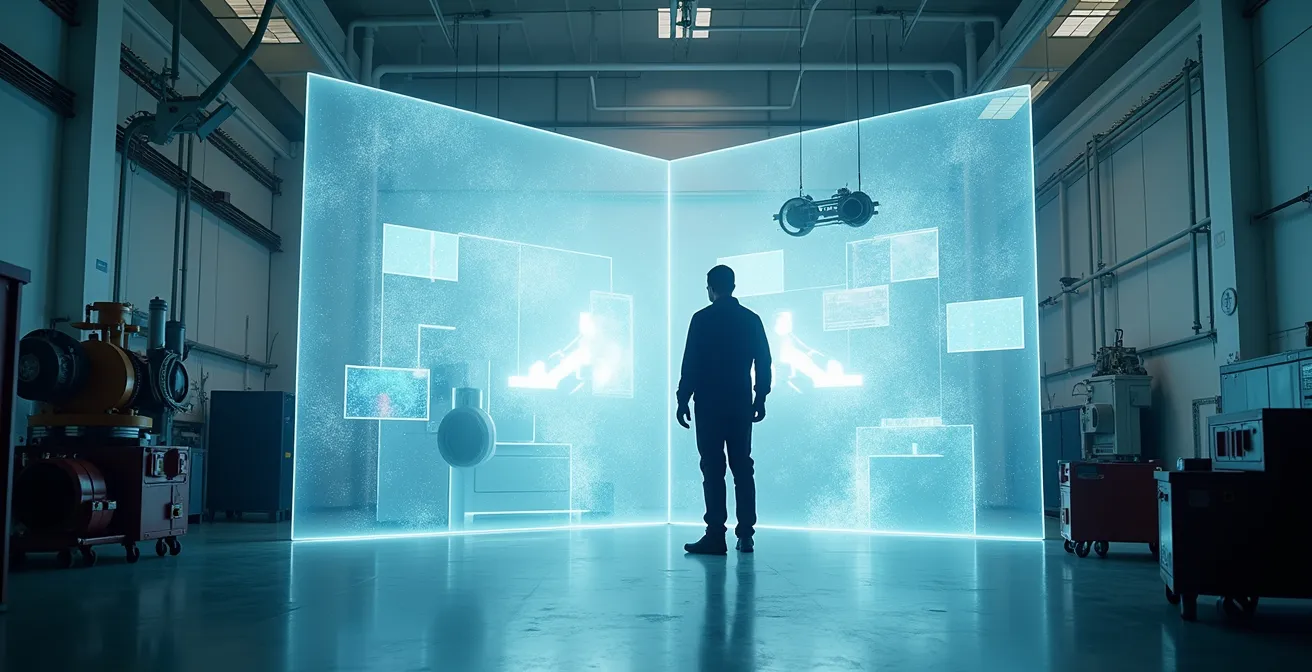
As the visualization suggests, this involves analyzing complex patterns, not just simple thresholds. The digital twin can simulate the future degradation path based on upcoming production schedules. If a component has a 40% chance of failing in the next 500 hours, but you only have 200 hours of production scheduled before a planned shutdown, the twin will recommend waiting, thus saving a perfectly good part and an unnecessary maintenance cycle. This optimization of MRO (Maintenance, Repair, and Operations) inventory and labor is a significant, often overlooked, source of savings.
When to scale your digital pilot project: 3 signs you are ready
A successful digital twin pilot is an exciting milestone, but the decision to scale from a single asset to a full factory implementation requires a strategic, data-backed approach. Moving too quickly can lead to wasted investment, while moving too slowly means leaving significant savings on the table. The key is to look for clear signals that your organization is ready for the next phase. As the VisioneerIT Research Team notes, this transition is becoming a hallmark of industry leaders.
Digital twins are moving beyond experimental pilots to become mission-critical infrastructure for competitive advantage.
– VisioneerIT Research Team, Digital Twin Technology: The 260 Billion Revolution
Here are three signs that you are ready to scale:
- You Have a Quantifiable Return on Information (ROI-I). You must be able to prove the pilot’s value with hard numbers. Did you reduce downtime by a specific percentage? Did you cut material waste on the pilot asset by a measurable amount? A global study shows that early adopters achieve an approximate 15% cost reduction and at least a 25% gain in operational efficiency within the first year. If your pilot is delivering metrics in this range, you have a strong business case for expansion.
- Your Team Trusts the Data. Technology is only half the equation. A critical sign of readiness is when your operators and maintenance teams have moved from skepticism to reliance. Are they actively using the twin’s insights to inform their decisions? Do they trust an alert from the twin over a “gut feeling”? This cultural shift, known as developing data literacy, is essential for a successful large-scale rollout. Without it, your scaled-up system will be ignored.
- You Have a Prioritized Expansion Roadmap. You shouldn’t scale everywhere at once. A successful pilot provides the data to identify which other assets or processes offer the most significant potential for improvement. A clear roadmap, which prioritizes the next 3-5 targets based on potential ROI and implementation complexity, shows strategic readiness. It proves you’re not just expanding for the sake of technology but are executing a deliberate plan to maximize value.
How to design a checklist that captures objective data on the factory floor?
A digital twin is only as intelligent as the data it receives. While automated sensors provide a constant stream of quantitative data, it’s crucial to capture the nuanced, qualitative observations of experienced operators on the factory floor. This is the “ground truth” that calibrates and validates the digital model. The challenge is moving this invaluable knowledge from informal “black books” and memory into a structured, objective data-capture system.
Designing an effective data-capture checklist or application is about bridging the human-machine gap. It must be fast and intuitive for operators to use, yet structured enough to provide clean data for the twin. Key principles include incorporating fields for both manual measurements (e.g., confirming a temperature reading with a thermal gun) and structured qualitative feedback. Instead of a generic “notes” field, use options like “Vibration feels: Normal / Slightly Increased / High” or “Machine sound: Standard / Whining / Grinding.” This turns subjective feelings into classifiable data.
Furthermore, every entry must be time-stamped to perfectly correlate with the sensor data stream from the same moment. Integrating the ability to capture photos or short videos of an anomaly (like a small leak or an unusual wear pattern) provides a rich layer of visual context that sensors alone cannot provide.
Case Study: The Pet Food Manufacturer’s “Black Book”
A pet food manufacturer was experiencing significant product waste during the hour-long startup phase of their processing line. Over years, experienced operators had developed a “black book” filled with handwritten notes on various startup conditions—temperatures, valve settings, timings—that seemed to lead to a successful run. While valuable, this knowledge was inconsistent, hard to share, and impossible to analyze at scale. By digitizing this process into a structured checklist integrated with a digital twin, the company was able to analyze the patterns. They discovered the critical combination of factors that guaranteed a good startup, turning tribal knowledge into a repeatable, data-driven procedure and drastically reducing initial waste.
This process of digital calibration ensures your twin reflects reality. It combines the relentless monitoring of machines with the irreplaceable experience of your human team, creating a system that is far more accurate and trustworthy than either could be alone.
Why 40% of your company’s software spend is on credit cards you don’t track?
The question in the title may seem disconnected from industrial waste, but it highlights a powerful analogy for a core problem in manufacturing: operational blind spots. In many companies, a significant portion of software-as-a-service (SaaS) spending happens on individual employee credit cards, outside the purview of centralized IT. This “shadow IT” creates a financial blind spot, leading to redundant subscriptions, security risks, and an estimated 40% waste in software spend.
The same dynamic is at play on the factory floor. The AWS IoT Team astutely points out the connection: “The same lack of centralized oversight and data-driven decision-making that leads to 40% software waste is what causes the 40% industrial waste.” Untracked micro-stoppages, small energy usage spikes, and minor material deviations are the “shadow waste” of manufacturing. Each one is a small, untracked “subscription” that drains resources. Individually, they seem insignificant, but collectively, they represent a massive, invisible cost.
A digital twin functions as the centralized oversight platform for your physical operations. It brings all these disparate data points into one place, making the invisible visible. By tracking and analyzing these previously ignored signals, companies can identify patterns and root causes. This is how they begin to tackle the systemic inefficiencies that lead to major waste. The prize for doing so is significant; integrating these technologies can reduce a product’s environmental impact by up to 40%. The parallel is clear: just as a CFO needs to eliminate shadow IT to control costs, a sustainability officer needs to eliminate shadow waste to achieve green targets.
The solution starts with a comprehensive audit to understand what you’re currently measuring and what you’re not. Preventing “sensor sprawl”—the industrial equivalent of shadow IT—requires creating a centralized registry for all data collection points, establishing data quality standards, and implementing clear workflows for deploying any new sensors. This ensures every data point has a clear purpose and contributes to the overall strategy rather than adding to the noise.
Key Takeaways
- A digital twin is a strategic tool for foresight, not a magic bullet. Its value lies in making invisible inefficiencies visible and quantifiable.
- Start small and prove value. Retrofitting older machines with non-invasive sensors is a low-cost, low-downtime entry point.
- The right data architecture (Edge vs. Cloud) depends on your need for real-time control versus deep analysis. A hybrid approach is often best.
Private vs. Public Cloud Solutions: Which Is Safer for Sensitive Client Data?
For any manufacturer, but especially those dealing with proprietary formulas, patented designs, or sensitive client information, data security is non-negotiable. The idea of sending a constant stream of detailed operational data to an external server rightly raises concerns about trade secret protection and the risk of operational sabotage. Choosing the right hosting environment for your digital twin’s data is the final, and perhaps most critical, piece of the strategic puzzle.
The primary options—private cloud, public cloud, and fully air-gapped solutions—each present a different balance of security, scalability, and cost. A private cloud, hosted on your own on-premise servers, offers maximum control over your data. Access is limited to your internal network, providing strong protection for trade secrets. However, it comes with a high capital expenditure for hardware and requires a dedicated internal team to manage it.
A public cloud (like AWS, Azure, or Google Cloud) operates on a shared responsibility model. The provider secures the underlying infrastructure, but you are responsible for configuring your environment securely. While this offers incredible scalability and a pay-as-you-go cost model, your data resides on third-party hardware, and it is exposed to the internet, increasing the attack surface. The highest level of security is an “air-gapped” solution, which is completely disconnected from any external network, but this is extremely costly and complex, typically reserved for national security applications.
The SMART USA Institute, part of the U.S. government’s Manufacturing USA network, is actively applying digital twins in the highly sensitive semiconductor industry. This initiative, backed by the CHIPS for America Act, is a testament to the fact that robust security models exist to protect even the most valuable intellectual property while still reaping the benefits of digital twin technology.
| Security Aspect | Private Cloud | Public Cloud | Air-Gapped Solution |
|---|---|---|---|
| Data Control | Full internal control | Shared responsibility model | Complete isolation |
| Operational Sabotage Risk | Low – internal access only | Medium – internet exposed | Near zero – physically isolated |
| Trade Secret Protection | High – on-premise custody | Medium – contractual protection | Maximum – no external access |
| Scalability | Limited by infrastructure | Unlimited | Very limited |
| Cost Structure | High CapEx | OpEx model | Highest total cost |
| Disaster Recovery | Manual backups required | Built-in redundancy | Complex offline process |
Securing your data is the final, crucial step in transforming it from a liability into a strategic asset. By embracing data-driven foresight—from retrofitting sensors to choosing the right cloud architecture—you can move beyond simply managing waste to systematically eliminating it. To put these concepts into practice, the logical next step is to identify a single, critical asset in your operation and begin planning a focused pilot project to prove the value for your organization.