
Believing a “sustainable” label is the first mistake; true ethical fashion is found in a brand’s verifiable actions, not its marketing words.
- Vague terms like “eco-friendly” are legally meaningless and often mask unsustainable production volumes.
- “Recycled” materials can create new problems like microplastics, and even top certifications like Oeko-Tex don’t guarantee ethical production.
Recommendation: Adopt an investigative mindset. Use transparency tools to trace supply chains and learn to decode what certifications truly guarantee before you spend a dime.
You’re standing in a store, holding a t-shirt. The tag whispers sweet nothings in your ear: “eco-friendly,” “conscious,” “made with recycled materials.” You want to believe it. As a conscious consumer, you’re trying to make better choices, to buy clothes that don’t cost the earth or exploit workers. Yet, a nagging skepticism remains. In an industry notorious for its smoke and mirrors, how can you be sure you’re not just buying into a well-marketed lie?
The common advice is to look for certifications or read a brand’s annual sustainability report. But this approach is flawed. It assumes that labels are foolproof and that brands are honest brokers of information. The reality is that many “eco” claims are unregulated marketing fluff, and sustainability reports can be masterpieces of corporate spin. This is the heart of greenwashing: the gap between what a brand says and what it actually does.
But what if the solution wasn’t just to look for better labels, but to develop a better lens? What if the key was to stop being a passive consumer and start thinking like an investigative journalist? The true power lies not in trusting a logo, but in knowing which questions to ask and where to find the real answers. It’s about understanding the systemic issues, from material trade-offs to the paradox of high-volume production.
This guide is designed to give you that investigative toolkit. We will deconstruct the most common greenwashing tactics, piece by piece. You will learn to see beyond the marketing jargon, verify claims independently, and ultimately discern which brands are genuinely committed to change and which are simply painting their fast-fashion model green.
To navigate this complex landscape, we will explore the critical pressure points where greenwashing thrives. This article breaks down the essential checks you must perform to become a more discerning and empowered consumer.
Contents: A Guide to Unmasking Fashion’s Green Façade
- Why the word “eco-friendly” on a label is legally meaningless?
- Recycled Polyester vs. Organic Cotton: Which is actually better for the planet?
- How to use transparency apps to trace where your t-shirt was really sewn?
- The influencer trap: Why a famous face doesn’t guarantee a fair wage?
- Why a brand launching 50 new styles a week cannot be sustainable?
- The GOTS vs. Oeko-Tex confusion: Which label guarantees zero pesticides?
- The “DNA Diet” myth that costs consumers millions annually
- Mushroom Leather vs. Plastic Vegan Leather: Which Textile Innovation Is Truly Eco-Friendly?
Why the Word “Eco-Friendly” on a Label Is Legally Meaningless?
The first rule of spotting greenwashing is to treat vague, feel-good words with extreme skepticism. Terms like “eco-friendly,” “green,” “conscious,” and “sustainable” are the cornerstones of marketing deception because, in most parts of the world, they have no legal definition. A brand can slap “eco-friendly” on a tag without having to prove any specific environmental benefit. It’s a hollow claim designed to appeal to your good intentions without committing the brand to any real standard of conduct.
This isn’t just an opinion; it’s a regulatory reality. In the United States, for example, the Federal Trade Commission’s “Green Guides” explicitly warn companies against using such broad, unsubstantiated claims. The guidelines state that for a product to be called “eco-friendly,” the brand must be able to prove specific, wide-ranging benefits, a standard that is almost impossible to substantiate for a complex product like clothing. Without specific proof—like “made from 100% recycled fibers” or “dyed using 50% less water than conventional methods”—these terms are effectively meaningless.
Greenwashing preys on the assumption that if a brand talks about sustainability, it must be sustainable. But talk is cheap. A truly responsible brand will be specific and transparent. Instead of using fluffy language, they will provide concrete data, reference credible third-party certifications, and openly discuss the challenges they face. When you see a vague claim, your first question should not be “Is this nice?” but “Where is the proof?” The absence of specific, verifiable data is your first and most significant red flag.
Recycled Polyester vs. Organic Cotton: Which Is Actually Better for the Planet?
One of the most sophisticated greenwashing tactics is to present a single material as a silver-bullet solution, ignoring its complex downsides. The “recycled polyester vs. organic cotton” debate is a perfect example of this. Brands proudly market garments made from recycled polyester (rPET) as a win for the circular economy, often sourced from plastic bottles. On the other side, organic cotton is lauded for being pesticide-free and natural. But the truth involves significant material trade-offs, and neither is perfect.
Recycled polyester does divert plastic from landfills, and its production requires less water and energy than virgin polyester. However, it has a major, often unmentioned, flaw: it sheds microplastics. Every time you wash a garment made from rPET, tiny plastic fibers are released into waterways, polluting ecosystems and entering the food chain. Furthermore, most rPET is not made from old clothes but from clear plastic bottles, meaning it doesn’t solve fashion’s textile waste problem. In fact, research from Greenpeace shows that less than 1% of all clothes are made from old textiles, turning the promise of a “closed-loop” system into a marketing illusion.
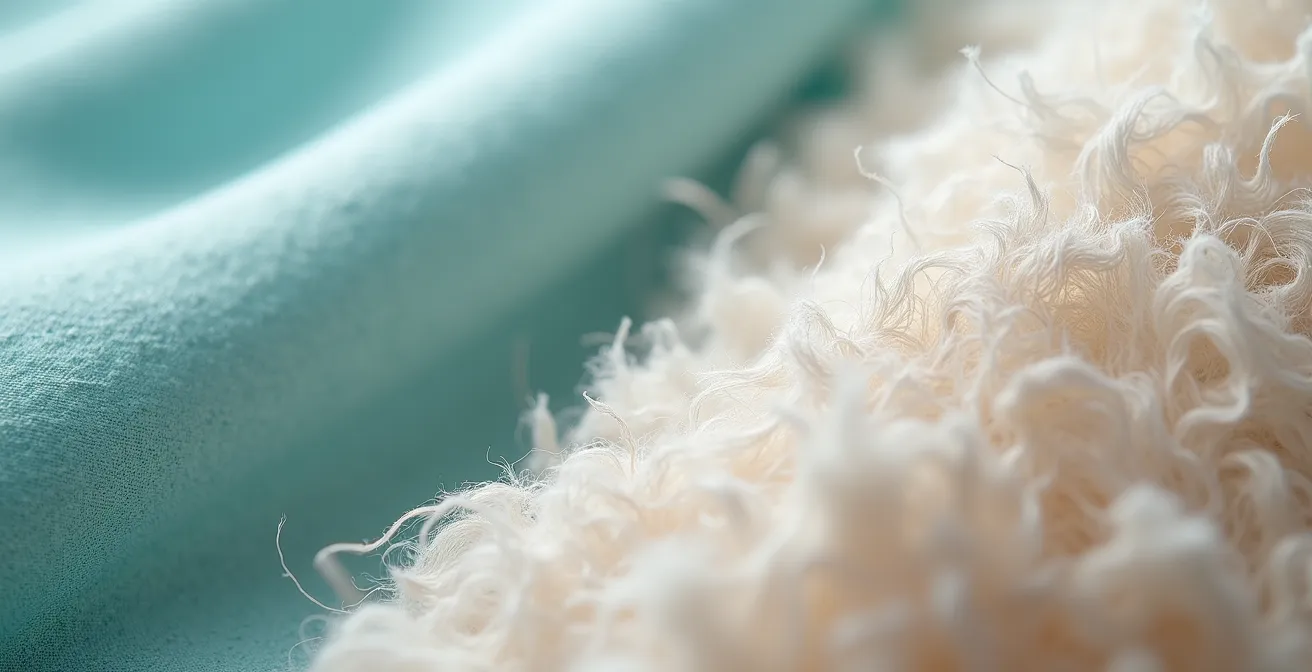
Organic cotton avoids the microplastic issue and is fully biodegradable if not treated with toxic dyes. However, its cultivation is incredibly water-intensive. While it avoids chemical pesticides, the environmental cost is shifted to water consumption. The choice between them isn’t about “good vs. bad” but about context: rPET might be suitable for durable outerwear that’s washed infrequently, while organic cotton is better for everyday basics. A truly sustainable brand will not only use these materials but will also be transparent about their specific drawbacks and the steps they are taking to mitigate them.
This table breaks down the fundamental differences, revealing that the “best” choice is rarely straightforward.
| Factor | Recycled Polyester (rPET) | Organic Cotton |
|---|---|---|
| Water Usage | Low in production phase | High during farming (but no pesticides) |
| Microplastics | Sheds harmful microfibers | No microplastic pollution |
| End-of-Life | Difficult to recycle again (downcycling) | Fully biodegradable |
| Best Use Case | Performance/activewear needing durability | Everyday basics for comfort |
How to Use Transparency Apps to Trace Where Your T-Shirt Was Really Sewn?
A brand’s claims are only as good as their verifiability. In the face of widespread supply chain opacity, a new wave of transparency tools and apps has emerged, empowering consumers to do their own detective work. While no single app is a perfect solution, using them in combination can help you piece together a more accurate picture of a brand’s operations than their marketing department would ever reveal. Answering the question “#WhoMadeMyClothes?” is no longer a passive hashtag; it’s an active investigation.
The first place to look is the brand’s own website for a supplier or factory list. A brand that is truly proud of its partners will not hide them. However, you shouldn’t stop there. This self-reported data needs to be cross-referenced. Platforms like the Open Apparel Registry (OAR) aggregate supplier lists from thousands of brands, allowing you to see which other companies use the same factory. This can reveal telling connections between a brand claiming “small-batch production” and one known for its massive scale. Furthermore, apps like Good On You provide independent ratings based on a brand’s public disclosures on labor, environment, and animal welfare.
Case Study: The Good On You Methodology
Good On You evaluates brands based on three key pillars: Planet (environmental impact across the supply chain), People (labor conditions and fair wages), and Animals (use of animal products and testing). The platform analyzes public disclosures, certifications, and third-party reports to generate ratings, helping consumers distinguish between genuine sustainability efforts and greenwashing tactics. However, a key limitation is its reliance on brand self-reporting; a lack of public data often leads to a lower score, but it doesn’t always prove negative practices, only a lack of transparency.
Following a structured approach is the most effective way to cut through the noise. Rather than randomly searching, use a methodical process to build a case file on a brand you’re considering. This toolkit, inspired by the work of organizations like Fashion Revolution, transforms you from a consumer into a supply chain investigator.
Your DIY Traceability Toolkit
- Check for Published Supplier Lists: Start by visiting the brand’s website. Is a list of their Tier 1 (garment factories), Tier 2 (fabric mills), and Tier 3 (raw material suppliers) publicly available? A lack of a list is an immediate red flag.
- Cross-Reference with Open Apparel Registry (OAR): Take factory names from the brand’s list and search for them on the OAR. This confirms their existence and reveals other brands using the same facilities.
- Analyze Transparency Depth: Does the brand only disclose its final assembly factories (Tier 1)? True transparency extends to fabric mills (Tier 2) and even farms (Tier 3), where the worst environmental and labor abuses often occur.
- Consult Independent Rating Apps: Use the Good On You app to see how experts have rated the brand based on its public data. Pay attention to the “People” score, which often reveals the most about ethical practices.
- Review Fashion Revolution’s Transparency Index: For major brands, check their score in the annual Fashion Revolution Transparency Index. This report benchmarks the world’s largest brands on their level of public disclosure.
The Influencer Trap: Why a Famous Face Doesn’t Guarantee a Fair Wage?
In the age of social media, influencer marketing has become a powerful tool for greenwashing. Brands partner with trusted faces to launch “conscious collections” or promote their “sustainable” credentials. The logic is simple: if someone you admire endorses a product, it must be legitimate. This creates an emotional halo effect that distracts from the critical need for factual evidence. A famous face is a marketing strategy, not a certification of ethical practice.
This tactic is particularly insidious because it co-opts the language of authenticity to sell products that may be anything but. An influencer’s beautifully curated post about an “eco-friendly” dress tells you nothing about the wages of the person who sewed it, the chemicals used to dye its fabric, or the carbon footprint of its journey across the globe. As climate activist Greta Thunberg has pointedly stated, this is often a calculated distraction.

Many are making it look as if the fashion industry is starting to take responsibility, by spending fantasy amounts on campaigns where they portray themselves as ‘sustainable’, ‘ethical’, ‘green’, ‘climate neutral’ and ‘fair’. But let’s be clear: This is almost never anything but pure greenwashing.
– Greta Thunberg, in a Guardian interview
To avoid the influencer trap, you must apply the same investigative mindset to their content as you would to a brand’s own advertising. Look past the aesthetic and search for substance. Does the influencer discuss the brand’s certifications? Do they mention specific details about the supply chain or labor practices? Or is the endorsement limited to vague praise about the product’s style and “conscious” nature? A truly conscious influencer will act as an educator, not just a billboard. They will show how a garment wears over time, engage with critical questions in their comments, and be transparent about their financial relationship with the brand.
Why a Brand Launching 50 New Styles a Week Cannot Be Sustainable?
This is perhaps the most fundamental and undeniable truth in the ethical fashion debate: the business model of fast fashion is inherently incompatible with sustainability. No amount of recycled polyester or organic cotton can offset the environmental damage caused by a business model built on massive overproduction and disposability. This is the production volume paradox. When a brand launches dozens or even hundreds of new styles every week, it is, by definition, a fast-fashion company, regardless of what its “conscious collection” marketing says.
Consider the sheer scale. A brand like H&M produces approximately 3 billion garments annually. This volume necessitates rapid production cycles, downward pressure on wages to keep costs low, and an enormous consumption of resources. The model encourages a throwaway culture, where clothes are treated as single-use items. The environmental cost of producing, shipping, and ultimately disposing of billions of items far outweighs any benefit from using a small percentage of “sustainable” materials. As Greenpeace UK noted in a scathing report, “The simple truth is that fast fashion will never be sustainable.”
Case Study: Shein’s Ultra-Fast Fashion Production Scale
Shein represents the extreme endpoint of this model, producing an estimated 7,200 new items every single day. This relentless churn generates up to 20,000 tons of CO2 emissions monthly. This business model is not just about selling clothes; it’s about leveraging overproduction as a core strategy. It anticipates that a significant portion of inventory will never be sold and is often destined for incineration or landfills to protect brand value, making a mockery of any claims to circularity or sustainability.
Therefore, one of the most powerful questions you can ask is the simplest: “How much do they produce?” A brand’s production volume is the ultimate indicator of its true impact. If a company’s primary business is churning out endless new trends at rock-bottom prices, its “sustainable” capsule collection is not a sign of progress; it is a calculated marketing ploy to greenwash its fundamentally unsustainable core operation.
The GOTS vs. Oeko-Tex Confusion: Which Label Guarantees Zero Pesticides?
For consumers trying to do the right thing, third-party certifications seem like a beacon of hope. However, not all labels are created equal, and brands often exploit this confusion. The GOTS vs. Oeko-Tex dilemma is a classic example. Many brands proudly display the OEKO-TEX Standard 100 label, leading consumers to believe the garment is organic and ethically made. This is a common and misleading assumption.
The OEKO-TEX Standard 100 is a product safety label. Its primary function is to test the *final product* for a list of harmful substances. It certifies that the t-shirt you’re holding is safe for your skin. It does *not* certify that the cotton was grown organically, that the factory workers were paid a fair wage, or that the dyeing process didn’t pollute local rivers. It’s a “final dish safety test,” not a certification of the entire cooking process.
In contrast, the Global Organic Textile Standard (GOTS) is a holistic process certification. It’s the “farm-to-table” equivalent for textiles. GOTS guarantees that the fibers are certified organic (grown without pesticides), and it sets strict environmental and social criteria for the entire supply chain. This includes rules on water usage, chemical inputs in dyeing and finishing, and fair labor practices based on the principles of the International Labour Organization. Therefore, GOTS is the label that guarantees zero pesticides in the farming stage and much more.
Understanding this certification hierarchy is a crucial part of your investigative toolkit. When a brand highlights an OEKO-TEX label without mentioning GOTS or Fair Trade, it can be a subtle form of greenwashing—promoting a weaker, product-safety claim to imply a broader, process-wide sustainability that it cannot prove.
This comparative table clarifies the stark differences in what these two common labels actually guarantee.
| Aspect | GOTS | OEKO-TEX Standard 100 |
|---|---|---|
| What it certifies | Entire supply chain (farm to finished product) | Final product safety only |
| Pesticide guarantee | Yes – requires organic farming without pesticides | No – tests for harmful residues in final product only |
| Social criteria | Includes fair labor standards | No social requirements |
| Environmental scope | Comprehensive (water, energy, chemicals) | Limited to chemical safety |
| Best analogy | Like ‘farm-to-table’ restaurant certification | Like a ‘final dish safety test’ |
The “DNA Diet” Myth That Costs Consumers Millions Annually
The world of wellness is littered with myths that cost consumers dearly, and few are more telling than the ‘DNA Diet’ craze. The promise was seductive: a simple DNA test could reveal the perfect diet tailored just for you. It sounded scientific and personalized, but it lacked robust, independent verification. This concept serves as a perfect playbook for understanding a similar deception in the fashion industry: greenwashing relies on the same tactics of using scientific-sounding language, promising simple solutions to complex problems, and lacking verifiable proof.
Just as there is no single gene that dictates a perfect diet for you, there is no single “eco” fabric that is perfect for the planet. The “DNA Diet” myth and fashion greenwashing are both built on a foundation of appealing falsehoods. They thrive where consumers want to believe in an easy fix. This parallel reveals a universal truth: any claim, whether in wellness or fashion, that sounds too good to be true probably is.
This shared DNA of deception means we can use a universal “BS Detector” to analyze claims in both fields. Before you buy into a “climate-neutral” t-shirt or a “personalized” nutrition plan, you must apply a framework of critical thinking. The core of this framework is to shift the burden of proof back onto the seller. Your default position should be skepticism, not belief.
Ask yourself these questions: Is the claim specific and measurable, or is it vague and aspirational? Is the evidence provided by an independent, credible third party, or is it a self-declared badge the brand created itself? Can the claim be independently verified? For a DNA diet, that would mean looking for large-scale, peer-reviewed studies. For fashion, it means looking for GOTS or Fair Trade certifications, not a brand’s own “Conscious Choice” logo. This critical filter is your best defense against misinformation, saving you money and protecting you from false promises.
Key Takeaways
- Sustainability is a system, not a single material; overproduction negates any “eco-friendly” fabric choice.
- Vague marketing terms like “conscious” are red flags. Demand specific, verifiable data and credible third-party certifications.
- Develop an investigative mindset: use transparency tools to trace supply chains and understand that a brand’s business model tells you more than its marketing.
Mushroom Leather vs. Plastic Vegan Leather: Which Textile Innovation Is Truly Eco-Friendly?
As consumer awareness grows, brands are racing to market the next generation of materials, particularly “vegan leathers.” This space is a minefield of greenwashing, where “vegan” is often conflated with “sustainable.” The classic example is plastic-based leather (PU/PVC), which, while animal-free, is a fossil fuel-derived product that will never biodegrade. In response, a host of bio-fabrications have emerged, with mushroom leather (like Mylo) leading the charge. But are these new innovations truly the eco-friendly solution they claim to be?
The answer, once again, lies in nuance and material trade-offs. Mushroom-based leathers and other plant-derived alternatives (from cactus, apples, or pineapples) are a significant step up from virgin plastic. They are derived from renewable resources and are often partially biodegradable. However, they are not perfect. Many of these materials still require a plastic-based coating or backing for durability and water resistance, which complicates their end-of-life and prevents them from being fully compostable. Furthermore, their current production is not yet at a scale that can compete with the price and performance of traditional or plastic leathers, making them a niche, expensive option.
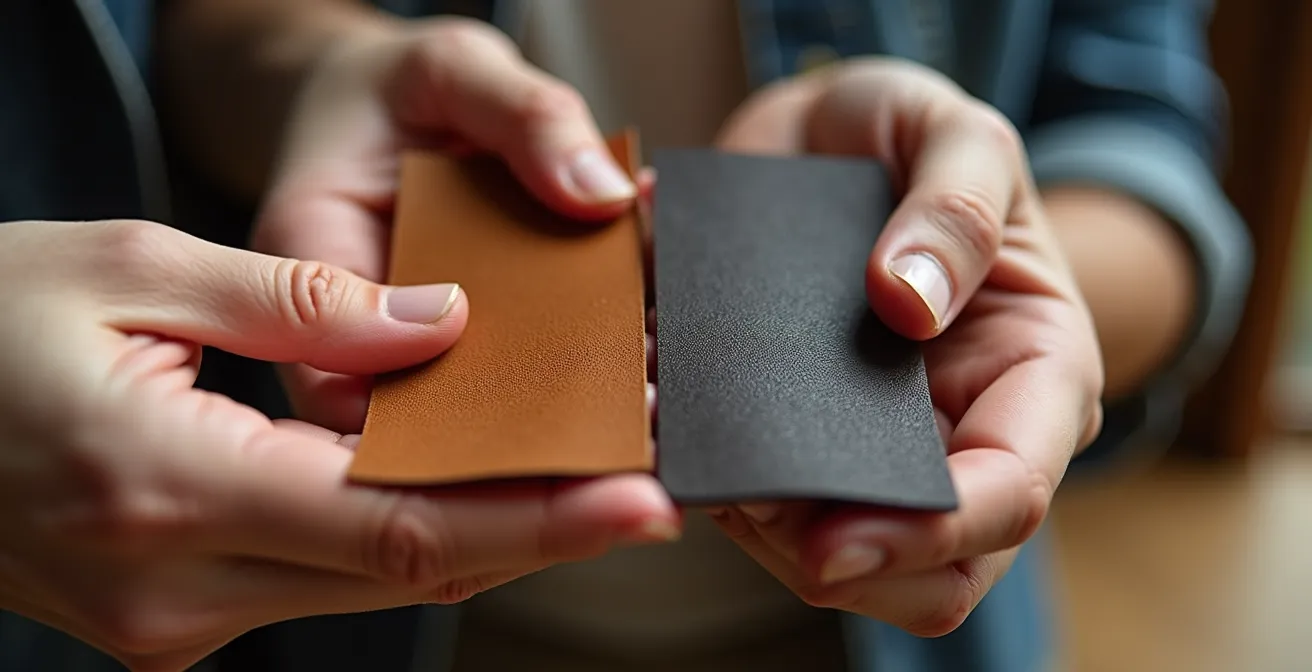
This scorecard for next-gen materials shows that even the most promising innovations come with compromises. Lab-grown leather offers high durability and biodegradability but is currently far from scalable, while plastic leather remains cheap and durable but environmentally disastrous. A truly transparent brand working with these new materials will be honest about these limitations. They will specify the exact composition of their “mushroom leather” (e.g., “80% mycelium, 20% polyurethane coating”) and discuss their roadmap for improving its circularity.
This table from a comparative analysis of textile innovations highlights the current state of play.
| Material | Biodegradable | Fossil Fuel Free | Durability | Current Scalability |
|---|---|---|---|---|
| Mushroom (Mylo) | Partially (depends on coatings) | Mostly | Moderate | Low/Expensive |
| Plastic PU/PVC | No | No | High | High/Cheap |
| Cactus Leather | Partially | Mostly | Moderate | Low |
| Apple Leather | Partially | Partially | Moderate | Low |
| Lab-grown | Yes | Yes | High | Very Low |
Ultimately, spotting greenwashing is not about finding perfect brands, but about recognizing genuine effort and transparency. By adopting an investigative mindset, you move beyond the marketing and empower yourself to support the companies that are truly committed to a better future for fashion. The next step is to put this toolkit into practice with every potential purchase.