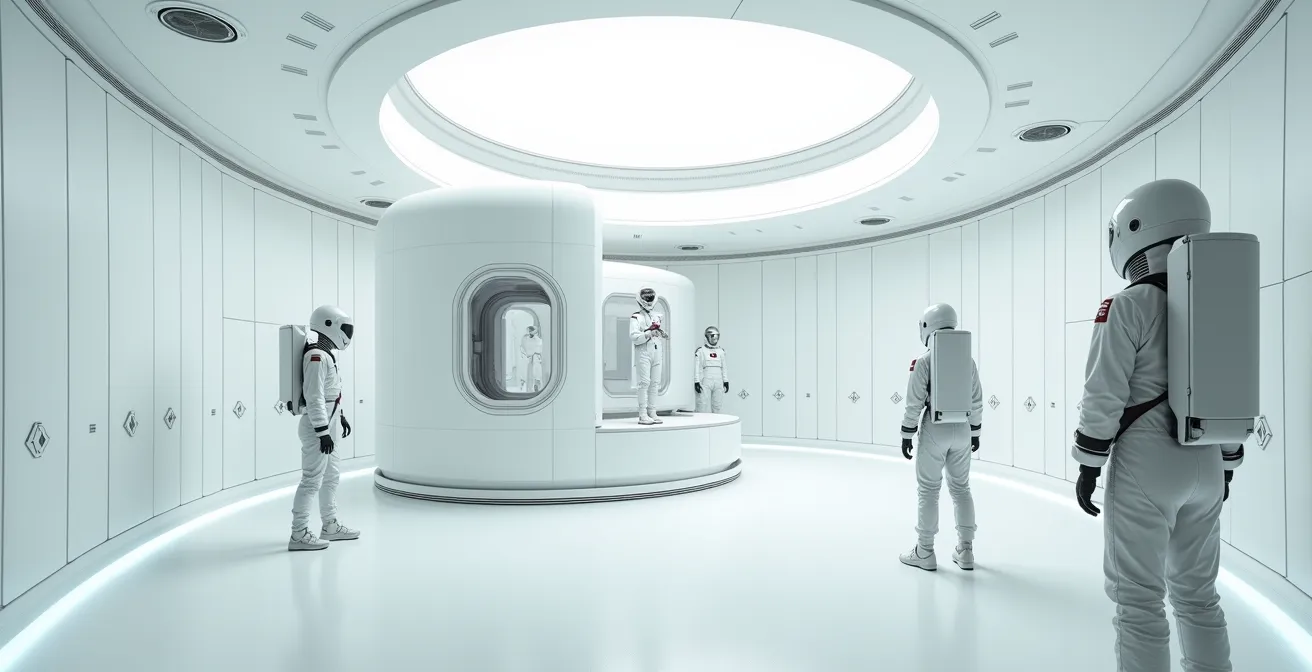
Contrary to the belief that space tourism is a simple luxury purchase, securing a seat for an orbital mission is the beginning of a demanding physiological and mental campaign.
- Success isn’t measured by your bank account, but by your body’s ability to handle extreme stressors like G-force blackouts and neurovestibular conflict in zero-g.
- Training is not a formality; it is a non-negotiable process of conditioning that mirrors elite athlete preparation, focusing on measurable resilience metrics like Heart Rate Variability (HRV).
Recommendation: Treat your preparation as the first stage of the mission itself. The journey to orbit begins not at the launchpad, but with the first day of rigorous, targeted physical and mental conditioning.
For the affluent adventure seeker, the final frontier is no longer a dream reserved for government astronauts. With orbital flights becoming a commercial reality, the question shifts from “if” you can go, to “what does it take?” Many assume it’s simply a matter of writing a check. This is a dangerous misconception. An orbital mission, even one lasting just three days, is not a passive luxury cruise. It is a grueling assault on the human body and mind, an environment so alien that it can incapacitate the unprepared in seconds.
Standard advice often revolves around generic fitness and a brief mention of G-forces. But this barely scratches the surface. The real preparation lies in systematically dismantling the body’s terrestrial programming and rebuilding it for the vacuum. We’re not just training passengers; we’re forging mission-ready civilians capable of functioning under extreme duress. This involves deconstructing the very concepts of “up” and “down,” managing the physiological debt incurred by rapid acceleration, and mastering the psychological shock of seeing our world from a divine perspective. The goal is mission readiness—to not just survive the experience, but to master it.
This training manual moves beyond the brochures. We will dissect the physical and mental demands of orbital flight, detailing the specific conditioning required to transform a tourist into a capable temporary astronaut. We will explore the brutal physics of launch, the disorienting reality of life in microgravity, and the profound psychological challenges that await 250 miles above the Earth.
For those ready to understand the true cost of admission, this short film offers a glimpse into the motivations and mindset of those who take on the challenge of commercial spaceflight. It’s a perfect primer for the rigorous journey ahead.
This guide is structured to mirror the progressive challenges a civilian astronaut will face. We will begin with the most immediate and violent stressor—G-forces—before moving to adaptation, mission realities, and the specific physical conditioning that underpins it all. This is your pre-flight briefing.
Contents: A Civilian Astronaut’s Training Manual for Orbital Flight
- Why 4G acceleration causes untrained passengers to black out?
- How to eat and sleep in zero gravity without getting sick?
- Suborbital vs. Orbital: What experience do you actually get for $450,000?
- The “Overview Effect” shock that overwhelms first-time space travelers
- When is the safest season to book a suborbital flight?
- HIIT vs. Steady State Jogging: Which is better for lowering cortisol?
- Why looking down at your laptop screen causes “tech neck” within 2 weeks?
- How Regular Cardio Activity Reduces Anxiety Symptoms Faster Than Medication?
Why 4G acceleration causes untrained passengers to black out?
The exhilarating ascent into orbit is also the first, and arguably most violent, physiological test. During launch, a spacecraft can subject its occupants to sustained forces of 3 to 4G, meaning you feel three to four times your normal body weight pressing you into your seat. For the untrained body, this is a critical event. The primary danger is G-induced Loss of Consciousness, or G-LOC. This occurs when the force pulls blood away from your head and down into your lower extremities faster than your heart can pump it back up. The brain becomes starved of oxygen, leading to a predictable sequence: first, a loss of peripheral vision (greyout), followed by total vision loss (blackout), and finally, complete unconsciousness.
Physiological research shows that most untrained individuals begin experiencing visual disturbances or risk G-LOC in the range of 4-6G before visual disturbances or unconsciousness. The key to preventing this is not raw strength, but specialized training. This involves high-G centrifuge sessions where you learn to recognize the onset of symptoms and execute countermeasures. The primary technique is the anti-G straining maneuver (AGSM): a combination of muscle tensing and rhythmic breathing that constricts blood vessels in the limbs and abdomen, forcing blood back toward the brain. Without this conditioning, a passenger is just that—a passive body at the mercy of physics.

As the visualization above demonstrates, the displacement of blood is a simple matter of physics. Your cardiovascular system must become a high-performance engine capable of fighting that downward pull. The vulnerability isn’t theoretical; a study of military pilots showed that G-LOC is a persistent threat even for seasoned professionals, reinforcing that this training is not optional, but fundamental to mission safety.
Case Study: Brazilian Air Force G-LOC Survey
A comprehensive survey of Brazilian Air Force pilots revealed that over 10% had experienced G-induced loss of consciousness in flight. A staggering 80% of these incidents were preceded by blackout symptoms, which the pilots either missed or couldn’t counter in time. The study’s conclusion was stark: the only effective mitigation is repeated centrifuge training, allowing pilots to understand their own physiological limits in a controlled environment. This proves that no matter your fitness level, specific G-force adaptation is a unique and mandatory skill.
How to eat and sleep in zero gravity without getting sick?
Once the violence of launch subsides, you face a far more insidious challenge: microgravity. On Earth, our sense of balance and orientation is an effortless harmony between our eyes, inner ear (the vestibular system), and body position sensors. In space, this harmony shatters. Your inner ear floats, no longer sensing “up” or “down,” while your eyes see a cabin where all orientations are valid. This is neurovestibular conflict, and it triggers Space Adaptation Syndrome (SAS), or space sickness. Symptoms range from dizziness and disorientation to debilitating nausea and vomiting, incapacitating many new astronauts for their first 24-48 hours in orbit—a significant portion of a 3-day mission.
Countering this requires a deliberate process of sensory recalibration. You must actively train your brain to ignore the chaotic signals from your inner ear and rely almost exclusively on visual cues. This involves specific head movement exercises and visual fixation drills performed in disorienting environments on the ground. Eating and sleeping present their own unique problems. The dulling of taste and smell in microgravity requires specially formulated, intensely flavored foods. Sleep is complicated by the lack of physical pressure, which can be disorienting. Training includes using sleep restraints that provide tight, tactile feedback, simulating the feeling of being in a bed and reassuring the brain.
Ultimately, adapting to zero-g is as much a psychological task as a physical one. It demands an ability to function within a team while your own senses are in turmoil. The focus is on building mutual trust and learning to operate effectively even when feeling profoundly unwell, a cornerstone of any successful mission.
Action Plan: The Space Adaptation Training Protocol
- Complete a 3-month modular training program focused on building team dynamics and mutual trust under pressure.
- Practice specific head movement exercises designed to accelerate neurovestibular adaptation and reduce the severity of space sickness.
- Train with advanced visual fixation techniques to combat spatial disorientation and retrain the brain to rely on sight over inner-ear sensations.
- Utilize sleep restraints during simulations that provide firm tactile pressure to simulate the sensation of a bed, aiding in psychological comfort.
- Adapt your palate to intensely flavored foods designed specifically to overcome the dulling of taste and smell common in microgravity.
Suborbital vs. Orbital: What experience do you actually get for $450,000?
The term “space tourism” covers two fundamentally different experiences with vastly different training requirements and price tags: suborbital and orbital flight. Understanding this distinction is critical to defining your mission. A $450,000 ticket with an operator like Virgin Galactic buys you a suborbital flight. This is an up-and-down trajectory to the edge of space, providing about 3-4 minutes of weightlessness and a view of the Earth’s curvature. The entire flight lasts 10-15 minutes, and the training is measured in days, not months.
Orbital flight is another universe of complexity and cost, with prices starting around $50-60 million for a multi-day stay in a capsule like the SpaceX Dragon. This involves achieving a velocity of over 17,500 mph to continuously fall around the Earth. The experience is not minutes of weightlessness, but days. You will witness 16 sunrises and sunsets every 24 hours and see the entire planet as a living, breathing sphere. This is the domain where all the rigorous training we’ve discussed becomes non-negotiable. The market for these experiences is robust; a 2024 analysis reported that the US space tourism market generated $327.60 million with 68% of global bookings from US customers, indicating a strong appetite for both types of journeys.
The following table breaks down the crucial differences. It’s not just a matter of price, but of duration, altitude, and the depth of the human experience.
| Aspect | Suborbital ($200,000-$450,000) | Orbital ($50-60 million) |
|---|---|---|
| Duration | 10-15 minutes total flight | 3 days to several weeks |
| Weightlessness | 3-4 minutes | Continuous for entire mission |
| Altitude | 50-62 miles (edge of space) | 250+ miles |
| Training Required | Minimal (days) | 3-6 months intensive |
| View Experience | Earth curvature, regional view | 16 sunrises/sunsets daily, full planet view |
| Vessel Capacity | 6 passengers (Virgin Galactic/Blue Origin) | Up to 7 passengers (SpaceX Dragon) |
The “Overview Effect” shock that overwhelms first-time space travelers
Beyond the physical trials of launch and microgravity lies a profound psychological challenge known as the “Overview Effect.” This term describes the cognitive shift in awareness reported by many astronauts when they see Earth from space—a tiny, fragile ball of life floating in an immense, sterile void. While often described as a transcendent or spiritual experience, the initial impact can be overwhelming, disorienting, and emotionally shocking. It can induce feelings of awe, but also intense anxiety or a sense of detachment from everything known and loved.
For a short-duration mission, being psychologically overwhelmed is a mission risk. You are not just a passenger; you may have tasks to perform, whether for research or operational support. Managing this emotional and cognitive shock is a key part of pre-flight training. This involves extensive psychological screening to assess your resilience and coping mechanisms. More importantly, it involves simulations using high-fidelity VR to expose you to the breathtaking, and potentially terrifying, views of Earth from orbit. The goal is to partially inoculate you against the initial shock, allowing you to process the experience without becoming incapacitated.
The ability to remain functional while experiencing this profound shift is a hallmark of a well-prepared civilian astronaut. Modern missions have proven that with the right preparation, tourists can not only manage this effect but also become valuable contributors to in-flight research.
Case Study: The Inspiration4 Mission’s Research Impact
The groundbreaking Inspiration4 mission, the first all-civilian orbital flight, demonstrated the power of proper preparation. During their 3-day mission aboard a SpaceX Dragon capsule, the crew successfully completed over 20 scientific research investigations. A key part of their training involved managing the anticipated psychological impact of the Overview Effect. By using VR simulations and undergoing extensive mental conditioning, the crew was able to remain focused and execute complex tasks while experiencing the profound cognitive shift of seeing Earth from orbit. The mission proved that civilians are not just passengers; they can be active, contributing members of a space mission.
When is the safest season to book a suborbital flight?
While the allure of space is timeless, the logistics of getting there are bound by very terrestrial constraints. A common question is about the “safest season,” but this framing is too simplistic. Safety in commercial spaceflight is not a seasonal variable; it’s a complex equation of technology, regulation, and operational readiness. While weather does create a practical launch season, often favoring the April-October period in many launch locations, the true metrics of safety lie much deeper. The industry is rapidly maturing, with the FAA reporting 148 licensed commercial space operations in FY 2024, a significant increase that signals growing operational tempo.
Instead of “season,” a mission-ready candidate evaluates safety through a different lens. Key considerations include:
- Vehicle Fleet Maturity: Is this the 5th flight of a new vehicle or the 50th? Earlier flights contribute to a vehicle’s test record but carry inherent risk, while later flights benefit from a proven safety record.
- Operator Safety Record: Every launch provider must meet stringent FAA safety requirements. A candidate should monitor the operator’s public record and adherence to these standards.
- Informed Consent: The documentation you sign is not a simple waiver. It details the specific risks you are accepting. A thorough review with legal counsel is part of mission prep.
- Crew Certification: Understanding the medical and training standards for the flight crew (e.g., FAA second-class airman certification) provides insight into the operator’s commitment to safety.

The decision of when to fly is therefore a strategic risk assessment. Booking early might secure a place on a historic flight, while waiting allows for a more robust safety case to be built. The “safest” time to book is when your personal risk tolerance aligns with the demonstrated maturity of the vehicle and operator you have chosen. It is an analytical decision, not a seasonal one.
HIIT vs. Steady State Jogging: Which is better for lowering cortisol?
A cornerstone of astronaut conditioning is cardiovascular fitness, but not just for general health. It is a primary tool for managing the immense stress of spaceflight. A key stress hormone, cortisol, can become chronically elevated due to anxiety, disruption of circadian rhythms, and the physical strain of the mission. While both High-Intensity Interval Training (HIIT) and steady-state cardio (like jogging) are beneficial, they serve different functions in pre-flight conditioning. HIIT, with its short bursts of maximum effort followed by recovery, is excellent for simulating the acute stress of launch. It trains your heart and nervous system to recover quickly from a massive shock—a critical adaptation for G-force tolerance.
Steady-state cardio, on the other hand, is superior for managing the long-term, ambient anxiety of a multi-day mission. It helps lower baseline cortisol levels and improves the overall resilience of your nervous system. The ultimate metric we use to track this resilience is Heart Rate Variability (HRV)—the variation in time between each heartbeat. A high HRV indicates a healthy, adaptable nervous system that can switch effectively between stress (sympathetic) and rest-and-digest (parasympathetic) modes. A low HRV signals a system stuck in a state of chronic stress.
A balanced training program incorporates both modalities. We use HIIT to prepare for acute stressors and steady-state cardio to build the deep, underlying resilience needed to manage the chronic physiological debt of the entire mission. This data-driven approach is not just a recommendation; it is mission-critical.
Case Study: NASA’s Non-Pharmacological Mandate
For private astronauts on commercial missions, NASA has an extremely strict policy prohibiting the use of most anxiety medications and sleep aids due to their unpredictable side effects in microgravity. This policy elevates cardiovascular training from a “healthy habit” to a non-negotiable medical countermeasure. Astronaut training programs now use HRV as a key biometric for flight readiness. High HRV, achieved through a tailored regimen of HIIT and steady-state cardio, serves as a data-driven “go/no-go” metric. It provides objective proof that a candidate’s nervous system is resilient enough to handle the mission without pharmacological support.
Why looking down at your laptop screen causes “tech neck” within 2 weeks?
It may seem trivial, but the poor posture we develop in our daily lives—specifically the forward head posture known as “tech neck”—becomes a significant liability during spaceflight. On Earth, for every inch your head juts forward, it adds approximately 10 pounds of force to your cervical spine. This chronic strain weakens deep neck flexor muscles and creates imbalances in the posterior chain. Now, amplify that. During a 4G launch, that extra 10 pounds of effective weight becomes 40 pounds. The forces acting on a poorly aligned spine are magnified exponentially, dramatically increasing the risk of injury and compromising your ability to perform the anti-G straining maneuver.
This is why a crucial, and often surprising, part of pre-flight conditioning is a rigorous postural screening protocol. We assess a candidate’s baseline posture, calculating the force multiplication they would experience under expected G-loads. Corrective exercises are then prescribed to strengthen the deep neck flexors and posterior chain muscles (back, glutes, hamstrings) that support the body in the reclined launch seat. As a leading study notes, posture is a direct factor in G-force tolerance.
Seated or reclined positions can increase tolerance by reducing the vertical distance blood must travel.
– Aviation Medicine Research, G-Force Effects on Human Body Study
This insight is critical. A neutral spine in a reclined position optimizes the body’s ability to withstand G-forces. Training involves practicing and holding this neutral spine position for extended periods in mock spacecraft seats. Your desk-induced slouch is no longer a minor aesthetic issue; it’s a potential point of failure for the mission.
Key Takeaways
- G-Force Is Non-Negotiable: The primary physical barrier is G-force. Training to counter G-LOC through centrifuge sessions and straining maneuvers is the first and most critical step.
- Adapt or Suffer: Space sickness is a near certainty. Sensory recalibration through specific head and eye movement drills is essential to remain functional during the initial 24-48 hours of a mission.
- Fitness Is a Tool, Not a Goal: Cardiovascular training, particularly a mix of HIIT and steady-state work, is a medical countermeasure used to manage stress, lower cortisol, and improve Heart Rate Variability (HRV)—a key metric for mission readiness.
How Regular Cardio Activity Reduces Anxiety Symptoms Faster Than Medication?
For a civilian astronaut, anxiety is not just an emotion; it’s a physiological state that can compromise cognitive function and mission safety. As medications are largely off the table, we turn to the most effective and reliable tool available: rigorous cardiovascular activity. Regular cardio works faster and more holistically than many medications by tackling anxiety at its source. It burns off excess cortisol and adrenaline, the primary stress hormones. More importantly, it stimulates the production of endorphins and neurotransmitters like serotonin and dopamine, which improve mood and create a sense of well-being.
The true power of cardio for an astronaut, however, lies in cognitive rehearsal. During high-intensity training, your heart rate soars, mimicking the physiological response to an emergency or high-stress situation. This is where we train you to think. We run you through emergency procedures and complex decision-making tasks *while* you are at your peak heart rate. This forges new neural pathways, teaching your brain to remain clear, focused, and operational under the exact type of physical stress it will experience during launch or a critical mission event. This is something no pill can do.
This conditioning is the foundation of mental resilience. Companies like SpaceX don’t just look for physically fit individuals; they require candidates who can demonstrate cognitive performance under pressure, a skill honed through months of intensive cardio. Your cardiovascular endurance becomes a direct proxy for your mission qualification status.
The path to becoming a civilian astronaut is a testament to human potential. It requires discarding the mindset of a passenger and embracing the discipline of an explorer. This is not a journey you can simply purchase; it is one you must earn, rep by rep, drill by drill. Your preparation starts now, on Earth, by building a body and mind resilient enough to master the final frontier. Begin the process of transforming yourself into a mission-ready candidate today.