
For those with sensitive skin, simply choosing “natural” bedding is not enough; the real key is understanding the material science behind the fabric.
- Most “bamboo” fabric is a chemically-intensive rayon that can trap irritants, while true linen offers superior cooling through its physical fiber structure.
- “Wrinkle-free” treatments often use formaldehyde, a known carcinogen and skin irritant, which undermines the benefits of the natural fiber itself.
Recommendation: Prioritize GOTS-certified organic linen or cotton, and learn the proper washing techniques to maximize softness and minimize chemical exposure for truly restorative, irritation-free sleep.
For individuals with sensitive skin, eczema, or allergies, the bedroom should be a sanctuary. Yet, it often becomes a source of nightly irritation, with itching, redness, and discomfort disrupting the restorative power of sleep. Many are advised to switch to “natural” bedding, a seemingly simple solution. You’ve likely heard the common refrains: choose cotton, try bamboo, avoid synthetics. While well-intentioned, this advice barely scratches the surface and can even be misleading.
The problem is that the term “natural” has been stretched to its marketing limits, obscuring critical differences in fiber structure, chemical processing, and long-term hygiene. As a dermatologist and textile specialist, I see patients who have dutifully invested in expensive “eco-friendly” sheets only to find their symptoms persist or worsen. The issue isn’t just the fiber’s origin; it’s the entire lifecycle of the product, from the pesticides used in the field to the chemical finishes applied in the factory and the allergens that accumulate over time.
But what if the solution wasn’t just about choosing a plant-based material, but about understanding its specific mechanical and chemical properties? This guide will move beyond the platitudes. We will adopt a material-first approach, deconstructing the very science of textiles. We will analyze why the physical structure of linen is fundamentally different from chemically-processed bamboo rayon, expose the hidden irritants in “easy-care” fabrics, and establish a clear protocol for washing, maintaining, and ultimately replacing your bedding to create a truly hypoallergenic sleep environment.
This article provides a detailed roadmap for navigating the complex world of textiles. By examining the evidence behind different materials, certifications, and care practices, you will gain the expertise needed to make choices that genuinely support your skin’s health and well-being.
Summary: Why Choosing Natural Textiles for Bedding Improves Sleep for Sensitive Skin?
- Linen vs. Bamboo Rayon: Which is truly hypoallergenic and cooling?
- Why “wrinkle-free” sheets often trigger dermatitis flare-ups?
- How to wash linen sheets to prevent them from becoming scratchy?
- The GOTS vs. Oeko-Tex confusion: Which label guarantees zero pesticides?
- When to throw away your natural pillow to avoid dust mite accumulation?
- Recycled Polyester vs. Organic Cotton: Which is actually better for the planet?
- How to eat and sleep in zero gravity without getting sick?
- How to Spot Greenwashing in Ethical Fashion Brands Before You Buy?
Linen vs. Bamboo Rayon: Which is truly hypoallergenic and cooling?
The debate between linen and bamboo is a perfect example of why the “natural” label can be deceptive. While both originate from plants, their journey to your bed is vastly different, impacting their performance for sensitive skin. The key distinction lies in chemical processing versus inherent fiber mechanics. Bamboo fabric, unless it is the rare and coarse “mechanically processed bamboo,” is actually bamboo rayon or viscose. This means the bamboo pulp is dissolved in a harsh chemical solution, extruded, and solidified into a fiber. While the resulting fabric is silky smooth, it can retain trace chemicals from this intensive process, potentially triggering reactions.
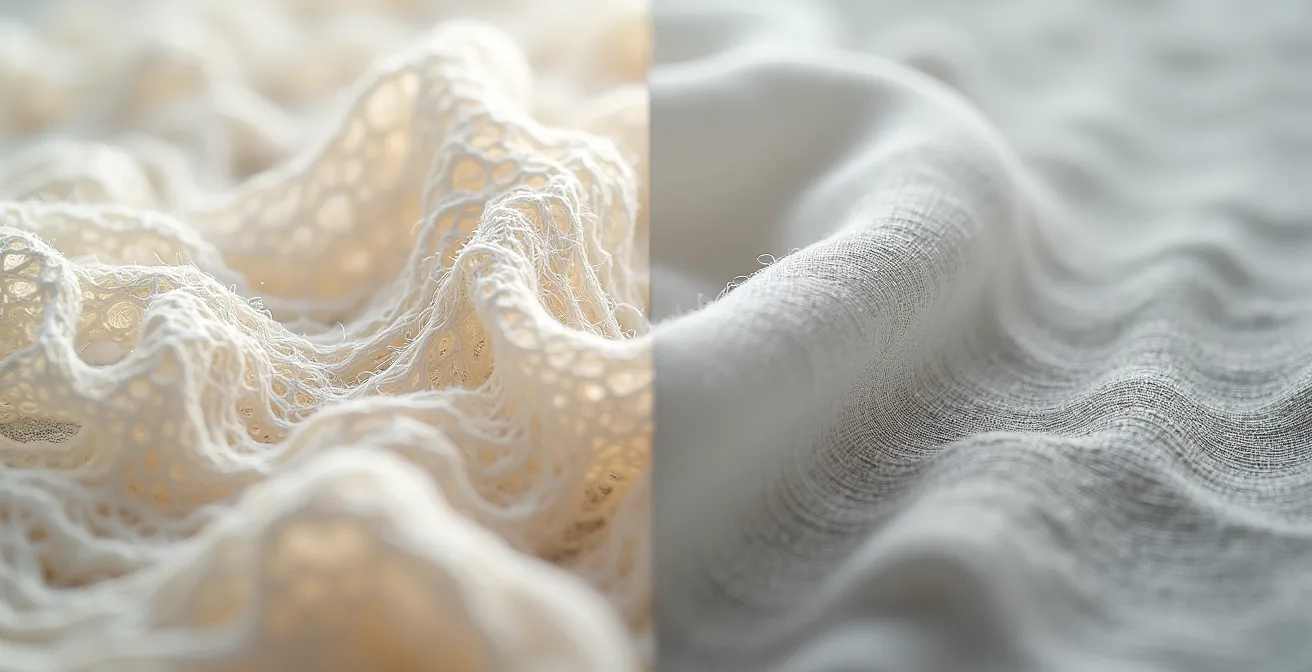
Linen, derived from the flax plant, is processed mechanically. The fibers are separated, combed, and spun. This minimal processing preserves the natural integrity and purity of the fiber. Its cooling property is not just about moisture-wicking; it’s about thermal conductivity. Linen fibers are hollow and actively conduct heat away from your body, feeling cool to the touch. Bamboo rayon manages heat by wicking sweat, but it doesn’t have the same heat-dissipating structure. For those with inflammatory skin conditions like eczema, linen’s superior, dry cooling is often more beneficial than the sweat-managing properties of rayon.
Ultimately, for a truly hypoallergenic experience rooted in chemical purity and structural performance, GOTS-certified linen is the superior choice. Its natural resistance to bacteria and its minimal processing make it an ideal material for direct, prolonged contact with sensitive skin.
The table below breaks down the crucial differences from a material science perspective.
| Property | GOTS-Certified Linen | Bamboo Rayon |
|---|---|---|
| Chemical Processing | Minimal (mechanical) | Intensive (chemical viscose process) |
| Cooling Mechanism | Thermal conductivity (pulls heat away) | Moisture-wicking (manages sweat) |
| Hypoallergenic Quality | Chemical purity (no pesticides) | Mechanical smoothness (less friction) |
| Antibacterial Properties | Natural resistance | Naturally antibacterial |
| Environmental Impact | Low (sustainable flax cultivation) | High (chemical processing required) |
Why “wrinkle-free” sheets often trigger dermatitis flare-ups?
The promise of “wrinkle-free” or “permanent press” cotton sheets seems like a convenient dream, but for those with sensitive skin, it can be a chemical nightmare. This convenience is achieved by treating the fabric with a formaldehyde resin. During this process, the resin cross-links the cellulose fibers of the cotton, essentially locking them in place to prevent creasing. The problem is that not all of this formaldehyde is consumed in the reaction; a process called “off-gassing” releases the excess chemical over time, directly onto your skin and into the air you breathe.
Formaldehyde is a potent sensitizer and a known trigger for allergic contact dermatitis. Symptoms can include redness, rashes, and intense itching, which are easily mistaken for an eczema flare-up. Unregulated, imported textiles can be particularly problematic. While some standards exist, studies have shown that wrinkle-free bedding in the unregulated U.S. can contain formaldehyde at levels up to 500 ppm (parts per million), far exceeding the safe limits for skin contact. This constant, low-level chemical exposure is a significant-yet-hidden stressor for an already compromised skin barrier.
The health risks extend beyond skin irritation. As the National Cancer Institute has pointed out, the dangers of long-term exposure are a serious concern. They state that the evidence raises significant questions about safety.
Research studies of workers exposed to formaldehyde have suggested an association between exposure and several cancers, including nasopharyngeal cancer and leukemia.
– National Cancer Institute, cited in GAO Study on Formaldehyde in Textiles
For anyone with sensitive skin, the choice is clear: embrace the wrinkles. The natural, slightly rumpled look of untreated linen or organic cotton is a sign of purity. It’s a visual cue that your bedding is free from the harsh chemical finishes that prioritize aesthetics over health.
How to wash linen sheets to prevent them from becoming scratchy?
One of the paradoxes of linen is that it gets softer with every wash, yet improper care can make it feel stiff and scratchy. This isn’t a flaw in the fabric but a misunderstanding of its unique fiber structure. Unlike cotton, linen fibers are long and smooth. Harsh detergents and high heat can damage these fibers, causing them to become brittle. The key to unlocking linen’s legendary softness lies in a gentle and consistent care routine that respects its natural properties.
The most common mistake is using fabric softeners. These products work by coating fibers with a layer of lubricating chemicals. On linen’s hollow fibers, this coating clogs the pores, reducing the fabric’s natural absorbency and breathability—the very qualities that make it so comfortable. Another pitfall is using alkaline or powder detergents, which can be too abrasive and may not dissolve fully, leaving a residue that stiffens the fabric. Over-drying is also a major culprit; when all moisture is blasted out on high heat, the fibers constrict and become rigid.
To cultivate softness, you must work with the fabric, not against it. Follow these specific steps to protect the fibers and encourage them to relax and soften over time:
- Initial Washes: Wash new linen sheets two to three times before the first use. This helps break down pectin, a natural binding agent in the flax fibers, jump-starting the softening process.
- Gentle Detergent: Always use a mild, pH-neutral liquid detergent. It’s gentler on the fibers and rinses out cleanly.
- Moderate Temperature: Wash in lukewarm water, around 40°C (104°F). Hot water can cause the fibers to weaken and shrink.
- Avoid Over-Drying: Tumble dry on a low to medium heat setting and remove the sheets while they are still slightly damp. This prevents the fibers from becoming stiff and brittle.
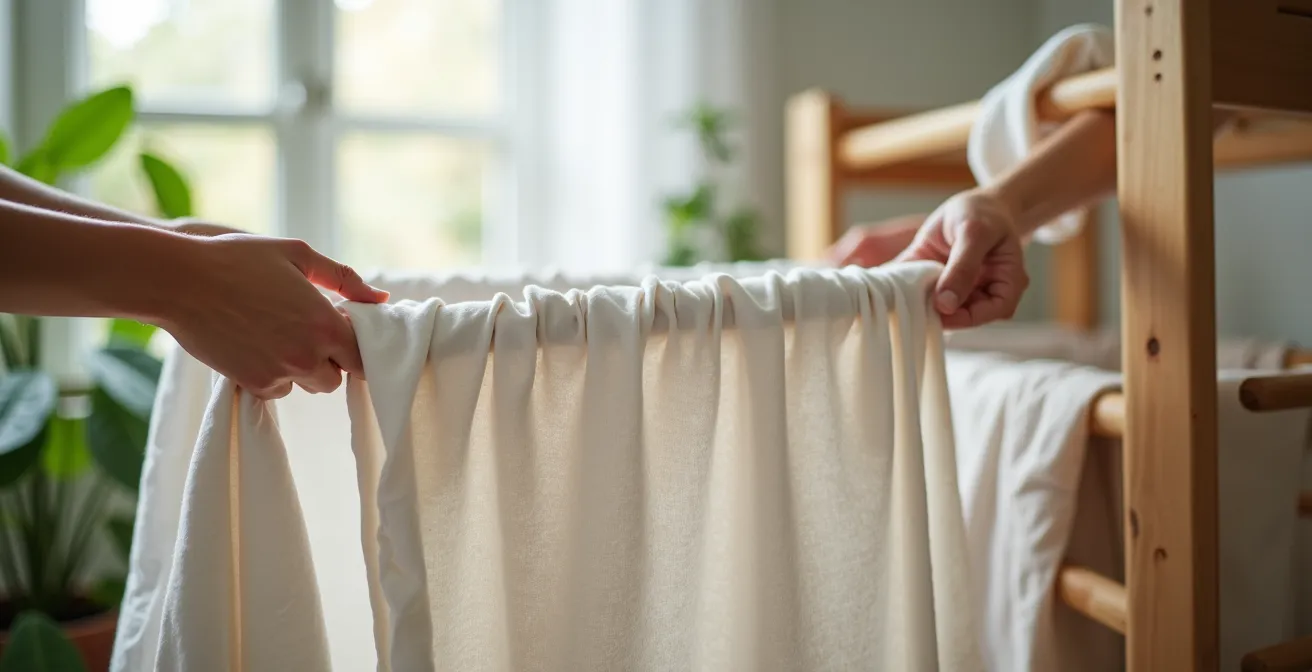
- Final Air Dry: Let the sheets air dry completely, either on a line or draped over a rack. This final, gentle step is crucial for achieving a soft, relaxed texture.
By treating your linen with this level of care, you ensure it not only remains comfortable but actually improves with age, becoming a softer, more cherished part of your sleep sanctuary year after year.
The GOTS vs. Oeko-Tex confusion: Which label guarantees zero pesticides?
Navigating textile certifications can feel like deciphering a secret code. Two of the most common labels, GOTS and Oeko-Tex, are often used interchangeably, but they certify fundamentally different things. For a person with sensitive skin, understanding this distinction is not just academic—it’s critical for avoiding specific triggers like agricultural chemicals versus processing residues.
The only label that truly guarantees the fiber was grown without synthetic pesticides is the Global Organic Textile Standard (GOTS). GOTS is a comprehensive, farm-to-factory certification. It ensures that the raw fibers (like cotton or flax) were cultivated according to strict organic farming standards. This means no synthetic pesticides, herbicides, or GMOs. It also sets environmental and social criteria for the entire manufacturing process, restricting the use of harmful chemicals during dyeing and finishing.
In contrast, Oeko-Tex Standard 100 is a product safety label. It tests the *final product* for a wide range of harmful substances. A fabric with this label has been tested to ensure that any residual chemicals—including pesticides, heavy metals, and formaldehyde—are below strict limits that are safe for human skin. However, it does not certify that the original fiber was grown organically. A conventionally grown cotton sheet, which used pesticides during cultivation, could still earn an Oeko-Tex label if it is processed and washed to the point where final residue levels are below the safety threshold. For context, certified products must have less than 30 ppm of formaldehyde for products intended for babies and sensitive skin, a standard Oeko-Tex helps enforce.
So, which should you prioritize? If your primary concern is eliminating exposure to agricultural pesticides at the source and supporting sustainable farming, GOTS is your gold standard. If your concern is a broader guarantee of safety from a list of over 100 chemicals in the final, finished product, Oeko-Tex provides that assurance. For the ultimate peace of mind, look for products that carry both certifications. This ensures the material started clean and stayed clean throughout its entire production journey.
When to throw away your natural pillow to avoid dust mite accumulation?
Even the highest quality natural pillow has a finite lifespan, not because the material wears out, but because it becomes a reservoir for biological irritants. Over time, pillows absorb moisture, skin cells, and oils, creating the perfect warm, humid environment for dust mites and fungi to thrive. For someone with allergies or sensitive skin, sleeping on an old pillow is like resting your head on a concentrated cloud of allergens.
The sheer volume of this accumulation is staggering. A study found that after just two years, a significant portion of a pillow’s weight can be composed of dead skin, dust mites, and their waste. In fact, research suggests that in an old, unwashed pillow, up to 10% of its weight can be attributed to this allergenic mixture. This is a primary trigger for nighttime symptoms like a stuffy nose, watery eyes, and skin irritation.
The science backing this up is robust, as highlighted by a landmark study from the University of Manchester.
Case Study: The University of Manchester Fungal Study on Pillows
Researchers at the University of Manchester conducted a pivotal study by dissecting synthetic and down-filled pillows aged between 1.5 and 20 years. They discovered a disturbing ecosystem within, identifying up to 16 different species of fungi per pillow. The study, cited by sources like SleepJunkie in their analysis of pillow hygiene, concluded that after one to two years, pillows become prime breeding grounds for these allergens. The compression of the filling creates dense, humid pockets ideal for both mold and dust mites, turning your sleep sanctuary into a source of constant exposure.
As a rule of thumb, the Asthma and Allergy Foundation of America recommends replacing pillows every one to two years. However, you can also look for these tell-tale signs that your pillow’s support and hygiene are compromised:
- The Fold Test: Fold your pillow in half. If it doesn’t spring back to its original shape, the internal structure has broken down.
- Persistent Lumps: If you can’t fluff the pillow back to a smooth, even consistency, the filling has permanently clumped.
- Noticeable Stains: Yellowish stains from sweat and body oils indicate moisture has penetrated deep into the pillow’s core.
- Increased Allergy Symptoms: If you consistently wake up with a stuffy nose, itchy eyes, or unexplained skin irritation, your pillow is the likely culprit.
Regularly washing your pillow (if the material allows) and using a high-quality, mite-proof pillow protector can extend its life, but it cannot stop the inevitable accumulation. Being disciplined about replacement is a non-negotiable aspect of maintaining a truly hypoallergenic sleep environment.
Recycled Polyester vs. Organic Cotton: Which is actually better for the planet?
In the conversation around sustainable textiles, recycled polyester (rPET) is often presented as a virtuous choice, diverting plastic bottles from landfills. While this has an upstream environmental benefit, it’s a deeply flawed solution for bedding, especially for those with sensitive skin. From a material science perspective, polyester—recycled or not—is a plastic. It lacks the fundamental properties that make natural fibers like organic cotton so beneficial for skin health.
The primary issue with polyester is its complete lack of breathability. The plastic fibers trap heat and moisture against the skin, creating a warm, sweaty environment that can exacerbate conditions like eczema and heat rash. Organic cotton, by contrast, is highly breathable and hygroscopic, meaning it absorbs moisture and allows it to evaporate, keeping the skin cool and dry. Furthermore, the friction of synthetic fibers against the skin can cause physical irritation. This problem is compounded by the fact that synthetic fabrics are a major source of microplastic pollution, shedding over 700,000 microplastic fibers in a single wash load, which ultimately pollute our waterways and ecosystems.
While recycling plastic is commendable, the process itself can introduce chemicals like antimony, a catalyst used in PET production, which can be a concern for highly sensitive individuals. GOTS-certified organic cotton, on the other hand, is grown and processed without these harmful inputs. It is also fully biodegradable, returning to the earth at the end of its life, whereas polyester will persist in the environment for centuries.
The following table, drawing from comparative analyses of fabric properties, starkly illustrates why organic cotton remains the superior choice for both skin health and true environmental responsibility.
| Factor | Recycled Polyester | Organic Cotton |
|---|---|---|
| Breathability | Poor (plastic-based, traps heat) | Excellent (natural fibers allow airflow) |
| Moisture Management | Traps moisture (18% more sweat production) | Absorbs and releases moisture naturally |
| Skin Irritation Risk | High (microplastic friction, heat buildup) | Low (smooth fibers, chemical-free) |
| Environmental Degradation | Never biodegrades, sheds microplastics | Degrades 78% faster than synthetics |
| Chemical Exposure | Antimony from recycling process | None with GOTS certification |
How to eat and sleep in zero gravity without getting sick?
While sleeping in space seems worlds away from our concerns on Earth, the principles astronauts follow to stay healthy in a sealed environment offer a powerful metaphor for creating a personal sleep sanctuary. In zero gravity, there is no “away.” Every particle—dust, skin cells, moisture—floats indefinitely within the habitat. Astronauts survive in this extreme environment by maintaining an almost fanatically controlled and purified space.
The International Space Station’s life support system constantly scrubs the air of contaminants, controls humidity to the tenth of a degree, and filters every drop of water. An astronaut’s sleeping bag is a personal micro-environment, designed for optimal thermal regulation and hygiene in a place where a traditional wash is impossible. They cannot afford to have irritants in their environment because there is no escape. Their health depends entirely on proactive prevention and absolute purity.
This is the mindset we must adopt for our own beds. For someone with sensitive skin, the bedroom is a personal space station. Your skin’s compromised barrier cannot effectively filter out the environmental irritants that others might not notice. You must become the “life support system” for your own sleep space. This means being rigorous about choosing pure, non-toxic materials (your habitat’s building blocks), controlling humidity, and diligently removing allergens like dust mites (the “floating particles”).
Thinking like an astronaut means shifting from a reactive to a proactive approach to hygiene. It’s not about cleaning up after a flare-up; it’s about engineering an environment where the triggers for flare-ups are minimized from the very start. It is the ultimate application of creating a controlled, irritant-free bubble to protect a sensitive system.
Key Takeaways
- Prioritize mechanically processed fibers like GOTS-certified linen over chemically processed ones like bamboo rayon for true hypoallergenic quality.
- Always avoid “wrinkle-free” or “permanent press” finishes, as they indicate treatment with formaldehyde, a known skin irritant.
- The GOTS label guarantees organic farming (no pesticides), while Oeko-Tex Standard 100 guarantees the final product is free from harmful residues. Prioritize GOTS for purity from the source.
How to Spot Greenwashing in Ethical Fashion Brands Before You Buy?
In the wellness market, terms like “natural,” “eco-friendly,” and “hypoallergenic” have become powerful but often empty marketing buzzwords. This practice, known as greenwashing, is designed to make you feel good about a purchase without providing the substantive proof to back it up. As an informed consumer protecting sensitive skin, you must become a detective, looking past the claims on the packaging to the verifiable facts.
The most common red flag is the use of vague, undefined terms. A brand might label its sheets “all-natural” without specifying the fiber or any certifications. Another major tactic is over-emphasizing one small positive attribute while ignoring a larger negative one. A prime example is “bamboo” bedding. The marketing focuses on the fast-growing, sustainable bamboo plant, while conveniently omitting that the fabric is almost always a chemically-intensive rayon. The U.S. Federal Trade Commission has been clear on this issue for years.
The U.S. Federal Trade Commission requires that yarn labeled as anything other than ‘mechanically processed bamboo’ must be called ‘rayon’ or ‘rayon made from bamboo’.
– Federal Trade Commission, from the FTC Guidelines on Bamboo Textiles
To protect yourself, you must learn to perform a quick but effective audit of a brand’s claims before you buy. This involves actively seeking out third-party proof and questioning any language that feels more emotional than factual. The following checklist provides a systematic framework for this process.
Your 5-Step Greenwashing Audit Plan: Bedding Edition
- Audit the Claims: Before buying, list every “eco” or “health” claim the brand makes on its website, packaging, and social media. (e.g., “Earth-friendly,” “chemical-free,” “pure”).
- Inventory the Evidence: For each claim, search for a specific, third-party certification next to it. Is it GOTS? Oeko-Tex Standard 100? Or a self-made logo like “PureComfort Seal”? Document the proof, or lack thereof.
- Cross-Reference with Reality: Confront the claims with known facts. If they say “bamboo,” check if they also use the word “rayon.” If they say “wrinkle-free,” assume it involves a chemical treatment unless they prove otherwise with a GOTS certification.
- Assess the Language: Is the brand relying on vague, emotional language (“sleep in nature’s embrace”) or on specific, verifiable data (“GOTS-certified organic linen, processed without formaldehyde”)? Prioritize facts over feelings.
- Make the Decision: Based on your audit, decide if the brand is transparent and trustworthy. If claims are unsubstantiated or misleading, make a plan to choose an alternative brand that provides clear, third-party certification.
Empowering yourself with this knowledge is the final and most crucial step. By learning to read labels, question claims, and understand the science of the materials you bring into your home, you transform from a passive consumer into a proactive guardian of your own health. The path to peaceful, irritation-free sleep begins not just in the store, but with the expertise you now possess. Use it to build the sleep sanctuary you and your skin deserve.
Frequently Asked Questions on Bedding Certifications
Does GOTS certification guarantee pesticide-free production?
Yes, GOTS (Global Organic Textile Standard) certifies the entire process from farm to factory, ensuring fibers are grown organically without synthetic pesticides. It’s the only label that truly guarantees the farming method was free of synthetic pesticides.
What does Oeko-Tex Standard 100 actually test for?
Oeko-Tex Standard 100 tests the final product for harmful substances including pesticides, ensuring any residues are below strict, safe limits for skin contact. However, it doesn’t guarantee the fiber’s organic origin or pesticide-free cultivation.
Which certification should sensitive skin sufferers prioritize?
If your primary concern is agricultural impact and guaranteed organic fiber from the source, prioritize GOTS. If your main concern is verified safety from a wide range of chemicals on the final product you bring home, prioritize Oeko-Tex. The gold standard for complete peace of mind is having both certifications.